
WCFA Fall Conference 2002
By Howie Thomas CJFThe first Western Canadian Farriers Association (WCFA) sponsored fall conference was held in Chilliwack BC at the Best Western – Rainbow Country Inn & the Heritage Park On Oct 25, 26, & 27 2002.
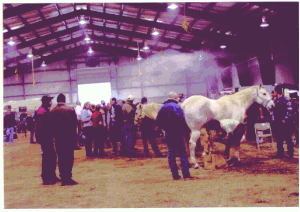
The theme for this year’s conference was advancement through education & communication, with the aim to promote & further equine knowledge for all. The conference was open to not only Farriers, Vets and associated professionals but also to the general public. The organizers, Steve Dixon of Maple Ridge BC and Rick Higginson of Chilliwack BC, were delighted with the attendance; 115 people registered for the conference traveling from all over Canada, as far away as New Brunswick, Ontario also from Washington state & Idaho.
Along with several guest speakers & presentations including Dr Anne Dick DVM, Bruce Hague CJF, Dr Bob Moats DVM, Rick Higginson CJF, and Tony Heisler CT, the keynote speaker & judge for the competition was Mark Caldwell FWCF from England. Mark is co-founder & Managing Director of Brooks Lane Smithy Farrier supplies (together with Hobby Horse Farriery Supplies the co-sponsor of the WCFA Fall Conference), international Farrier competitor, member of the English Farrier Team, surgical farrier to Liverpool University Veterinary Field Station & appointee to the Examinations Board of the Worshipful Company of Farriers.
A summary of presentations are as follows:
Dr Ann Dick DVM - Leg Dissection
This was a great educational lecture, as all Farriers need to know the anatomy & function of the leg and foot of the horse. Farriers must know where the structures of the foot are in relation to each other in order to safely remove horn from a normal or distorted foot, drive nails into it, or change weight distribution over a foot. During her lecture Dr Ann Dick discussed the bones of the leg & foot, their location & function, the characteristics of tendons & ligaments, from where they originate & their attachments, sensitive structures, blood pumping mechanism of the foot & nerves.
Mark Caldwell FWCF - Back to Basics
Mark talked about the true definition of the word "balance". Balance is maintenance of optimal limb efficiency. The foot is designed to absorb the dynamic forces placed upon it & that most damage is done on weight bearing in the stance phase of the stride & upon impact. All external factors have to be considered prior to trimming or shoeing & that not all feet will be perfect. When shoeing Mark likes to extend the base support (shoe) in the opposite direction of the limb deviation. He also likes support to the last weight bearing point of the heel & likes to fit the quarters of the shoe to the widest part of the foot.
Bruce Hague CJF - Tool Maintenance & Knife Sharpening
Bruce made it perfectly clear to his audience the importance of maintaining sharp tools. Using dull tools like a hoof knife, rasp, nippers etc, can lead to problems for the farrier such as carpal tunnel syndrome, tennis elbow & just plain-old tired arms & wrists, so keeping your tools sharp is good time spent. Bruce likes to use a sharpening method on hoof knifes called hollow ground. Using a Dremmel tool to demonstrate & keeping the power to a minimum he ground the cutting edge approximately 1/8th inch in from the edge, creating a hollow, this eliminates the wedge that builds up over time. Also it's important to keep all nippers pull-offs, clinchers etc lubricated, they will be easier to use & the rivet will not wear as fast. A properly sharpened & shaped clinch gouge & a good quality-finishing rasp will create a beautiful finish to a hoof.
Jokingly Bruce says to keep both hands on the hoof knife - that way you won’t slip & cut your other hand.
Dr Bob Moats DVM - Reading Radiographs
Knowing how to read radiographs is beneficial to all Farriers who work on therapeutic cases. Knowing where the coffin bone is located inside the hoof capsule in relation to the wall at the toe & the frog is crucial to any chance of success when applying therapeutic shoes. Bob explains that the aiming of the x-ray beam is absolutely crucial in diagnosing coffin bone rotation inside the hoof capsule. When taking x-rays for Farriers he places thumbtacks at the toe in a vertical position & at the apex of the frog, with this procedure the Farrier will know how much toe to trim off & where to place the support of a heart bar shoe. He also explained the difference between coffin bone rotation and hoof capsule distortion. Much of Bobs lecture was an open discussion format; he also explained the importance of good Vet/Farrier relationship & that the Vet, Farrier & owner have to work as a team in order to keep the horse sound.
Rick Higginson CJF - Treating Laminitis & Founder
As Rick is a certified Farrier he understands the difficulties Farriers have in treating lame horses. He explained the difference between Founder & Laminitis. Laminitis is a tearing & separation of the lamina leaves between the coffin bone & hoof wall. Founder is when the coffin bone sinks or rotates inside the hoof capsule. Rick gave a fantastic talk on the anatomy of the hoof wall, coffin bone & lamina using an overhead projector, stressing that early detection is critical in successful treatment of acute founder. Also Rick explained that approximately 50% of all founder cases are never diagnosed as to what caused the horse to founder in the first place.
Mark Caldwell FWCF – Natural Balance Shoe
The mechanical principles around which the natural balance shoeing technique is founded are fundamentally sound. These principles have been around for centuries; the problem with the natural balance shoeing technique lies with the application. All too often the shoes are fitted with little regard to medial lateral or caudal-cranial hoof distortion/displacement and almost certainly with no regard to individual conformation defects. Most practitioners fit the shoes using ridged measurements determined by the point of frog leaving the dorsal hoof wall unsupported. As with all three-dimensional objects an unsupported structure will collapse into the space provided (gravity). Very often following 3 or 4 shoeings the dorsal hoof wall collapses forming a stress fracture at the toe leading to lameness. Interestingly enough rather than accelerate the point of break-over these shoes, when fitted with no regard to physiological function, will cause the horse to accentuate the knee action with the limb having to leave the ground before the normal anterior phase of the stride.
Tony Heisler CT - Infrared Thermography as another diagnostic tool for Veterinarians
Infrared Thermography is a type of camera that detects heat from inflammation, and which is slowly making it’s way into the world of Equines. Tony explained its many benefits, such as non-invasive, cost-effective diagnostic testing. A human hand can only determine heat at 4 degrees in temperature change & this is when the camera comes in to action. It has many benefits, such as a first diagnostic test, treatment management, condition monitoring & pre-purchase or pre-sale protection.
Tony made it very clear that it is NOT a see-all, cure-all technology and something just anyone can buy a camera and do. Certification & training is important for the use of this equipment.
In closing:
Overall I thought this conference was extremely educational. The organizers, Steve Dixon and Rick Higginson, did a fantastic job in putting together the sponsors, the speakers & the trade show.
Thanks and congratulations should also go to the speakers themselves who presented their topics so successfully and to all those trade exhibitors who turned out in support of the Conference.
If you are at all serious about shoeing horses, or if you are an Equine professional of any type you should put this event on your calendar for next year.