Implicit Differentiation is an application of the Chain Rule:
d(kyn)/dx
= d(kyn)/dy · dy/dx
= nkyn-1 · dy/dx
(31a)
Determine dy/dx for
6x2 - 3y2 = 5
d(6x2)/dx
- d(3y2)/dx
= d(5)/dx
d(6x2)/dx
- d(3y2)/dy • dy/dx
= d(5)/dx
... differentiating implicitly ... Chain Rule
12x - 6y • dy/dx = 0
- 6y • dy/dx = -12x
dy/dx = 2x/y
(31b)
Determine dy/dx for
y3 + x2y - 2x2 = 0
d(y3)/dx
+ d(x2y)/dx
- d(2x2)/dx
= d(0)/dx
d(y3)/dx
+ y • d(x2)/dx
+ x2 • d(y)/dx
- d(2x2)/dx
= d(0)/dx
... d(uv)/dx = u • d(v)/dx + v • d(u)/dx
... Product Rule
d(y3)/dy • dy/dx
+ y • d(x2)/dx
+ x2 • d(y)/dy • dy/dx
- d(2x2)/dx
= d(0)/dx
... differentiating implicitly ... Chain Rule
3y2 • dy/dx
+ 2xy
+ x2 • dy/dx
- 4x
= 0
(3y2
+ x2) • dy/dx
+ 2xy - 4x = 0
... collecting like terms
dy/dx
= (4x - 2xy)/(3y2
+ x2)
(32)
Determine the slope of the curve
2x3 + 2y3 - 9xy = 0
at the point (1,2)
d(2x3)/dx
+ d(2y3)/dx
- d(9xy)/dx<
= d(0)/dx
d(2x3)/dx
+ d(2y3)/dx
- (9x • d(y)/dx
+ y • d(9x)/dx)
= d(0)/dx
... d(uv)/dx = u • d(v)/dx + v • d(u)/dx
... Product Rule
d(2x3)/dx
+ d(2y3)/dy • dy/dx
- 9x • d(y)/dy • dy/dx
- y • d(9x)/dx
= d(0)/dx
... differentiating implicitly ... Chain Rule
6x2
+ 6y2 • dy/dx
- 9x • dy/dx
- 9y
= 0
(6y2
- 9x) • dy/dx
+ 6x2
- 9y = 0
... collecting like terms
dy/dx
= (9y - 6x2)/(6y2 - 9x)
dy/dx
= (3y - 2x2)/(2y2 - 3x)
... reducing to lowest terms
At P(x,y) = (1,2) the slope equals:
dy/dx
= [3(2) - 2(1)2] ÷ [2(2)2 - 3(1)]
= [6 - 2] ÷ [8 - 3] = 4/5
(33a-i)
Given the relation
4x2 + y2 = 16
solve for y explicitly as a function of x, then differentiate with respect to x.
The relation may be written as two functions:
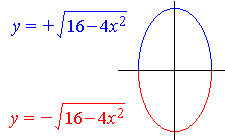
Differentiating the function in the upper two
positive
quadrants:
dy/dx
= d(16 - 4x2)1/2/dx
dy/dx
= d(16 - 4x2)1/2/d(16 - 4x2)
• d(16 - 4x2)/dx
... Chain Rule
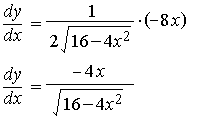
The solution for the function in the
negative
quadrants returns the same terms but with opposite sign.
(33a-ii)
Use Implicit Differentiation to differentiate
4x2 + y2 = 16
with respect to x
d(4x2)/dx
+ d(y2)/dx
= d(16)/dx
d(4x2)/dx
+ d(y2)/dy • dy/dx
= d(16)/dx
... differentiating implicitly ... Chain Rule
8x + 2y • dy/dx = 0
2y • dy/dx = -8x
dy/dx = - 4x/y
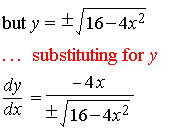
(34a)
Find the derivative for the function
y = (2x2 - x)(3x2 + 5)8
Let 3x2 + 5 = u
, therefore du/dx = 6x
Let 2x2 - x = v
, therefore dv/dx = 4x - 1
Let (3x2 + 5)8 = w
, where w = u8
, therefore dw/dx = d(u8)/du • du/dx
... invoking the Chain Rule and substituting for w
y = vw
dy/dx = d(vw)/dx = v • d(w)/dx + w • d(v)/dx
... Product Rule
dy/dx = d(vw)/dx = v • d(u8)/du • d(u)/dx + w • d(v)/dx
... invoking the Chain Rule and substituting for w
dy/dx
= (2x2 - x) • 8(3x2 + 5)7 • 6x
+ (3x2 + 5)8 • (4x - 1)
... substituting the original functions in terms of x
dy/dx =
(3x2 + 5)7
[48x(2x2 - x)
+ (3x2 + 5)(4x - 1)]
... factoring the common term (3x2 + 5)7
dy/dx =
(3x2 + 5)7
[96x3
- 48x2
+ 12x3
+ 20x
- 3x2
- 5]
... expanding the expression in the parenthesis
dy/dx =
(3x2 + 5)7
[108x3
- 51x2
+ 20x
- 5]
... collecting like terms
(34b)
Find the derivative for the function
y = (t2 - 6t) ÷ (t2 + 6t)
y = [t(t - 6) ÷ t(t + 6)] = (t - 6) ÷ (t + 6)
... simplifying the expression and reducing it in degree
Let t - 6 = u
, therefore du/dt = 1
Let 1/(t + 6) = (t + 6) -1 = v
... changing the division to a multiplication and permitting the use of the simpler Product Rule
Therefore dv/dt
= (-1) • (t + 6) -2
= -1/(t + 6)2
Let (t - 6) ÷ (t + 6) = w = uv
, therefore y = w5
dy/dt = d(w5)/dw • dw/dt = d(w5)/dw • d(uv)/dt
... Chain Rule
= d(w5)/dw • [u • d(v)/dt + v • d(u)/dt]
... Product Rule
dy/dt
= 5[(t - 6) ÷ (t + 6)]4 • [- (t - 6)/(t + 6)2 + 1/(t + 6) • 1]
... substituting the original functions in terms of x
dy/dt
= 5[(t - 6) ÷ (t + 6)]4 • [(- t + 6)/(t + 6)2 + (t + 6)/(t + 6)2]
... multiplying the final term in the parenthesis by (t + 6)/(t + 6) , creating a common denominator for both terms
dy/dt
= 5[(t - 6) ÷ (t + 6)]4 • [(- t + 6 + t + 6)/(t + 6)2]
dy/dt
= 5[(t - 6)4 ÷ (t + 6)4] • [12 ÷ (t + 6)2]
dy/dt
= 60(t - 6)4 ÷ (t + 6)6
Find the derivative for the function
y = (3 - 2x)5(x2 - 2)4
Let (3 - 2x)5 = u
du/dx
= d(3 - 2x)5/d(3 - 2x) • d(3 - 2x)/dx
= 5(3 - 2x)4 • (-2)
... Chain Rule
Let (x2 - 2)4 = v
dv/dx
= d(x2 - 2)4/d(x2 - 2) • d(x2 - 2)/dx
= 4(x2 - 2)3 • (2x)
... Chain Rule
y = (uv)
dy/dx
= d(uv)/dx
= u • d(v)/dx + v • d(u)/dx
... Product Rule
dy/dx
= (3 - 2x)5 • 4(x2 - 2)3 • 2x
+ (x2 - 2)4 • 5(3 - 2x)4 • (-2)
... substituting in the Product Rule formula
dy/dx
= 2(3 - 2x)4 (x2 - 2)3 • [4x(3 - 2x) - 5(x2 - 2)]
... collecting terms and factoring
dy/dx
= 2(3 - 2x)4 (x2 - 2)3
(12x - 13x2 + 10)
... solving the terms in the square parenthesis
Find the derivative for the function
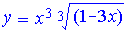
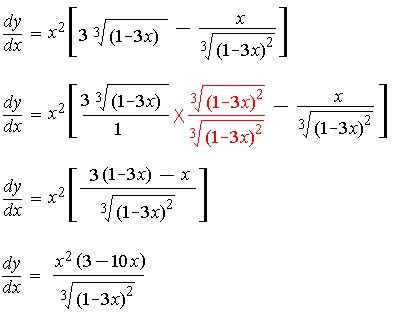
y = x3 • (1 - 3x)1/3
Let x3 = u
du/dx
= d(x3)/dx
= 3x2
Let (1 - 3x)1/3 = v
dv/dx
= d(1 - 3x)1/3/d(1 - 3x) • d(1 - 3x)/dx
= [(1 - 3x) -2/3 ÷ 3] • (- 3)
= -1/(1 - 3x)2/3
... Chain Rule
y = (uv)
dy/dx
= d(uv)/dx
= u • d(v)/dx + v • d(u)/dx
... Product Rule
dy/dx
= x3 • (-1/(1 - 3x)2/3)
+ (1 - 3x)1/3 • (3x2)
= 3x2(1 - 3x)1/3
- x3/(1 - 3x)2/3