Evaluation of Limits
|
(1) Determine the following limits Substitution
If the function has a zero divisor at the required limit, try factoring and cancelling like terms to create an equivalent function with a non-zero divisor.
(x - 3)(x - 4)/5(x - 3) = Substituting the limiting value of 4 for x...
Multiplying the right hand term by (x + 1)/(x + 1) ... 1/(x + 1)(x + 2) + (x + 1)/(x + 1)(x + 2) = (x + 2)/(x + 1)(x + 2) Cancelling like terms ... Substituting the limiting value of -2 for x...
(- 6/n + 1/n2 + 2/n3) ÷ (2/n2 - 3/n + 5) Terms with n as a divisor approach zero as n approaches to infinity ... Therefore the value of the function approaches ...
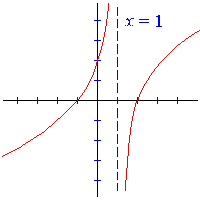
Factoring ... (x + 1)(x - 2)/(x - 1) The expression cannot be factored ... As x approaches the limiting value of 1 from the left ... f (.9) = 20.9 f (.99) = 200.99 f (.999) = 2000.999 f (.9999) = 20000.9999 f (.99999) = 200000.99999 ... f(x) is approaching positive infinity As x approaches the limiting value of 1 from the right ... f (1.1) = -18.9 f (1.01) = -198.99 f (1.001) = -1998.999 f (1.0001) = -19998.9999 f (1.00001) = -199998.99999 ... f(x) is approaching negative infinity Graphing the function y = (x2 - x - 2)/(x - 1)
(2) y = f (x) = 3x2 - 2x + 5 y + Δy = 3(x + Δx)2 - 2(x + Δx) + 5 = 3x2 + 6x•Δx + 3Δx2 - 2x - 2Δx + 5 ... expanding the right-hand side Δy = [3x2 + 6x•Δx + 3Δx2 - 2x - 2Δx + 5] - [3x2 - 2x + 5] = 6x•Δx + 3Δx2 - 2Δx ... subtracting y from each side Δy/Δx = 6x + 3Δx - 2 ... dividing both sides by Δx
Supplementary: y = f (x) = 3x2 - 2x + 5 at the point x = 3 At x = 3 , f (3) = 3(3)2 - 2(3) + 5 = 26
d[f (x)]/dx = 6x - 2 Substituting for x in the derivative: At x = 3 , dy/dx = 6(3) - 2 = 16 |