Optimization, Maxima and Minima
The tangent to a curve at a maximum or minimum point is horizontal.
Tangent = Slope = f(x)/dx = 0
|
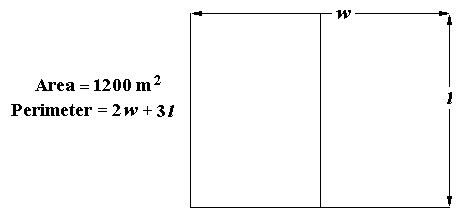
Area = wl = 1200 m²
Therefore l = 1200/w Perimeter = 2w + 3l = 2w + 3(1200/w) ... substituting for l = 2w + 3600/w dP/dw = 2 - 3600/w² ... rate of change of perimeter with respect to the width dP/dw = 2 - 3600/w² = 0 ... a zero rate of change or slope is required w² = 3600/2 = 1800 m² ... solving for w w = 42.42641 m and l = 1200 m²/w = 28.28427 m Perimeter = 2(42.42641 m) + 3(28.28427 m) = 169.70563 m of fencing ... Testing the solution Let l increase to 29 m, therefore w = 41.37931 m Perimeter = 2(41.37931 m) + 3(29 m) = 169.75862 m ... > 169.70563 m Let l decrease to 28 m, therefore w = 42.85714 m Perimeter = 2(42.85714 m) + 3(28 m) = 169.71428 m ... > 169.70563 m Increasing or decreasing the value of l (and therefore changing the value of w to maintain the required area of 1200 m²) returns an increase in the value of the perimeter. Hence the solution for the perimeter is the optimum value, producing a minimum perimeter for the given area. ... Validating the solution by differetiating the perimeter with respect to l Area = wl = 1200 m² Therefore w = 1200/l Perimeter = 2w + 3l = 2(1200/l) + 3l ... substituting for w = 2400/l + 3l dP/dl = -2400/l² + 3 ... rate of change of perimeter with respect to the length dP/dl = -2400/l² + 3 = 0 ... a zero rate of change or slope is required l² = 2400/3 = 800 m² ... solving for l l = 28.28427 m and w = 1200 m²/l = 42.42641 m Perimeter = 2(42.42641 m) + 3(28.28427 m) = 169.70563 m of fencing ... the same results as differentiating with respect to w |
|
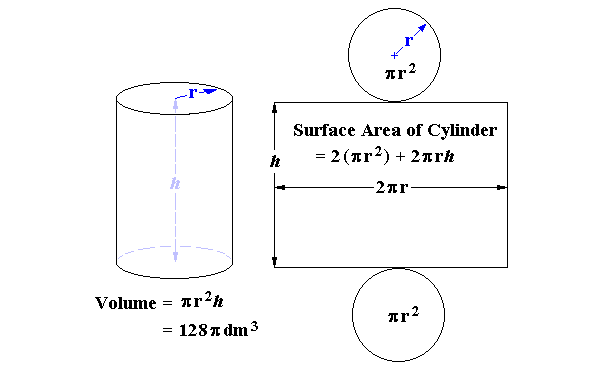
Cylinder Volume = πr²h = 128π dm³
Therefore h = 128/r² Cylinder Surface Area = 2πr² + 2πrh = 2πr² + 2π(128/r) ... substituting for h = 2πr² + 256π/r dA/dr = 4πr - 256π/r² ... rate of change of surface area with respect to the radius dA/dr = 4πr - 256π/r² = 0 ... a zero rate of change or slope is required 4πr = 256π/r² ... solving for r r ³ = 64 r = 4 dm and h = 128 dm³/r² = 128 dm³/16 dm² = 8 dm Cylinder Surface Area = 2π(4 dm)² + 2π × 4 dm × (8 dm) = 301.59289 dm² ... Testing the solution Let r decrease to 3 dm, therefore h = 14.22222 dm Cylinder Surface Area = 2π(3 dm)² + 2π × 3 dm × (14.22222 dm) = 324.63124 dm² ... > 301.59289 dm² Let r increase to 5 dm, therefore h = 5.12 dm Cylinder Surface Area = 2π(5 dm)² + 2π × 5 dm × (5.12 dm) = 317.92918 dm² ... > 301.59289 dm² Increasing or decreasing the value of r (and therefore changing the value of h to maintain the required volume of 128π dm³) returns an increase in the value of the surface area. Hence the solution for the surface area is the optimum value, producing a minimum surface area for the given volume. ... Validating the solution by differetiating the surface area with respect to h Solving for r in terms of h 
Substituting for r in the formula for the surface area and differentiating with respect to h returns the equation: 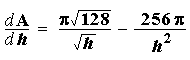
Setting the expression equal to zero and solving returns h = 8 dm Solving for the radius returns r = 4 dm |