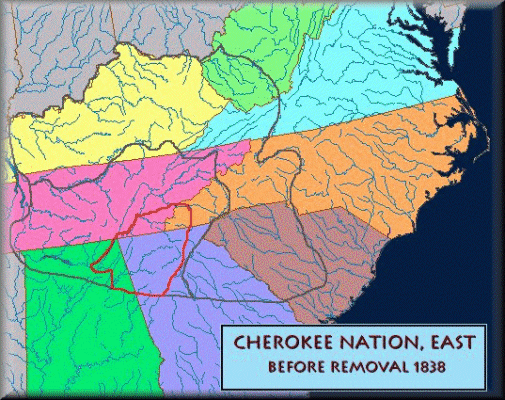
areas of North and South Carolina, Virginia, Tennessee, Georgia and Alabama.
Other Cherokee maps

The Five Civilized Tribes came from
the Southeastern United States.
Cherokee
Choctaw
Chickasaw
Creek
Seminole
The Cherokee
| The Cherokee Nation had occupied vast
areas of North and South Carolina, Virginia, Tennessee, Georgia and Alabama. Other Cherokee maps |
|
About 200
villages were located in the Great Smokies,
the Blue Ridge Mountains of Virginia and
the Great Valley of Tennessee. The Cherokee
people spoke in dialects of the Iroquian
language. They called themselves
“Ani-Yun-Wiya” which meant “real people.”
They lived in homes made of logs, bark and
branches plastered with mud and clay. Their
villages ranged in size from 200 to more then
2000 people. Cherokees were farmers, hunters, fisherman,
artists and warriors. They
produced basketwork, pottery, masks and
pipes which were traded. They had a
republican form of government with a
constitution, a chief, a senate and a house of representatives.
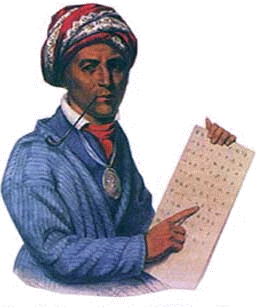
One outstanding man named Sequoyah
worked for 12 years to reduce their verbal
language to written form. He invented a
syllabary or alphabet that has 86 characters.
With a character for each sound in the language.
Sequoyah
points out his syllabary.
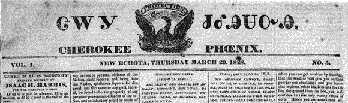
Below is a copy of the Cherokee Phoenix
 |
  |

The Chickasaw
Prior to their removal, the Chickasaw were
in northern Mississippi, western Tennessee,
western Kentucky and eastern Arkansas.
Like the Choctaw they spoke the Muskogean
language and had close ties to the Creek.
| The Chickasaw were noted for their successes
in war |
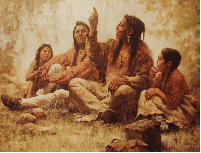 |
The Chickasaw were noted for their successes
in war; into a thousand battles their men
carried clan medicine bundles cherished as
sacraments because they contained the clans’
mystic powers. Religion was the center of
their world. They celebrated each new full
moon and kept a lunar calendar.
Their tribe was divided into the Imosakta
and the Incukwalipoa, with the Imosakta
having precedence and providing the High
Minko or King. Each clan had a separate
government: together they confederated
into a nation.
The Chickasaw struggle on The Trail of
Tears continued after their arrival in
Oklahoma. While starvation and disease
on the trail killed thousands, the tainted
food supplies and swindling by white
merchants in Oklahoma territory led to
continued mass starvation.
The Choctaw
According to tradition, the Choctaw
originated from a sacred hill titled
“Nanih Waya.” The tribe was socially
organized into two groups of families.
Several clans derived from the two groups.
Children belonged tthe mother’s clan
and their mother’s brothers were in
charge of their education.
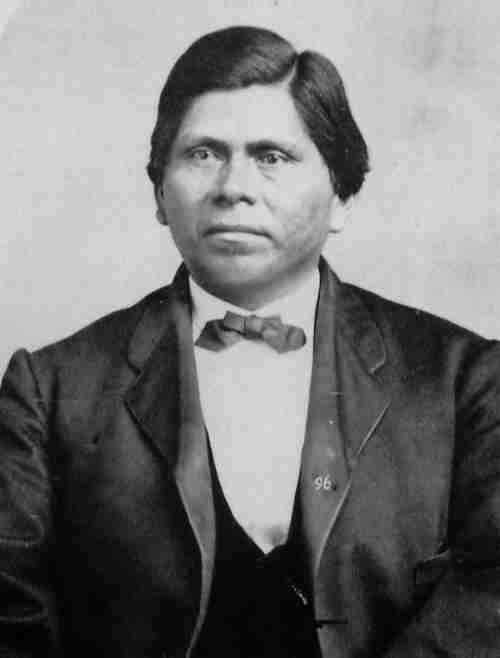
| Choctaw, Allen Wright, who is credited with
naming Oklahoma,
" Land of the red man" |
 |
Known for their farming skills and
peaceful disposition, they occupied what
is now southern and central Mississippi
and much of Alabama extending east to
parts of Georgia. Families lived in homes
supported with pole frames and covered
with grass mats, reeds, branches and clay.
By the beginning of the 19th century brick
and stone houses in the southern style started
to appear as the Choctaw developed
plantations, using slaves sold to them by
American traders and the U.S. government.
The forced relocation of the Choctaw to
Oklahoma from 1831-34 happened despite
many treaties with the U.S. By Oklahoma
statehood in 1907 they were on their 16th
treaty, as the U.S. continued to violate
agreements. The name Oklahoma is derived
from the Choctaw word for “Red People.”
The Creek
The Muscogee were called “Creek” by the
British because they were located on creeks
and streams in what is now Georgia, Alabama, northern
Florida, eastern Louisiana and
southern Tennessee. The Creek Occupied
a loose confederacy of 40 to 50 towns. Each
autonomous group had their won version of
the Muskogean language. Legends say the
Creek migrated from the north and may have
been descendants of the “mound builders.”
There were Red Creek and White Creek.
The Red were predominately warriors while
the White were peace-makers. In response
to white settlement, civil war broke out
among the two factions, with federal and
state troops mobilizing under General
Andrew Jackson intervened. Jackson
punished the Creek by forcing them to sign
the Treaty of Horseshoe Bend, which took
away 23 million acres of land. They lost the
remainder of their land after the Indian
Removal Act. Upon their removal 1600 Creek
warriors and their chief, Neamathla were
put into chains. With his back straight and
his eyes proud the 84 year old chief walked
every step to Oklahoma.
The Seminole
The Seminole were inhabitants of Florida
before their forced removal. The word
“Seminole” loosely translates to “runaways.”
The Seminole spoke a language related to
Muskogean. They lived in open-sided
Mikasuki “Chickees” that were grouped
in villages built near rivers The thatched
roofs and raised platforms were well suited
for their warm, damp climate. The Seminole
were hunters and gatherers as well as farmers.
Seminole leader, Osceola led troops against
the federal government and was successful in
defeating the U.S. for many years. Three
Seminole wars took place before they tired
of fighting and surrendered before they were
forced to move to Indian Territory. Following
the Indian Removal Act, most of the Seminole
traveled by boat to New Orleans then up the
Mississippi and Arkansas rivers. They were
lacking food and blankets and man6y
succumbed to disease and starvation.
Summary
Finally all of the Five Civilized Tribes were
in their new home. With the loss of loved
ones, land and independence, life was forever
changed. Today, the Five Civilized Tribes
are a classic tragedy to triumph story,
representing over 300,000 Indian people
and contributing over $600,000,000 annually
to Oklahoma’s economy. These tribes
furnish services that care for the elderly,
educate the young and enhance the overall
quality of life for all of their citizens while
building successful businesses that provide
employment for thousands of Oklahomans.
Workbook page 11