| How Seafood Is
Harvested |
| Many different fishing techniques are employed to harvest
the finfish and shellfish that enter the seafood market. Some of these
methods target individual fish within a selected species, while others
are less discriminating, designed for higher volume and mass production.
Each can have an effect on the quality of the end product. Here's a look
at eight common methods of harvesting seafood, as well as their advantages
and drawbacks. |
| |
|
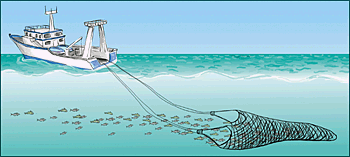
| OTTER
TRAWLING - A large cone-shaped net, held open by huge
plates (called "doors"), is dragged through the water, scooping up everything
in its path. The fish end up in the rear section, or cod end, of the net.
There are two kinds of trawling: bottom trawling (in which the net is
dragged across the bottom) and midwater trawling. The value of trawling
is volume fishing for groundfish species like pollock and flounder. Disadvantages
include a loss of quality because of the sometimes heavy tonnage hauled
up in a single lift of the net - a problem that can be mitigated somewhat
by reduced towing times. |
| |
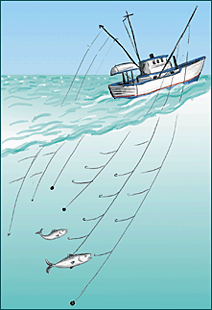  TROLLING
- Baits or lures are dragged behind a vessel as it moves through
the water. With salmon trolling, as many as six wire lines are lowered
from the boat, with "cannonballs" (lead balls) holding each wire more
or less perpendicular to the hull. Off each trolling wire, as many as
20 leaders, with bait lures attached, are pulled through the water. The
main lines are reeled in and out by hydraulic gurdies (spools). Albacore
trolling, on the other hand, consists of a dozen or so feathered jigs,
each on a single line, skimmed along the surface. The advantage of troll-caught
fish is quality. One fish is hooked at a time, cleaned and bled, then
stored in ice or frozen onboard. TROLLING
- Baits or lures are dragged behind a vessel as it moves through
the water. With salmon trolling, as many as six wire lines are lowered
from the boat, with "cannonballs" (lead balls) holding each wire more
or less perpendicular to the hull. Off each trolling wire, as many as
20 leaders, with bait lures attached, are pulled through the water. The
main lines are reeled in and out by hydraulic gurdies (spools). Albacore
trolling, on the other hand, consists of a dozen or so feathered jigs,
each on a single line, skimmed along the surface. The advantage of troll-caught
fish is quality. One fish is hooked at a time, cleaned and bled, then
stored in ice or frozen onboard. |
| |
|
 |
 |
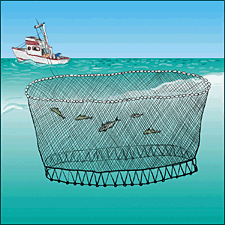
| PURSE
SEINING - Schools of fish like herring, mackerel and
tuna are encircled with a net, which is then "pursed" at the bottom, trapping
the fish. The filled net is hauled back to the vessel through a power
block; when it's alongside the vessel, the fish are usually "brailed,"
or pumped aboard with a suction hose. The quality of seine-caught fish
is a function of the volume of the catch. |
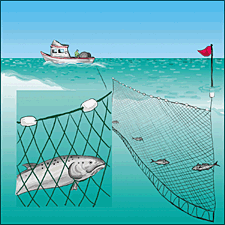
GILLNETTING
- Gillnets entangle target species like salmon and sharks by
their gills after they penetrate the net and get caught in the mesh, which
is invisible to fish. The mesh size determines the size of the fish captured.
The advantage of this method is its efficiency; its disadvantage is that
it kills on capture, sometimes inflicting injuries that compromise the
quality of the product. |
| |
|
|
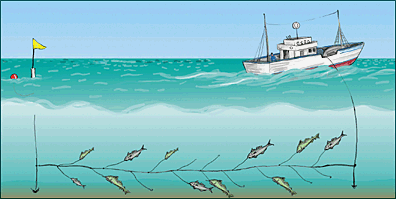
| LONGLINING
- To attract fish, baited hooks are attached to a single
longline, which is then set either along the bottom of the ocean or at
a depth nearer to the water's surface (depending upon the target species).
The ends of the set are marked by buoys and, in the case of bottom longlining,
anchored to the bottom. |
Mahimahi and swordfish are two examples of species that
are taken, in part, by surface longlining; halibut and cod are examples
of fish species taken by bottom longlining. The advantage of this method
of harvest is that fish are brought aboard one at a time, usually while
they're still alive, and processed quickly to ensure quality. |
| |
|
 |
 |
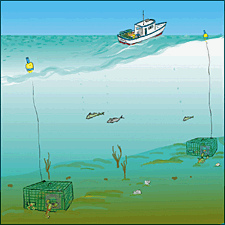
| POT
FISHING - Pots, or traps, are fished on the bottom from
single lines and buoys, with one pot per line, or from longlines, with
several pots to a string and buoys marking either end of the "set." Lobsters
and most crab species are captured by the former method (single pots).
A wire lobster pot may weigh less than 10 pounds, while a king crab trap
can weigh 500 pounds. Pot fishing is highly selective, and the product
is landed live for maximum quality. |
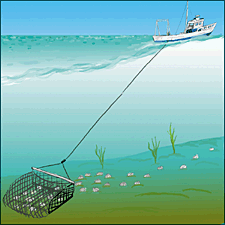
DREDGING
- This is a method used for capturing shellfish, primarily
scallops, clams, oysters and mussels. A dredge is essentially a metal
"rake" that's dragged across the ocean bottom, scraping up shellfish in
its path. The shellfish are collected and held in a chain-mesh bag. Dredges
vary from hand-operated to much larger, hydraulically operated versions
like those used for harvesting sea scallops and surf clams. |
| |
|
|
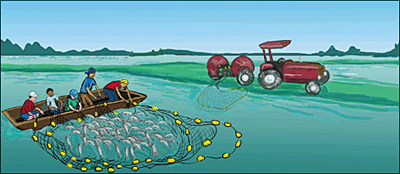
| AQUACULTURE
- Aquacultured finfish and shellfish are harvested from
a controlled environment in which they have been raised to market size
from fingerling or larval stage. For example, salmon are grown in ocean
pens, while catfish and tilapia are raised in freshwater ponds or tanks
on land. Mollusks like oyster and mussels are grown in systems that suspend
them off the ocean bottom. |
Shrimp are farmed in ponds worldwide. In aquaculture operations,
water quality and feed are carefully monitored. Farmed fish and shellfish
are usually processed and shipped within hours of harvesting. As such,
the quality of product is typically excellent. Aquaculture also offers
a consistent, year-round supply and greater price stability than wild-caught
seafood. |
 Top
of Page Top
of Page |
|