Mona Simpson's 1986 novel Anywhere But Here uses Family Affair's Buffy as a recurring image. The novel is about a young girl, Ann, and her mother, who hopes getting Ann into show business will mean a better life for them both. Ann's mother's quest is sparked by Family Affair, and, later, Ann learns of Anissa Jones' death (though Jones is not mentioned by name). Johnnie Whitaker appears in the novel under the name Timmy Kennedy, but many of the details of his life that are mentioned are correct or nearly correct.
"My mother and I made up a secret. It started one evening, a usual evening in our house, when my grandmother and I sat watching Family Affair on television...During one of (my mother's) migrations, she stopped in the living room and stood for a few minutes watching TV with us. "Ann, come here. I want to talk to you for a second. You know, you're cuter than Buffy," she whispered, looking down hard, as if she were appraising me..."You know, I've been thinking. We ought to get you on TV."
Ann and her mother go to a cerebral palsy benefit (a charity that Johnnie Whitaker supports in real life) to meet "Timmy Kennedy":
The boy from on television sat playing checkers. He was wearing a velour shirt with a zipper, just like any other kid. But I knew he wasn't. I'd seen him on television. His father told my mother that he was a gym teacher and that his family was Mormon. "Mother used to do all her own canning and of course that's had to stop. One or the other of us travels with him. He has eight brothers or sisters, and they've had to make sacrifices for him to be on the show. So with part of his money, we've taken out insurance policies for each of them."...The boy's father told us that Buffy snubbed Timmy on the set. In real life, she was year's older, almost in junior high.
The final Family Affair mention comes years later:
One day I read it in the newspaper, Buffy died. The girl who was an actress everyone wanted to be when I was nine. She'd been nine, too. She looked younger, she played a twin on Family Affair with two high blond pigtails. Mattel put out a Buffy doll, and they also made one of Mrs. Beasley, Buffy's doll on television. Buffy was famous. When I lived in Bay City, I read everything there was about Buffy. I found an interview with her in TV Guide. I remember it said she lived in Pacific Palisades. She talked about working, she said once when she came home her brother had eaten all the strawberries. I knew she had a mother and no father, like me. I thought of her now, enormous, full-grown, but with the pale thin legs and white anklets, a nineteen-year-old girl in blond pigtails. I kept thinking of paper around her, the long woman's legs, eerie where they met the white anklets, in a shoe box. She died of a drug overdose in an apartment on the Palisades. I guess she'd never gone too far away.
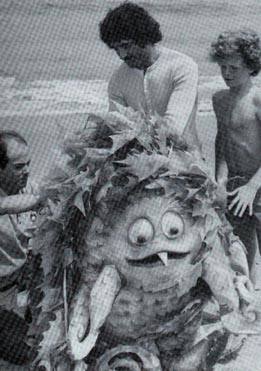
Johnny (as he was then billed) Whitaker starred as Johnny Stuart in Sid and Marty Krofft's Saturday morning show Sigmund and the Seamonsters.
Johnny looks on as Sid Krofft, center, helps to prepare Sigmund
In David Martindale's Pufnstuf and Other Stuff (1998), the Kroffts are highly complimentary of Johnny--which can't be said about some other young actors with whom they have worked. The following is an excerpt from the Martindale book:
Of course, Sigmund also got a lot of help in the believability department from his two human co-stars, played by Johnny Whitaker, then age thirteen, and Scott Kolden, eleven. Whitaker, who is still perhaps most widely known for playing Jody Davis on Family Affair, was hand-picked by Sid and Marty for the part--no complicated casting process involved this time--and he didn't let them down.
"It was because of Family Affair that we knew who he was," Sid says. "I can't remember whose idea it was, but Johnny Whitaker was an established household name at that time and we felt he was perfect for this show."
"He was a star and we went after him and he accepted and we were thrilled to have him. I mean, getting Johnny Whitaker to star in our show was just incredible."
Whitaker, who now goes by the name John, was in a period of transition at that time. Puberty had begun to kick in since Family Affair had wrapped--with subtle yet significant changes in his appearance, his voice, even the spelling of his first name--but he made the shift from playing a supporting co-star in prime time to te young lead of a children's series with tremendous ease.
Ever since Pufnstuf, the Kroffts ad been looking for another young lead who could be as polished and professional as Jack Wild had been. With Whitaker, they finally had found him. Of course, that should come as no surprise, given that this thirteen-year-old had more years of experience in television than Sid or Marty.
"What he did on that show--and this isn't an easy thing to do, even for big, big adult stars--he made you believe in Sigmund," Sid says. "He made Sigmund real to the viewer. That just shows what a good little actor he was."
Sid and Marty Krofft are currently involved in the production of the forthcoming Family Affair movie.
Watching TV: Four Decades of American Television
By Harry Castleman and Walter J. Podrazik, McGraw-Hill, 1982
I found this book at a used book store that was going out of business and practically giving books away. It's a pretty interesting season-by-season look at network prime-time TV. This is what the authors have to say about Family Affair:
"The most popular new sitcom was CBS's Family Affair, which featured the tried-and-true formula of a bachelor father adopting and raising orphaned children. Brian Keith played the father figure (he was their uncle, actually) and Sebastian Cabot was his manservant, French. In a very predictable format, the two portrayed refreshingly believable level-headed adults. Keith, as a construction company executive, enjoyed a life apart from his new-found family, and Cabot, despite proper huffing and puffing, grew to love his new charges. The two men were not endowed with a magic instinct for raising children perfectly but, rather, made mistakes, yelled, and were sometimes baffled by the process. Unfortunately, the children, Buffy, Jody, and Cissy, were as mechanical and cardboard as the adults were real. They were children that fulfilled an adult's view of the perfect child: sweet, heartwarming, and innocently profound. No self-respecting kid would ever identify with them. Yet in the same way that Leave it to Beaver's realistic children saved the program from its cardboard adults, Family Affair's adults rescued it from the children. Though occasionally overloaded with saccharine plot twists, the series had its heart in the right place. CBS seemed to acknowledge that the show was geared to adult fantasy rather than children's by slotting it rather late in the evening (9:30 p.m.)."
The authors also note that Family Affair was one of only three bona fide new hits of the 1966-67 season. Later in the book, they describe Diff'rent Strokes as "a black-infused Family Affair."