| Chinese Cooking Utensils |
| Chinese 5 Spice Powder -- China cassia cinnamon, star anise, aniseed, ginger and cloves. $2.19 for 1.05-ounce jar... $16.90 for a one-pound bag. |
An old Chinese proverb says, "To have job well done, first sharpen the tools." You cannot sharpen tools you do not have. The first requirement to be a successful Chinese cook is to have the proper tools for the job.
Flat Bottom
|
Round Bottom
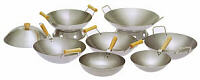
THE WOK: The Wok is a very versatile cooking tool. It can be used for almost any type of food preparation. We demonstrate this in our cooking classes by not only stir frying but deep frying, steaming, stewing, and even baking a cake in the Wok. Woks are available in various sizes, shapes and in the materials used to make them. When selecting a wok you must consider the type of range you have. If you have a gas range you may use either a round- bottom or flat-bottom wok. If you have an electric range the flat-bottom style is the best choice. By selecting your wok appropriately, you will eliminate the need of a ring stand. Most Woks range in sizes from 10" to 16", we prefer the 14" size which is adequate for the preparation of most dishes in the cookbook. Although Woks are available in many different types of materials we prefer the traditional wok made from uncoated carbon steel. This material conducts the heat well and is the most economical to purchase. Follow the manufacturers instructions for seasoning and cleaning your wok,
WOK ACCESSORIES: You will find that there are many accessories available. Most are very inexpensive and will make your Chinese cooking easier. Select these tools to meet your individual needs. Listed below are a few we consider to be of value.
Spatula Spatula: This long handle utensil is essential for keeping the food in motion while stir frying.
Note: Since the flavor of Chinese food is very delicate and can be easily tainted by metal against metal, we prefer to use wooden utensils and china or glass bowls.
Steamer Baskets Steamer Baskets: These bamboo baskets are available with a lid and can be used with your wok as the water receptacle or some sets come with their own base pan.
Bamboo Brush Bamboo Brush: A gentle scouring tool for use in cleaning your carbon steel wok.
Tongs Tongs: For use in removing fried foods from the hot oil and steamed food from the steamer baskets. Here again we prefer to use the wooden style.
Cleaver Cleaver: As is true with any style of food preparation, sharp knives are essential. Because of the amount of cutting and chopping required, a Chinese cleaver is an important tool. Once you have learned the proper technique for using a cleaver, you will find that the preparation stage of your cooking will proceed much faster. We prefer to use a simple style cleaver with wooden handle and carbon steel blade. These are very inexpensive and can be sharpened with a good cutting edge.
All of the tools and accessories we use are manufactured and distributed by Atlas Metals in San Francisco and are available at quality cooking shops and major department stores. If you wish, you may order direct from us by using our Cooking Products page. The special prices listed are exclusive values for "Cooking Together" customers.
| Chinese Cooking Helpful Hints
Before beginning preparation of any dish read entire recipe making sure you understand each step and that all ingredients are available.
Most of our recipes serve four to six people. If you are serving more than six people we suggest you double the entire recipe and cook in two batches or as the Chinese would do – add more dishes to your menu. A good rule of thumb would be: Two to four people – 2 - 3 dishes Six to eight people – 3 - 4 dishes Eight to ten people – 5 – 6 dishes Plus appetizers, soup and a simple dessert. If serving more than 10 people, it will probably be necessary to double the recipes.
Chop and cut all ingredients to uniform size as indicated. They will cook evenly and have a better appearance.
Prepare all ingredients, sauces, pastes, thickeners, etc. in advance. Make sure everything is handy before beginning the cooking process.
If meats are partially frozen you will find them easier to cut.
If you crush garlic cloves first, it makes the skin easier to remove.
In recipes calling for chicken stock you can use canned chicken broth or your own basic stock recipe. Freeze leftover stock in ice cube tray for future use. One cube equals two tablespoons of broth.
Mix cornstarch in cool liquids. This will prevent lumping and always stir mixture immediately before adding to wok.
For a basic sauce mix use 2 tablespoons cornstarch in 2 tablespoons dry sherry (or water). Blend with 1 cup chicken stock and 2 tablespoons soy sauce.
Buy fresh ginger root, peel, slice, place in jar with dry sherry and store in refrigerator for future uses. It will last almost indefinitely.
Make sure you do not overcook the vegetables. They should be heated through but remain crisp and/or firm. As a general rule, when the color of the vegetable intensifies, proceed to next step in the recipe.
For stir-frying, use a vegetable oil that can be heated to a high temperature without smoking. We prefer peanut oil, but corn, canola or soybean oil also work well. Some of our recipes call for using olive oil, sesame oil or butter which all have low burning points so use a lower cooking temperature than the normal high heat. (Med.. to Med... High)
Ginger and garlic fry very quickly. Make sure they do not burn.
Remember quality ingredients produce quality dishes.
|
| The Art of the Stir-Fry
by Wen Zientek
Introduction I love making stir-fry dishes. Actually, I prepare two to three a week. Before you start wondering how our family can eat that much Chinese food, I should let you know that we only eat Chinese stir-fry once or twice a month. If you are befuddled, there is probably a good reason. Most people associate stir-fry with Chinese and do not realize that there are numerous benefits and tremendous style variations of stir-fried cooking. This primer, I hope, will be your guide.
Benefits of Stir-Fry Dishes Time Factor: The stir-fry method of cooking is fast. Health Benefits: Because vegetables are cooked quickly, they retain much of their vitamin and mineral content. Because the pan is so hot, it is possible to stir-fry with very little fat. Low Cost: While tender or expensive cuts of meat or seafood are used, only a small amount is needed as they are paired with large quantities of inexpensive rice, pasta and vegetables. Fast Clean-up: Clean-up is easy as oftentimes you only use one or two dishes to cook the whole meal. Variety of Fare: Stir-fry is an almost foolproof cooking method for incorporating many different flavors and textures. I have assembled a collection of my favorite dishes and a brief primer on how to stir-fry correctly.
The Art of the Stir-Fry: The Process by Wen Zientek
1. The art of slicing and dicing: The Chinese have brought the art of slicing and chopping to incredible heights. While you do not have to be an expert at the cutting board, there are two principles that you should follow.
The longer it takes to cook a food, the smaller you should cut the pieces.
To shred or finely chop meat or poultry, place it in the freezer for 20 minutes before beginning. 2. Be prepared: It is essential to be well-prepared when making a stir-fry. If you want rice, you should prepare it first unless you use instant rice. Before starting to cook, slice and dice everything. Spices and other ingredients should also be handy so that you do not have to stop stirring the mixture.
3. Preheat the wok before adding oil: It is important to preheat the wok for several minutes over medium heat WITH NO OIL in it. This process will ensure that ingredients do not stick and that the wok does not absorb oil, thereby making you add more oil (and fat) to your dish.
4. Swirl oil onto sides: Once the wok is heated, add the oil and swirl it all over the bottom and up the sides of the wok. Depending on the recipe, you will either heat the oil until it is very hot (for example, if you are first cooking meat or a robust vegetable), or only moderately hot (for when a recipe starts by cooking garlic, scallions, onions or minced ginger).
5. Keep the ingredients moving: Once you've added your ingredients, it is crucial you keep them moving across the heat source from side to side. If anything sits in the center too long it will burn. The one exception to this rule is browning meat. When browning, allow the meat to sit for a minute or so on each side so that it browns evenly.
6. Creating the sauce: Once the ingredients are cooked, you will want to move them to the side of the wok so that the liquids remain on the bottom. Remove the wok from the heat and add the flour or cornstarch mixture to the liquid at the bottom of the wok. Stir the mixture vigorously and return to the heat. As soon as the mixture begins to thicken, mix in the rest of the ingredients, making sure to stir the ingredients in a tossing motion to thoroughly coat the mixture. Serve right from the wok or place in a serving bowl, and your flavorful dinner is all set.
The Art of the Stir-Fry: The Wok by Wen Zientek
The wok was designed for stir-frying. Woks have a rounded bottom and high sloping sides. This design allows you to cook food over very high heat while "storing" already-cooked food out of heat's range. While you can duplicate many of these recipes using a frying pan, you will have to use a selection of other dishes to remove ingredients as they are cooked, and maybe a second pot to make a sauce.
Choosing a wok need not be bewildering. The traditional, inexpensive carbon-steel woks are the best choice for stir-frying. These woks conduct heat better and scorch less often than stainless steel woks do. A nonstick wok is clearly the best if you are watching your fat intake and want to cook with spray. But note that nonsticks are less tolerant of high heat and cannot be seasoned like carbon-steel woks. I do not recommend electric woks, as they do not reach the necessary high heat.
As for brands, look for the Pau and Cantonese woks. The Pau, with one long handle, is recommended for stir-frying, as its handle does not get hot. The Cantonese, with two side handles, is designed more for steaming and deep-frying.
|
--------------------------------------------------------------------------------
To Order Cooking Together Cookbook
and Cooking Products
--------------------------------------------------------------------------------
Wok Ring Reversible $6.95 1 $6.95
Cleaver Carbon Steel $10.95 1 $10.95
Spatula Bamboo $1.95 2 $3.90
Wok Brush 7" $2.95 1 $2.95
Tempura Rack (Fits 14" Wok) $3.95 1 $3.95
Tongs Bamboo $1.95 2 $3.90
Cooking Together Chinese Syle Cookbook $22.50 1 $22.50
14" Wok Side Handle Flat Bottom $22.95 2 $45.90
Your Total: $101.00 ordered 20010209
[email]