| rule summaries |

date:20020918 Copyright ©,2001, American Wallyball Association® abreviated rules 1. Service area is 3 feet from each end of the court. 2. Game ends at 15,18 or 21 points, must win by 2 points. 3. Time outs call by captains only at end of point played. 4. Limit: 2 time outs, 30 seconds each per game. 5. If more than 2 time outs are called then other team is awarded point or side out. 6. A 5 minute injury time out can be awarded to the team with the injury by referee. 7. Two substitutions per game allowed. 8. Coin toss will determine first service or choice of court side. Second game service to other team. Third game if necessary will need another coin toss. 9. Out of bounds is when a ball while crossing the net hits the ceiling, back wall of opponent’s side or two walls consecutively on service, volley or block. 10. Ceiling and back wall on own side is in bounds if own player touches it. 11. Server cannot spike or block in (4) four person play. (Four Person). 12. If sever catches the ball on service toss, the sever can replay the serve. 13 The service must be a clean contact with the ball. Pushing the ball or rolling the ball off the fingers (paint brush) is not allowed. 14. Service order must be kept prior to serving. 15. If a ball on 1st or 2nd hit goes into the gallery, a replay is awarded. 16. If the ball is only partly across the net, and the opponent hits it, it is good. 17. Touching the net is not allowed by players, unless the ball is driven into the net and the net hits the player. 18. In the attack, the player must contact the ball before the ball has completely crossed over the net. 19. Blocker's can reach over the net to block, providing the other team has made it’s third contact of the ball. 20. The opponent cannot block the set. If any part of the ball has crossed the vertical plane, a free ball is in effect and both teams are entitled to it. 21. If two opposing players touch the net simultaneously the point is replayed. 22. A ball crossing below the net across the vertical plane can be played back by your side it is not over (3) three hits. 23. A ball on the vertical plane above the net is open to both sides. 24. A Ball passing through the side openings of the net on the 1st or 2nd contact is replayed. 25. A double hit is only allowed on a block, or the return of a hard driven hit. 26. If a ball is touched on a block, the team still has 3 hits and the blocker can make the any of these hits. 27. Contacting two or more walls is allowed only by the team in possession of the ball on their own side, provided a player on that team touches the ball first. The ball must also be touched by another player before going over on multiple wall hit. 28. Holding, pushing, scooping, lifting or carrying the ball is not allowed, it must be a clean hit. 29. Holding the ball at the top of the net by both sides is a replay. 30. If two players on the same team, hit the ball simultaneously, it counts as one hit and either player can play the next hit. 31. No climbing or using the walls or players assisting each other to gain height at the net. 32. A ball can hit the back wall and over the net directly (when being played by your side), but if two walls are touched, another player must touch it before going over the net. 33. If a ball spins across to the opponent’s side and back to yours on the 1st or 2nd hit, you can play your 2nd or 3rd hit. If it is on the 3rd hit that it spins back, loss of pint or side out occurs. 34. An open hand dink of the ball is illegal, it must be a paint brush hit, a clean hit, closed fist, knuckle, cobra shot or soft spike. 35. A ball can not contact below the waist. 36. Rude conduct constitutes a warning, two penalties means expulsions. 37. On a block, if two players touch the ball, the teams still has 3 hits. 38. On a spike return, a double hit is allowed on the first player, if the player makes two attempts or the 2nd player double hits the ball, that would be a double hit and a fault. 39. Blocking, Spiking or attacking a serve is Illegal. The above basic rules are only to simplify the understanding of the game and should not in anyway replace the interpretations of The American Wallyball Association® official rule book. The official rule book is $9.95 and is available through rules@wallyball.com
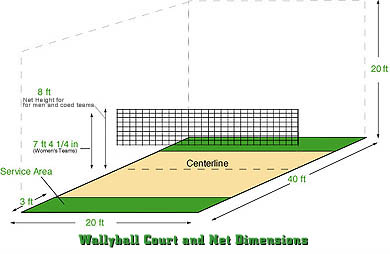
A wallyball court is forty feet long by twenty feet wide by twenty feet high.
The court is divided into two equal sides with a centerline between each
side. The net is eight feet high for men's and coed teams, and seven feet four and a quarter inches high for women's teams. The serving area is three feet from the back walls, extending across the entire width of the court. Scoring Matches will consist of the best of two out of three games, or best of three out of five games. Every time the ball is served, a point is scored by the winning team, except when the score for both teams is frozen. Both teams are frozen when the serving team achieves the freeze point. At the next side-out, one additional point will be awarded to the team that has won the serve. At this time, standard side-out volleyball scoring will apply, and either team can score points only when serving. The "freeze point" is three points less than the number of points needed to win a game. A team must win by two points.
Team and Players Each team will be composed of two, three or four players. Teams compete in men's, women's or coed doubles or triples divisions. Novice teams can also compete in men's, women's and coed 4 player teams In four-person play, the server on the offensive team and the last person who served on the defensive team are prohibited from spiking or blocking the ball. These players are not allowed to either fake or even attempt to spike or block the ball.
The Serve The ball must pass over the net without touching a member of the serving team. The ball cannot contact the net or net hardware, two or more walls before being played or landing on the floor, the opponent's back wall or the ceiling of the court. A serve that is attempted before the referee calls the score will be canceled and replayed. No part of the server's body can be in contact with the service line until after the serve A jump serve is legal. Players must maintain the original serving order throughout the game No members of the serving team may block the server from the view of the opposing team by raising their hands above their heads, flailing their arms from side to side or forming groups of two (2) or more to hide the actions of the server. Players on the serving team may not deliberately switch their positions to block the server from the view of the opposing team. In two or three person play, players may be in any position on the court. Only the serving order (rotation) must be maintained. In four-person play, players must be in their designated serving positions. After the service, players may move to an alternative offensive or defensive position. When receiving the serve, you must bump the serve - setting the serve is not legal.
Play at the Net A ball (other than a served ball) that touches or rebounds off the net or net hardware may be played. If only part of the ball crosses the net (breaks the vertical plane of the net) and is hit by an opponent, the ball is considered as having crossed the net. The receiving team has three additional touches of the ball. A player may not touch the net while the ball is in play In returning the ball, a player's arm may follow-through over the net provided he/she first makes contact with the ball on his/her side of the playing court or when the ball is within the vertical plane of the net. A player may step on, but cannot go over the centerline. A ball that breaks the vertical plane of the net may be played by either team. Any ball passing through the net opening on the first or second hit of a volley will be replayed. A ball passing through the net opening on the third hit or on the serve will result in a side-out.
Playing the Ball Each team is allowed up to three successive contacts of the ball in order to play the ball. A player may not make multiple contacts with the ball except when playing a hard driven spiked ball. For the purposes of this rule, multiple contacts can come from a ball hit directly at a player or from a ball that is spiked off the wall. A block does not count as one of the three allowed touches of the ball by a team. If, on an offensive hit, the ball contacts two or more walls a side-out will be called. However, a team in possession of the ball may cause the ball to make contact with two or more walls on their own side of the net, as long as the ball does not cross over the net. The ball must be handled in such a manner that it rebounds cleanly after contact with a player. Throwing, scooping, lifting, pushing or carrying the ball with one or two hands or arms (either underhand or overhand), will be considered to be a form of holding or throwing.
Blocking Any player on a 2 or 3 person team may block the ball before it breaks the vertical plane of the net, as it crosses the net or immediately after it has crossed the net. A block does not count as one of the three successive contacts allowed a team. To qualify as a block, the player must be at the net and have their hands above their head. A team may attempt a block if a player on the attacking team spikes the ball, the opponents have made three contacts on the ball and if the ball falls near the net but no player on the attacking team can reasonably make a play on the ball. A served ball may not be blocked or spiked. Players may not climb the wall(s) to make a play on the ball. A player may bounce the ball off the back wall on his/her side of the court in a manner that propels the ball over the net as long as the ball does not contact a second wall on either side of the court before being touched by another player on the opposing team. Any player may spike the ball in 2 or 3 person team play. A player may not attack spike a ball coming from the team on the other side of the net until the ball breaks the vertical plane of the net. As long as the spiker's hand or arm does not contact the net or an opponent, the hand or arm may cross over the net as a part of the spiker's natural follow-through motion. A ball that spins off the net into an opponent's court and subsequently returns to the team originally in possession of the ball will be good, provided it takes place on the first or second contact by the team. Any team member other than the last player to hit the ball can play the ball. If the ball spins off the net into an opponent's court and subsequently returns to the team originally in possession of the ball on the third hit, a side-out will be called. Players attempting a block may reach over the net, but they may not touch the ball until an opponent strikes the ball in an attempt to send it into the defensive court. A player cannot block an opponent's set or pass. If an opponent's set or pass (or any played ball) breaks the vertical plane of the net, it is considered a free ball and both teams are entitled to play it.
Dinking To qualify as a "dink" shot, the offensive player's intention must be to lightly drop the ball over the net so that it hits the floor within approximately 2-3 feet of the net. The player must be at the net (within approximately two feet of the net) when the shot is made. The ball must be propelled over the net in one of the following four ways: a. Using the knuckles of the hand b. Using the closed fist c. Using the back of the hand d. Using the cobra shot Open hand dinks are illegal. A "mis-hit" ball is not a "dink", as there is no intention to drop the ball lightly over the net. A ball that drops more than 2-3 feet from the net is likewise not a "dink". In this situation, the ball may be hit with an open hand as long as there is no "carry", "push" or "throw" involved.
During Play Faults Any of the following actions that take place during play by a player or a team will count as a fault:
a. The ball is touched more than three (3) consecutive times by a team.
b. The ball touches the ceiling on the opponent's side.
c. The ball is hit over the net and it hits two (2) or more walls consecutively.
d. The ball is hit over the net and it hits the back wall on a fly or volley.
e. The ball hits the floor on the court.
f. The ball is hit twice by the same player consecutively.
g. A player touches the net while the ball is in play.
h. A player crosses the centerline.
i. The ball contacts a player below the waist.
j. A player illegally handles the ball, such as holding, throwing or pushing.
k. The ball lands outside the court or in the spectator's gallery.
l. A personal penalty is called on a player.
m. A game is delayed.
n. A substitution is made illegally.
o. An illegal block is attempted.
p. Players purposely distract the opponents.
q. A time-out exceeds 60 seconds.
r. A player illegally assists a teammate.
s. A defensive player attempts to block or spike the serve.
Miscellaneous The rules involving males and females on the same team will be the same as the rules that govern all team players with the following exceptions: Men and women will alternate service in four-person play. A female team member must make one (1) contact with the ball if the ball is played more than once by a team. Since a block does not count as one of the three contacts allowed a team, if the ball is blocked by a male player, a second male player may hit the ball back into the opponent's court without having a female touch the ball.
from auwp.org Association of United 'Wallyball Players |


[email]
 skatetoit skatetoit |