Theater Pipe Organs
A Brief History of the Theater Organ
During the early days of silent pictures, the motion picture houses had to employ an entire
orchestra to provide for the background music for the pictures that they were showing. This proved to be a great burden on many of them, so a means of downsizing in staffing had to be come up with. Thus came the invention of the Theater Organ.
Theater houses all around the world were installing these mighty "Unit Orchestras." Though there were several companies that manufactured them, the company that laid claim to the most was the Wurlitzer Corporation.
But, with the advent of sound pictures, the mighty "Unit Orchestras" were soon silenced. Many of them were destroyed in huge bonfires, many were donated to churches, a few are still in their original installations, and a few of them found their way into the homes of collectors.
What's the difference between a Theater Organ, and a Church Organ?
The main differences between the Theater Organ and it's counterpart the Church Organ are as follows:
- How the actions of the instrument were performed.
- Church Organs used a system of cables and push rods to activate the various ranks of pipes, and to open and close the various valves beneath the pipes when the appropriate keys were pushed. The console was usually attached to the pipes directly, so there was no mobility with the instrument.
- Theater Organs utilized electrical relays between the console and the pipes to control the various ranks selected, and to open the relays beneath the pipes when the appropriate keys were pressed. Thus, the console was semi-portable as it was only attached to the instrument by a huge bundle of electrical wires.
- There is a difference between the main voice pipes of the instruments.
- The main voice pipes of a Church Organ are called Diapasons.
- The main voice pipes of a Theater Organ are called Tibias.
- Theater Organs also employ various percussion instruments and sound effects also known as TRAPS and the TOY COUNTER that are not present in a Church Organ
Lloyd Gets a New Hobby!
I first fell in love with the Theater Pipe Organ at the age of 8 years old. A friend of my family took us one night to a local pizza parlor that had a 1922 Wurlitzer Theater Pipe Organ installed in it.
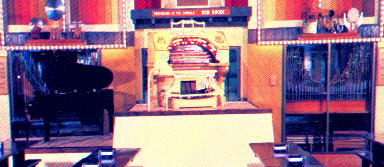
This particular instrument was originally installed in the Grauman's Egyptian Theater in Hollywood California. The theater sold it to a collector who constantly worked on it, doubling the size of the original instrument. He finally sold the instrument to a man in Phoenix (who has one of five Wurlitzer's manufactured with 5 manuals, installed in his home) who then built the pizza parlor and had the instrument installed there for the public's enjoyment.
This is a small section of what the Phoenix instrument looked like
A few years after opening the first restraunt, he opened a second one in the city of Mesa, and a few years after that, the third restraunt was opened in the city of Tucson.
The Tucson restraunt, however, was plagued with problems, and unfortunatly did not stay open for very long. I never got to go to that particular restraunt. I wish that I could have had the chance.
The restraunt in Phoenix closed several years ago due to the land in the area being sold to build an office complex. Rumors had it that the restraunt would be reopening in another part of Phoenix, but it was later learned that the instrument was sold to a collector in Chicago.
The restraunt in Mesa is still in operation (having moved into a larger facility, and expanding the size of the instrument). Mesa Arizona is now the home of one of the world's largest Wurlitzer Theater Pipe Organ installations in existance!
I became involved in restoration and repair of these Instruments back in 1989 when the American Theater Organ Society (ATOS) was holding their annual convention. They chose Arizona as the state for the convention that year. A friend of mine is an Organ Technician and was helping out with some work on a Wurlitzer that was installed in a local church. That instrument was going to be a part of the convention, with a concert being held in the church. I managed to help out a bit with some of the work being done on the instrument and immediatley fell in love with it. As you can guess, this is not a hobby that I have done often (actually that was the only time that I ever got to work on one!) But it is something that I will do again in a heartbeat if the opportunity ever arises.
Some links to other Pipe Organ sites on the Internet
Return to Main Page