Fencing:
The Weapons
and Their
Conventions
(another page on fencing is here)
|
|
Taken from the Cape Fear Fencing
Association's excellent presentation on fencing, the three fencing weapons,
and their respective conventions. It is also posted online at http://www.oocities.org/capefearfencing.
Foil is a small thin sword, about 3 feet in length. Its blade’s cross-section
is rectangular, with no cutting edge, but it comes to a point at the end. Of
course, the modern sport foil has either a plastic button tip, or an electrical
scoring button for the point, rendering it a non-deadly implement. Nonetheless
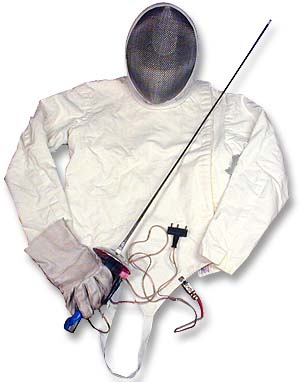
it is made of steel and when steel meets flesh, flesh loses, therefore, certain
protective equipment is required. Most people have at least seen the white
uniforms fencers wear in movies... that uniform is not just a formality. It
provides real and needed protection. Touches are scored only with the point of
the foil.
The
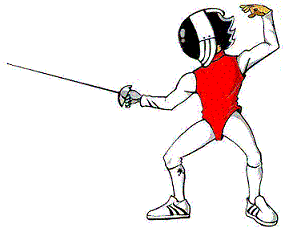
valid target area in foil is essentially the torso of the fencer's opponent,
excluding the arms and head. The rules actually define this area more precisely,
however the idea is that this is the only area on which points may be scored. At
this point it is useful to know the historical purpose of the foil to understand
the rules of the modern foil fencing which would seem peculiar otherwise. It was
used as a training weapon for the duel to the death. Naturally, in such a duel,
when one's opponent makes an attack, the defender's first obligation should be
to protect his own life before taking the offensive. After all, without such a
precaution, both duelists would attack, both hit, and both die. Whose honor is
satisfied then? As a result of this common sense approach to training for the
duel, we have what could otherwise seem like an uncommon-sense a pproach to
judging foil points in the modern sport. Namely, foil fencing embodies the
concept of "Right of Way." The idea is really simple: When one fencer makes an
attack, the other fencer is obligated first to make that attack fail before he
can take right of way from his opponent.
Epée, pronounced "epay" or "aypay", is the same length as a foil, but it is
heavier, and its blade is thicker, having a triangular cross-section. Like foil,
points are scored only with the point of the weapon. Its bell guard is larger
than the foil's to protect the fingers (the importance of which will become
apparent in a moment).
Now for
a quick glimpse of epée history to understand how it is different from foil.
Epée was actually a dueling weapon that evolved after most European nations had
outlawed duels to the death. As a result of such duels being outlawed, duels
adapted so that honor was considered satisfied when first blood was drawn. The
dynamics of the duel changed dramatically when death was no longer a primary
concern. Preservation of one's life was no longer an absolute factor (though it
could not be completely forgotten) and it was no longer necessary to restrict
one's target to the vital area of the body. As a result modern epée has no right
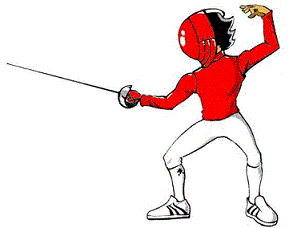
of way (whoever hits first scores) and the whole body, including fingers, toes
and even the soles of one's shoes are valid targets. In fact, the only thing
that a fencer has which is not valid target is the epée itself, which is
considered a defensive device.
Sabre or Saber (whichever spelling you prefer) is a descendant of the cavalry
sabre, and thus has a bell guard which covers the fingers and wraps around on
one side to attach at the pommel providing protection for the knuckles. The
blade is roughly the same length as both the foil and the épée, however, it has
a "cutting edge" as well as a point. Naturally this cutting edge is not actually
sharp in modern competition sabres. It is the lightest of the three weapons, and
points may be scored either with the edge (in a cutting action) or with the
point (in a thrusting action).
Again,
a bit of history is needed. Since fencing sabre is the descendant of the cavalry
sabre, which was a weapon of war, its historical purpose was therefore to kill
people. This suggests a similar need as in foil for defending one's own life
before taking an aggressive action, hence sabre, like foil is a Right of Way
weapon. Unlike foil, however, a cavalry sabre was to be wielded while mounted on
a horse. When combating a mounted adversary, one had to keep in mind the
adversary's horse... it was to be part of the spoils of war for the victors, and
a good war horse was a precious commodity. While a soldier took a matter of
months to train to be useful in battle, a horse took years to train. As a
result, neither side wanted to hurt the horse. This is reflected in the modern
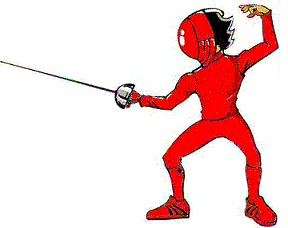
rules in the target area for sabre, which is everything from the top of the hips
up, including the arms and head, ie. the part of the body which could safely be
hit without damaging the horse underneath. (If this reasoning sounds cold,
consider that in even earlier ages archers were often used sparingly at the
expense of infantry. Arrows cost money. Dead soldiers don't.)