|
|
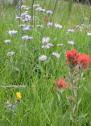
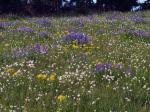
Flowery Meadows
On farmland, meadows were once
commonly cut for hay at the end of the summer and then grazed by stock.
Most of these flower-rich grasslands have now gone - 95% were "improved"
(ploughed, re-seeded and fertilised) or converted to arable crops in the
50 years after World War II. There may be 200,000 ha of garden lawns,
almost all of which are currently carefully tended to eradicate any
wildflower that makes an uninvited appearance. Few people may want to turn
their entire lawns into wildflower meadows but these are hugely valuable
wildlife habitats, even on a small-scale. Creating them is not easy since
lawn soils are generally very rich and weedy, unwanted vegetation can
easily take over once regular cutting stops. However, few garden habitats
are more rewarding in wildlife terms than a well-made meadow.
Valuable for:
Hay meadow
wild flowers,
insects such as bees,
butterflies, grasshoppers and crickets etc,
garden birds, which feed on the
insects and seeds, amphibians -
that use meadows as cover.
Useful tips:
- Starting from scratch in a new
property, consider sowing wildflower seed harvested from a wild meadow.
- Alternatively, sow a mix of
fine-leaved grasses (fescues and bents like common bent at a rate of 2g
per m2) with wildflower seed - incorporating species such as red clover,
common bird's-foot-trefoil, common knapweed, cowslip, ox-eye daisy,
meadow buttercup, and self-heal).
- Other wild flowers can be added
to the lawn as bulbs - such as snake's-head fritillaries - or as plug
plants.
- If your lawn already consists of
fine grasses use these as the basis of a meadow and add in pot grown
wild flowers or bulbs.
- Do not try to improve the
fertility of the soil - wild flowers do best in poor soils.
- A new lawn will need mowing
regularly for the first year of its life.
- In the summer before you want to
start growing your meadow, add some seed of yellow-rattle - burying the
seed in worm casts, or in a shallow scrape. This plant is a parasite
that feeds off the roots of grasses, thereby reducing their vigour and
encouraging more wild flowers. It is also a good food source for bees.
- Yellow rattle is an annual and
you must allow this plant to produce a little seed each year; but don't
let it seed too long or it may kill patches of lawn.
- Do not use other annual
wildflower species such as the common poppy - as they may not survive in
a lawn.
- Mow the lawn short in late
winter, just before bulbs such as fritillaries start to grow and then
leave it uncut until July. Allow plants to set seed.
- A tidier effect can be obtained
by allowing the most distant part of the lawn to grow tall in the spring
(place your bulbs and cowslips here) and progressively allow a little
more of the lawn to grow each week. This produces a graduated effect
from short to tall meadow.
- When you cut the hay, leave it
to dry to attract birds such as house sparrows linnets and goldfinches,
which may feed on the seed as it dries out.
- Remove the hay and mow the lawn
regularly for the rest of the year. It will look brown at first but will
recover rapidly.
- Allowing different parts of the
lawn to grow and flower at different times - some early in the spring,
others later in the summer, will provide a constant nectar source for
insects, and encourage a greater variety of flowers that flower at
different times of the year.
- If you cannot grow a meadow,
consider allowing your lawn to flower for a few weeks in high summer if
it contains plants such as clover. This provides a much-needed source of
food for some insects such as bumblebees.
- If you have frogs in the garden,
cut your meadow carefully to avoid killing them.
|
|