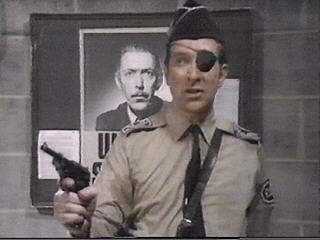
 An industrial drilling project in darkest Avengerland. Sinister green sludge leaking from pipes having a terrifying effect upon anyone with whom it comes into contact. A titanic ego-clash between the Doctor and a bearded git. Sounds, as "Doctor Who Magazine" once remarked, alarmingly like a hybrid of multitudinous Pertwee stories. However, there is something very different about "Inferno". I'm not knocking the other Pertwee stories I was just comparing it to, by the way- that era of "Doctor Who" happens to be one of which I'm very fond, I'm simply saying that if you're expecting something in that style then, for the most part, you will be surprised.
 Interestingly, for instance, although the stock characters of 'unorthodox visionary scientist prepared to act without computer approval', and 'neurotic bureaucrat incapable of independent action' are present, their plot roles are a near reversal of the usual position. Consider Clent and Penley from "The Ice Warriors" as a good example to contrast with Sir Keith and Stahlman.
Moreover, there is an air of incipient armageddon hanging over this story that never lets up until the final episode. There are many factors present to help this process along, from the doom-laden incidental music to the repetitive disasters shown through the twin Earth storyline- if any problem can crop up again in another reality, then how can it truly be solved, but the main method is simply the oldest fiction possible: Take a man or group of men standing on a rock. Raise the tide. In episode one, the Doctor has several days to penetration, the resources of UNIT to help, and some belief that things will go well. Problems: Professor Stahlman is being unpleasant, and there's a mysterious, possibly abnormal killer on the loose. Two episodes later, and the reliable help of UNIT has turned into a deadly threat, people are changing into deadly monsters, and we are counting down towards the destruction of Earth. A few episodes further on, and the Brigadier has just been shot after threatening to kill the Doctor, Benton and UNIT are all dead, and the world is about to end. In purely spatial terms from the entire project our roaming ground has been reduced to a small shed and edging around two control rooms, constantly in fear of death. The tide of destruction is coming in, quite literally in fact. Over six episodes the goalposts, which normally come closer as the Doctor works out a solution, are smoothly and inexorably moved away from us until finally, in the last shot of episode six, there is no hope left at all. It's possibly the most believable cliffhanger of them all.
That's not to say that episode seven doesn't live up to the standards of the others. After losing everything, the Doctor is given a second chance. Put on our Earth, he resolutely refuses to allow anything to come between him and stopping it happen all over again. Having ground our spirit down to nothing in the previous episodes, Don Houghton and company then build it right up again.
The script is, quite simply, brilliant. Effective dialogue and good use of humour grant a 'realism' to the production that has never been equalled, and the acting is all top-notch. Combine this with some quite inspired location filming, and the totally chilling central premise, together with the wonderful 'new hope' of the last episode, and the result is just plain fantastic. Of course, there are a few flaws- I personally find the 'volcano' opening title sequence a little irritating by episode seven, but this would not be apparent to those watching the story on a weekly basis, and there are undeniably a few occasions where the Primords look rather more amusing than was presumably the intention of the production team, but these come nowhere near counteracting the story's many strengths.