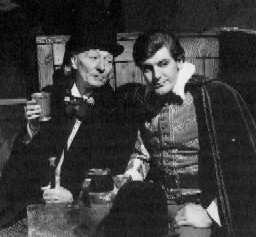
 Arriving in sixteenth century Paris, the Doctor hastily divests himself of Steven Taylor (always a wise move) before scurrying across the city to visit apocathary Charles Preslin, a founding figure of modern biology. What he finds is disturbing, Preslin is terrified and planning to flee the capital in fear of the Abbot of Amboise, a religious zealot with a hatred of scientists. The Doctor ponders a little visit to the Abbot...
Meanwhile, Steven waits impatiently as the Doctor fails to return. A chance encounter embroils him in the affairs of a group of Hugenots- French protestants living in an uneasy and sometimes broken truce with the Catholic majority of France. It becomes clear that certain factions in the government are plotting to murder an influential Hugenot figure, thought to be Henri Navarres, newly married to the King's sister, and Steven learns that key to the plot is a sinister and mysterious figure, the Abbot of Amboise. Just arrived from Rome, the Abbot has taken charge of operations, providing an assassin for the murder of "The Sea Beggar"- not Navarres, but Steven's friend's master, the Admiral de Coligny. As events move out of control and the assassination attempt fails the Abbot is murdered by his co-conspiritors, but not before Steven has identified him as the Doctor....
Or has he? That, is the question. Although we, and Steven, appear to accept at the end of the adventure that the dead Abbot and the Doctor's similarity are in fact co-incidence, given that no one in Paris has met the Abbot before- Colbert has seen him once at a distance, and Steven has precious little chance to closely examine the body in the gutter, there exists the tantalising possibility that the harsh figure of Amboise is the Doctor after all, and the dead Abbot discovered in episode three is in fact his work, rather than the guards. Of course, there is no proof for this theory, nor am I saying that you should believe it. It's certainly possible that the Doctor was elsewhere with Preslin during the whole story, having either decided against, or failed to encounter the Abbot, but the fascinating aspect of the tale is the way that this is less open. Irrespective of what happened, the way the Doctor shrugs off questioning about his behaviour and whereabouts leaves all the questions we have been asking ourselves about him wide open, and for the first time in a long while, we find his motives a mystery and his conduct less than comprehensible.
The major player here though, is Steven. Despite my critical remark at the beginning of this review, I have to admit that Peter Purves' usually blank faced performance is in fact rather effective here, and it makes a nice change to have a male companion who won't indulge in a bit of pointless swordplay to suit the guest thug. Steven comes across as a real individual, for once, as do all the characters and his sense of disbelief and astonishment at the apparent discovery that the Doctor is dead is very effective. The strangled cry of "But he wasn't the Doctor!" followed by his hurried departure from de Coligny's rooms, and his gasped "What have they done?" on the discovery of the body sound frighteningly genuine, echoing the viewers' own belief in the Doctor's immortality, and thus undermining it at the crucial point.
As for the main plot, well, I can't speak for the historical accuracy, but the story itself is certainly effective. I have always disliked organised religion of any sort for the atrocities it tends to perpetuate, so the central theme was going to strike a chord with me in any case, and it is well presented here, with the facts- politics and religion intermingling, being allowed to speak for themselves for once without any simplification or moralisation. There is no straightforward 'good' and 'bad': as Nicholas says of the Catholic hordes "some of our followers are just as bad", and events are presented in a horrifyingly realistic manner, the constant references to the time and date emphasising the inexorable march of the story towards the fateful date of the massacre itself.
Lastly of course, we have the aftermath (makes sense really). For once, William Hartnell agrees to a long speech, and the effect is stunning. Although we can sympathise with Steven's position (especially those of us like me who have our own suspicions about the Doctor's activities in the interim), Hartnell manages to totally win back the viewer's confidence, receiving his last great moment and giving a rare insight into the Doctor's personality. Then Dodo boards. Dorothea Chaplet is my only criticism of "The Massacre", but she is a major criticism. Anne, despite the attendant problems of primitivity, and the dubious morality of rescuing one individual and allowing the rest to die, would have been a far better character. Steven might be bland, but at least he's a well-acted bland character. Dodo not only lacks any personality, but Jackie Lane seems to lack any ability to offer her a trace of a personality. Before, I'd attributed her weakness to the sudden enforced removal of her accent from proceedings- a poor defence, but the only one I could think of, not being able to believe that anyone would give an important role to such a poor actress, but here, with accent intact, she is just as bad. A brilliant story, it's just a shame it had to introduce who it did.