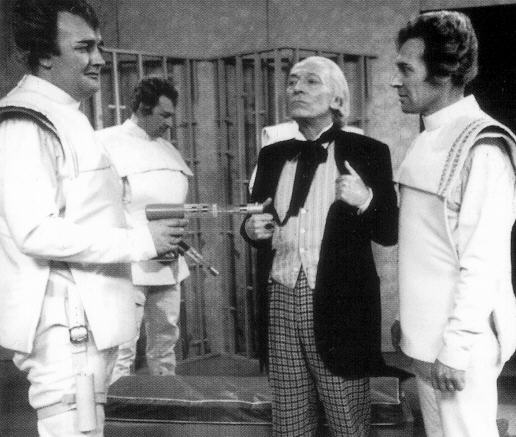
 This is another misjudged gem, in my humble opinion, a story where an ingenious script and still fascinating science fiction concept rises above a low budget. To say that the story looks cheap is fair enough, but to accuse it of bad special effects is quite another. The judge of a good effect is not spectacularity, for how many times have Dalek stories been spoiled by the sight of enormous explosions emerging from unfeasibly small bombs (or more frequently from the nearest large box-like object to them). Yes, "The Space Museum" has few visual effects after episode one, but that's primarily because it doesn't need them.
The acting might be a bit wooden in some places, but other performances:
Barbara, the Doctor, Ian, Maureen O'Brien's for once superlative Vicki, and governor Lobos more than make up for the shortfall, and the dialogue is wonderful, creating a sense of real people trapped in a real, if fantastical situation. Yes, there are bad lines:
"The universe is huge", for instance, but they're more than outweighed by the strengths of the story, and no, I'm not just talking about episode one. The writing is, for the most part, wonderful, with keenly judged use of humour bringing a highly stylised, surrealistic air to the proceedings which is exacerbated by the for once highly appropriate stock music. Yes, the rest of the story is formulaic in the extreme, but given the central idea that the TARDIS crew have accidentally landed after the end of a routine adventure which went horribly wrong, that, surely, is the whole point. If the Moroks were the most deadly foe they had ever faced, then they would detract from the central scenario, as well as losing their highly comic presence. They are just 'agents of destiny'; in this story it is time herself who is the real enemy.
This is another misjudged gem, in my humble opinion, a story where an ingenious script and still fascinating science fiction concept rises above a low budget. To say that the story looks cheap is fair enough, but to accuse it of bad special effects is quite another. The judge of a good effect is not spectacularity, for how many times have Dalek stories been spoiled by the sight of enormous explosions emerging from unfeasibly small bombs (or more frequently from the nearest large box-like object to them). Yes, "The Space Museum" has few visual effects after episode one, but that's primarily because it doesn't need them.
The acting might be a bit wooden in some places, but other performances:
Barbara, the Doctor, Ian, Maureen O'Brien's for once superlative Vicki, and governor Lobos more than make up for the shortfall, and the dialogue is wonderful, creating a sense of real people trapped in a real, if fantastical situation. Yes, there are bad lines:
"The universe is huge", for instance, but they're more than outweighed by the strengths of the story, and no, I'm not just talking about episode one. The writing is, for the most part, wonderful, with keenly judged use of humour bringing a highly stylised, surrealistic air to the proceedings which is exacerbated by the for once highly appropriate stock music. Yes, the rest of the story is formulaic in the extreme, but given the central idea that the TARDIS crew have accidentally landed after the end of a routine adventure which went horribly wrong, that, surely, is the whole point. If the Moroks were the most deadly foe they had ever faced, then they would detract from the central scenario, as well as losing their highly comic presence. They are just 'agents of destiny'; in this story it is time herself who is the real enemy.
Of course, there are faults. The rather vile costume design for one thing, and the snivelling Xerons for another. However, even these are more failed ideas than straightforward mistakes. The whole concept was of a gone-to-seed empire, with soldiers so ill-trained that Ian Chesterton can outmatch four of them at once. It may look odd, but it is a nice change to have an enemy universally acknowledged as pathetic. Like "The Romans" and "The Web Planet", "The Space Museum" is an experiment, this time in literary SF and, in my own personal opinion, a rather successful one. Compare and contrast with "The Happiness Patrol", and explain one thing that's wrong about one and good about another.