|
|
|
|
|
This is a temporary mirror of this page from the Tracker
Trail website.
The rest of the Tracker Trail website is located at
http://trackertrail.com |
|
|
|
Wilderness Survival - Fire |
|
Can of Coke and a Chocolate Bar
|
|
|
|
Yes, you CAN make a fire from a can of coke and a chocolate bar!
This idea was originally proposed by Andre Bourbeau to
Rob Bicevskis about 6
years ago. I don't know if he is the one that came up with it in the first
place. Thanks to Rob for bringing this method to my attention. The original
concept was to investigate unique and unusual ways of making fire using
everyday objects that one might be carrying around, should one be stranded
in the wilderness. Of course, prudent hikers will probably be carrying a
lighter or matches. :)
To make fire from a can of coke and a chocolate bar is actually
quite easy, and you don't need any tools.
However, you do need some sunlight and some
tinder
when you're actually ready to start a fire!
For the doubters reading this page, at the bottom are comments from people
who have actually done it. In addition,
Rob Bicevskis,
who passed this concept onto me, has done it. It's his hands you see in the
demo farther down the page.
|
|
|
 |
The can....
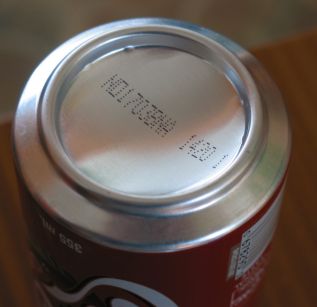
The key to this is the bottom of the coke can (by the
way, any pop can will do), which is
ideal for reflecting and concentrating the sun's light and energy.
Here is a photo of a coke can bottom. Note that it has a
slightly dull finish. In its present condition it is not shiny enough
to concentrate the sun's rays enough to ignite tinder.
That's where the chocolate bar comes in ....
|
|
|
|
 |
The chocolate bar....
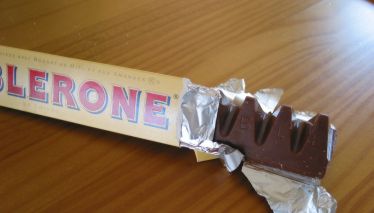
The can bottom is not shiny enough to function as a good reflector
and concentrator of sunlight. It needs polishing. The chocolate does an excellent
job of this. So, simply break off a piece of chocolate and use it to
polish up the can bottom!
P.S. Any type of chocolate will do. Probably the purer it
is, the better. In that case, maybe a Toblerone bar isn't so great, as
it has nuts and honey in it.
|
|
|
|
|
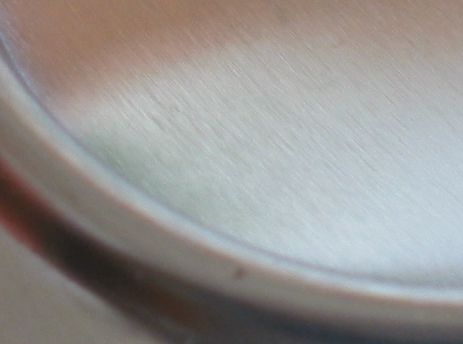
This is a close-up of the surface of an un-polished can's
bottom. Note the fine straight lines in the aluminum. These scatter
the sun's rays, and prevent them from being focused together into a
single bright point.
This is why the can needs polishing.
Compare this to the picture below of a polished can
bottom.
|
|
| |
|
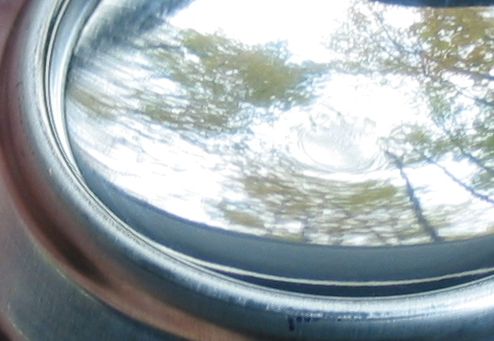
Here is a close-up of a polished can bottom.
Compare this to the picture above of an un-polished can
bottom. There's a big difference.
|
|
|
|
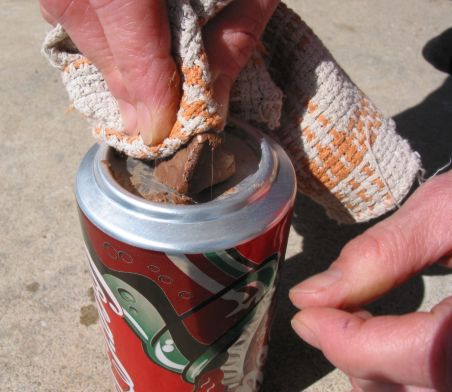 |
Polishing the bottom of the can.
Note: For polishing the can, one needs to
use the wrapper (or something else) in the process. Just rubbing chocolate on the bottom
of the can won't do too much. The process is to smear some chocolate
on the bottom, then use the wrapper (or whatever) as a "cloth" to do the
polishing. Every now and then, one needs to add a bit more of the
"abrasive." As a reference point, it will probably take ½-1
hour or more to finish the process.
Toothpaste also works as a
good polish.
|
|
|
|
|
|
|
|
|
|
|
|
|
|
|
|
|
 |
|
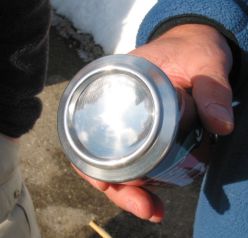
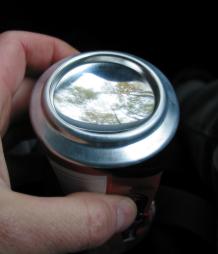
All polished and shiny.
|
|
|
|
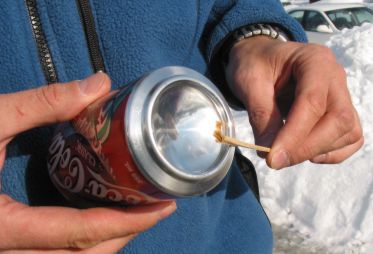 |
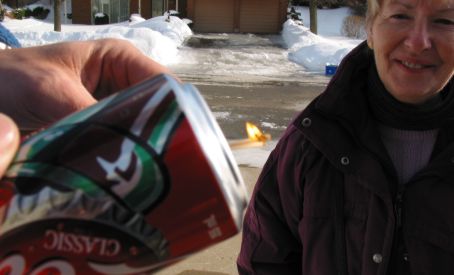
How to actually make fire...
Hold a piece of suitable tinder, such as a fragment of
tinder
fungus, at the focal point of the can bottom -- about 1 -
1.25" away from the center of the "bowl".
One doesn't need to use tinder fungus. To
keep to the core of the challenge, one can use pieces of the chocolate
wrapper to get a coal. If the chocolate bar has a black paper insert,
this is of course the best due to the dark colour. It takes a bit
longer with the wrapper - but, as with a magnifying glass, many things
can be used.
|
|
|

|
Holding the small piece of
tinder
fungus is easier with a long thin stick with a small split in the
end, such as is shown in this photos.
|
|
|
|
|
|
After a very short time (only a few seconds
in the bright sun), the
tinder
fungus will be smoldering. Then transfer it to a tinder bundle and
blow it into flame (if you're using a large enough piece of
tinder
fungus). If you're using a very small piece, then transfer the
ember to a larger piece by holding the two pieces together and blowing
on them.
Alternatively, you could use a small bundle of very volatile
tinder.
For more info about
Tinder,
click here.
|
|
|
|
|
... And that's all there is to it!
For something slightly different to do with a pop can, yet still related to
fire, go to
this
page on PCTHiker.com, where the author describes how to make an alcohol
backpacking stove from a Pepsi can.
|
|
|
|
|
Here is an email exchange with "Billy", who tried this
method with success. At first, he had trouble figuring out how to do it, but
with a little help, he then went out and actually got fire!
Email received February 25, 2003:
That's pretty neat. Ok guys, I've tried for two days to figure the coke can
fire thing out. You have stumped me to never ending on this one. It's wore
me to the bones now. Has anyone figured it out yet? This would be neat to
know and show youngsters and scouts. It appears that there is a oval shaped
glass in the indention in the bottom of the can. Or a liquid of some kind. I
just can't tell from the picture. Of all the fire making techniques I've
done and learned in the military I've gotta say this one is the neatest
sounding and one I've never heard of. Could you please let me in on it? I'd
like to test it and see if it works before I have to deploy again. Thank you
very much for your time. Billy.
Reply back to "Billy":
The key question to ask here is ... how did the bottom of the coke can get
shiny? Well, the bottom of the coke can happens to be an excellent
reflector. That is once it is shined up. It's not shiny enough as it comes.
That's the job of the chocolate bar. Apparently chocolate can act as a
polish. :) So, once you've shined it up....you hold a small piece of tinder
at the focal point of the parabolic reflector, in the sun, and you'll get a
coal.
Email received on February 26, 2003:
Ohhhhhhhh MAN!!! That "was" my first guess because I know that the
bottom of a can is not shiny like you are mentioning (I didn't think of
using a chocolate bar, I just thought the bottom needed shinning up somehow
first). It appears that there is trees reflecting off of it in the picture.
But I "never" thought of using a chocolate bar to do such a thing.
That is wild. Who would've ever guessed such a thing? That's neater than
sliced bread. I made it harder than it should have been apparently. I'm
going to polish one up to see how it does right now. I'll use some Hershey's
Kisses, they're chocolate, extremely chocolaty at that. I'll have to wait
for the clouds to leave this week to try it though. This will be most
interesting. Wonder if the cold weather will effect the out come even if one
has a bright sunny day. I've never used a reflector method in the winter
time months. I'll let you know eventually how it turns out. You did well :-)
Good stumper bro. That is a good one. Thanks friend for your time and info.
What a deal :-)
Billy.
A subsequent email received March 2, 2003:
Soda can & Chocolate bar fire "Does Work" :-)
The coke can (any soda can) and chocolate bar fire "DOES WORK". I
just now did it. Finally got some sun around here. It's like 45 degrees
outside, partly to mostly sunny today and I just made a nice coal and fire
with red cedar bark over the soda can about 1" to 1 1/4" over the
center of the dish of the can (to concentrate the focal point). I rolled the
small amount of bark up like a thick cigarette a couple inches in length.
Folded it over on itself (like you would see twist tobacco done). Tested
focal point with finger, Ouch! that burned, dang it! Pointed can toward the
sun and brought the bark in from the side (as not to block the suns rays
with my fingers in the way), rolled the bark around a bit to find a good
surface area for the focal point of the light to hit flat and good. Bam! no
time flat that sucker was a small coal. Worked quite well actually. Put in
other tinder ball, made fire. So there ya go, it does work. BBB.
|
|
|
|
|
|
|
The following email was received from "Bob" in March
2004: We've been teaching "fire without matches" to new Boy
Scouts in our troop (T513, Austin, TX) for several years now. As you might
expect with 11-year-old boys, the kids love it. This year someone brought me
a printout from your website with instructions on the coke can and chocolate
bar method of starting a fire. Looked interesting, so we added it to our
instruction mix and gave it a try...
Worked like a charm. Since we needed to prep a number of cans for our
classes, we cheated a bit and started our polishing with Comet cleanser,
then moved up to a "whitening" toothpaste before finishing off with
chocolate. On a bright Texas winter day, about 60 degrees with no clouds,
the cans gave us flames (not just embers) on pieces of shredded inner bark
from Texas cedar in just 1-2 minutes. Very consistent, if a bit fattening! |
|
|
|
This is a temporary mirror of this page from the Tracker
Trail website.
The rest of the Tracker Trail website is located at
http://trackertrail.com |
|

|

