Siucxtrasm_trans.gif (2780 bytes)Off-Campus Academic Programslogomotto.gif (9325 bytes)

Independent Study Programs
at
Goodfellow Air Force Base


What is a Persuasive Paper?

Summer 2000

FACULTY:

Fred L. Wilson, Ph.D.
4022 Townview Lane
Suite 2092
San Angelo, TX 76901
(915) 223-9325
e-mail: fwilson@airmail.net


     A persuasive paper, because of its intended purpose, tries to do certain things. That implies there is a best way to construct one (Houp, Pearsall and Tebeaux 1995). You should read the chapter about argument in their book if you can find a copy. If not, try to find a comparable book. Read all you can about this kind of paper. It is the most important kind of paper you, as a manager, will write.

     Why? Because a manager makes recommendations; he or she has to support decisions made. Most importantly, he or she has to achieve cooperation of the people in the organization. This means persuasion, so you can see how important it is to you to understand what a persuasive argument is and how to be successful in arguing your position.

     First, a persuasive paper is based on an opinion that you have, not a verifiable fact. "Your purpose in argument is to convince your audience of the probablity that the opinions you are advancing are correct" (Houp et al., 1995, p. 162). The main opinion is called the major premise or proposition. Sometimes it is called an hypothesis. Once you have identified the major premise you must identify minor premises that suport the major premise. These minor premises are also opinions, but they are closer to verifiable fact. Finally, you must present documented evidence that supports each of these premises.

     Obviously, the major opinion you choose to argue in favor of must be related to your academic program -- management. You must be able to answer the following questions before you can write a credible paper persuasive paper.

  1. What is the major premise/opinion of this paper?
  2. What are the minor premises that support the major premise?
  3. What evidence can be presented to support these premises?

     All of the evidence you offer must answer the question, Why should your major premise be believed?"

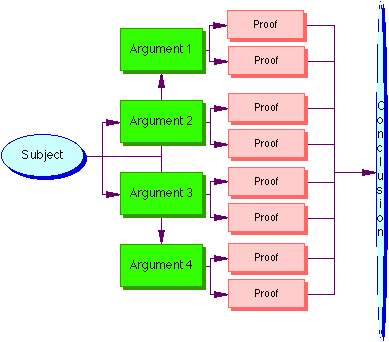
     Now take a look at a generic outline for a persuasive paper.


Generic Example of an Outline for a Persuasive Manuscript


Title

  1. Introduction

    1. Introductory remarks that identify your topic

    2. Your reasons for choosing the topic

    3. Identification of the major premise

    4. Identification of the minor premises

  2. Statement of and elaboration on the major premise

  3. Statement of minor premise #1

    1. Evidence to support premise #1

    2. Evidence to support premise #2 (and so on)

  4. Statement of minor premise #3

    1. Evidence to support premise #3

    2. Evidence to support premise #3 (and so on)

  5. Continue with the minor premises until all have been stated and evidence supporting them has been given.

  6. Conclusion -- Identify the conclusions you have reached.


Partial example of a persuasive paper's outline.

Outline musst be fully documented


Companies Must Change and Innovate to Remain Successful

  1. Introduction

      To quote Daft (1994), "To be successful, organizations must embrace many types of change" (p. 362). These changes can reange from using better production methods to improving the skills of their employees. These types of changes have been made by companies such as Westinghouse, Black & Decker, Intel, and Merck.

    1. While change in inevitable, it can still be managed. Companies must be alert to trends and customer needs that are evolving so that managers can plan the changes required in their organizations to meet these perceived trends and patterns. If organizations do not identify to these environmental changes, it is due to management's failure (Daft, 1994). Because of this responsibility managers must be aware of and able to make whatever changes are necessary to keep their organizatioins competitive and, consequently, successful.

    2. It is this writer's opinion that companies must change and be inovative to remain competitive and successful.

    3. In support of the major premise the following minor premises are offered.

      1. Companies that have produced new products to meet customer needs have prospered generally.
      2. Changes in technology can make production more efficient and reduce costs.
      3. Structural changes within the organization may be needed to remain competitive.
      4. Finally, because people and cultures change, companies need to adapt (Daft, 1994).

  2. It is this writer's belief the companies must change and be innovative to remain competitive and successful. Over the past twenty to thirty years there have been enormous changes in the products available to society. The companies that have produced these new products are the ones that have survived and prospered. Companies that were unable or unwilling to develop new products or technologies are no longer in business (Daft, 1994)

  3. Companies that have produced new products to meet customer needs have prospered generally

    1. Evidence -- You must include actual evidence here to support the premise above.
    2. Evidence -- You must include actual evidence here to support the premise above.

  4. Changes in technology can make production more efficient and reduce costs.

    1. Evidence -- You must include actual evidence here to support the premise above.
    2. Evidence -- You must include actual evidence here to support the premise above.

  5. Structural changes within the organization may be needed to remain competitive.

    1. Evidence -- You must include actual evidence here to support the premise above.
    2. Evidence -- You must include actual evidence here to support the premise above.
    3. Evidence -- You must include actual evidence here to support the premise above.

  6. Because people and cultures change, companies need to adapt

    1. Evidence -- You must include actual evidence here to support the premise above.
    2. Evidence -- You must include actual evidence here to support the premise above.
    3. Evidence -- You must include actual evidence here to support the premise above.

  7. Conclusions -- here the writer will state the conclusions reached.

NOTE: Additional evidence should be added as you do more research. Remember that the body of the manuscript must be at least seven (7) full, double-spaced pages long. That excludes the introduction and conclusions and of course abstract and references.


References


Houp, W., Pearsall, T. E., & Tebeaux, E. (1995). Reporting technical information (8th ed.). Boston, MA: Allyn & Bacon.


Reasons Why This is a Bad Persuasive Paper

For one thing, this paper does not have an introduction. I'm not quite sure if I use strong, emotional words or not. This also be having bad grammar and have bad speling and this is a bad paper and has lots of runon sentences and is a bad paper. This is a bad paper, and I have a tendency to repeat myself. After all, this is a bad paper. it is not dubble spaced so all the words are crammed together and it is hard to read and the font is not standard--it is unusual, therefore it is a bad paper. It might be a good paper, though. But it is a bad paper because the opinion that this is a good paper is not clearly stated, so it is a bad paper. It does not have a sound opinion. My computer is bad, so this is a bad paper, and it uses faulty cause and effect and circular reasoning so it is a bad paper. A very important point is as follows: this paper is a bad paper because it is a bad paper because it is a bad paper because it....I back up my opinion that this is a good paper with the following facts: 1) This is a bad paper. 2) This is a bad paper. I got those impresive facts from a survey of my past english teechers. All of them aggree that I be having well grammer and speling skils. I have always been a bad riter, so this is a good paper. I never use faulty cause and effect, and I never repeat myself. Also, I never repeat myself. Therefore, this is a bad paper. This paragraph is way to long and I always forget to indent, so it follows that this is a bad paper. I have po or typinng skils and I get the letetrs of the wurds mixxed up. This is a good paper because it is a bad paper, so I conclude from the following that the Bill of Rights should be amended. This paper is confusing to the reader and it leads them to believe that this a poorly written paper, which proves my point. This paper motivates all readers to believe that this is a bad paper, therefore it makes it extremely effective and a good paper. I believe I should receive an A on this assignment because this is a well-written, bad paper. It is extremely persuasive and I prove my point lots of times. I never repeat or contradict myself or use bad grammer or speling or anything else that is badder. This is a very good paper, but it is also a bad one so it is a good paper. No one can disaggree with the fact that this is a poorly writen, well paper. Either this paper gets an A, or it gets an F, because this is a bad paper. It is a good paper because I never use either/or errors or any other things. All persuasive papers, including this one, are bad because they use overgeneralization. I infer that this is a good paper, and I conclude that this is a bad one, so I will avoid confusion for the reader and contradicting myself. Bad sentence fragments. Short sentences are bad. Choppy sentences are bad. Many short, choppy sentences are bad. This paper is bad. This paper is bad because I have errors in reasoning and weak opinions, and it just isn't good enough. I think I should get an A. It also has a bad ending, so I should get an F. This is a bad paper because it is a good paper and is not a bad paper. The end. I begin this paper by stating the opinion that figure skaters should not be allowed to wear ice skates during performance because they are dangerous weapons and could injure someone. This is also a bad paper because I have facts that do not apply to the paper. 4+4=8, therefore Louisiana History classes should be eradicated. Using big words that don't sound right sounds ludicrous and makes you look completely imbecilic. Therefore, this is a bad paper and women's rights should be enforced. Therefore, teens should not be able to stay out past 7:00 a.m. on school nights because they might not be able to go to sleep that night. I conclude that this is a poorly written paper that deserves an A because it is an unfair world.
The End
(finally!)


Number of Visitors to this Site


Contact me at: fwilson@airmail.net
Last Revised May 16, 2000