|
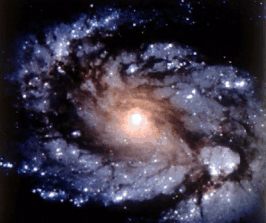
Concerning the creation of the heavens and the earth, the Qur'an says that prior to the creation, the Heaven was smoke. God then commanded it and the earth to come into being and they came willingly (see surah 41:1 1). How does that compare with modern scientific explanations? Let us hear a scientific explanation and then judge for ourselves.
Dr. Bucaille
explains the connection between his description and that of the Qur'an
as follows: "Smoke is generally made up of a gaseous substratum, plus,
in more or less stable suspension, fine particles that may belong to solid
and even liquid states of matter at high or low temperature" (p. 143).
We
notice here two remarkable features of the Qur'an. The first feature is
that it expresses scientific truths that will be verified many centuries
later. The second feature is that the Qur'an expresses those truths using
terms and expressions that would avoid confusing its first readers in the
seventh century. The seventh century reader of the Qur'an can easily
relate to the image of smoke, and the twentieth century scientist can easily
interpret the word as a gaseous mass.
|