| Today we know that the Moon revolves around the earth
in approximately 29.5 days. The sun also revolves in its own orbit. To
understand the sun's orbit, Dr. Bucaille says that the position of the
sun in our galaxy must be considered, and we must therefore call on modern
scientific ideas (The Bible, the Qur'an and Science, p. 162).
Our galaxy, the milky way galaxy, includes one hundred billion stars
situated in such a formation that the galaxy is shaped like a disc. This
disc turns around its center like a gramophone record. Now, it is obvious
that when a gramophone record turns, any point on the disc would move around
and come back to its original position. Similarly, every star in the galaxy
moves as the galaxy rotates on its axis. Therefore the stars that are away
from the center of the galaxy orbit around the axis. The sun is one of
those stars.
"The above is the orbital movement of the sun that was already referred to in the Qur'an fourteen centuries ago." (The Bible, the Qur'an and Science, p. 162)
And yet this is a new finding. As Dr. Bucaille says, the knowledge of the
sun's orbit is an acquisition of modern astronomy (The Bible, the Qur'an
and Science, p. 162).
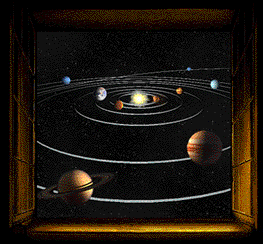
Two verses in the Qur'an refer to the orbits of the sun and moon. After mentioning the sun and the moon, God says: "Each one is travelling in an orbit with its own motion" (Qur'an 21:33; 36:40). How did the author of the Qur'an know of this? Even after the Qur'an was revealed, early commentators could not conceive of the orbits of the sun and moon. The tenth century commentator Tabari could not explain this so he said, "It is our duty to keep silent when we do not know" (XVII, 15 quoted in The Bible, the Qur'an and Science, p. 161). Dr. Bucaille comments: "This shows just how incapable men were of understanding this concept of the sun's and moon's orbit." (The Bible, the Qur'an and Science, p. 161). From this it is clear that if the Qur'an was here expressing an idea already known to the people, the commentators would have easily understood it. But this, as Dr. Bucaille explains was "a new concept that was not to be explained until centuries later" (The Bible, the Qur'an and Science, p. 161) This confirms what God said to his prophet, on whom be peace: "This
is of the tidings of the Unseen which we inspire in you (Muhammad). Neither
you nor your people knew it before this" (Qur'an 11:49).
THE SUN & MOON MOVE WITH THEIR OWN MOTION
The phrase "travelling with its own motion" in the verses quoted
above is a translation of the Arabic verb 'yasbahoon'. This could also
be translated 'they swim.' In that case, the verse would read that the
sun and the moon, "Each swim in its own orbit." Those who translate
the verse this way explain that the term swim refers to movement with one's
own internally generated force. Furthermore the movement of a swimmer is
graceful, measured, and smooth. This is a very fitting description for
the movement of the stars and planets including the sun and the moon.
It is also amazing that the Qur'an uses a different term for the movement of the clouds and the mountains (see Qur'an 27:88). Obviously, the clouds and mountains are driven by external forces. The cloud is driven by the wind and the mountains move with the rotation of the earth. The sun and moon, however, move with their own motion, and therefore the Qur'an uses a peculiar term "they swim" to refer to their smooth, graceful, self-propelled movement. How did the author of the Qur'an know enough to make this choice of
words that will reflect a modern scientific truth? The Qur'an is no less
than a revelation from God.
1. The Moon's Orbit.
2. The Sun.
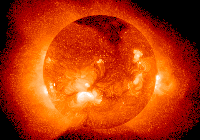
The Sun occupies a position in it which is far removed from the centre of the disc. The galaxy revolves on its own axis which is its centre with the result that the Sun revolves around the same centre in a circular orbit. Modern astronomy has worked out the details of this. In 1917, Shapley estimated the distance between the Sun and the centre of our galaxy at 10 kiloparsecs i.e., in miles, circa the figure 2 followed by 17 zeros. To complete one revolution on its own axis, the galaxy and Sun take roughly 250 million years. The Sun travels at roughly 150 miles per second in the completion of this. The above is the orbital movement of the Sun that was already referred to by the Qur'an fourteen centuries ago. The demonstration of the existence and details of this is one of the achievements of modern astronomy. The Moon completes its rotating motion on its own axis at the same time as it revolves around the Earth, i.e. 29.5 days (approx.), so that it always has the same side facing us. --The Sun takes roughly 25 days to revolve on its own axis. There are certain differences in its rotation at its equator and poles, (we shall not go into them here) but as a whole, the Sun is animated by a rotating motion. It appears therefore that a verbal nuance in the Qur'an refers to the Sun and Moon's own motion. These motions of the two celestial bodies are confirmed by the data of modern science, and it is inconceivable that a man living in the Seventh century A.D.--however knowledgeable he might have been in his day (and this was certainly not true in Muhammad's case)--could have imagined them. This view is sometimes contested by examples from great thinkers of antiquity who indisputably predicted certain data that modern science has verified. They could hardly have relied on scientific deduction however; their method of procedure was more one of philosophical reasoning. Thus the case of the Pythagoreans is often advanced. In the Sixth century B.C., they defended the theory of the rotation of the Earth on its own axis and the movement of the planets around the Sun. This theory was to be confirmed by modern sciece. By comparing it with the case of the Pythagoreans,it easy to put forward the hypothesis of Muhammad as being a brilliant thinker, who was supposed to have imagined all on his on his own what modern science was to discover centuries later. In so doing however, people quite simply forget to mention the other aspect of what these geniuses of philosophical reasoning produced, i.e. the colossal blunders that litter their work. it must be remembered for example, that the pythagoreans also defended the theory whereby the Sun was fixed in space; they made it the centre of the world and only conceived of a celestial order that was centered on it. It is quite common in the works of the great philosophers of antiquity to find a mixture of valid and invalid ideas about the Universe. The brilliance of these human works comes from the advanced ideas they contain, but they should not make us over look the mistaken concepts which have also been left to us. From a strictly scientific point of view, this is what distinguished them from the Qur'an. In the latter, many subjects are referred to that have a bearing on modern knowledge without one of them containing a statement that contradicts what has been established by present-day science. Back to Islam & astronomy |