|
“We created man from an extract of clay. Then We
made him as a drop in a place of settlement, firmly fixed. Then We made
the drop into an alaqah* (leech, suspended thing, blood clot), then
We made the alaqah into a mudghah** (chewed, lump)” ( QURAN,
23:12-14)
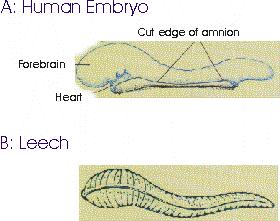
| In comparing a leech to the embryo at the transitory stage (alaqah)
we find similarity between the two. (1)
Also, the embryo at this stage obtains nourishment from the blood of
the mother, similar to the leech which feeds on the blood of others. (2)
The second meaning of the word alaqah is “suspended thing”... The suspension
of the embryo, during the alaqah stage, in the womb of the mother. (3) |
|
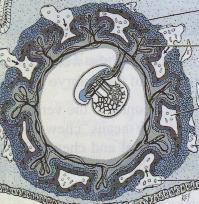 |
Suspension of an Embryo during the early stages in the womb of the
mother. (About 15 days old) The actual size of the embryo is about
0.6mm. |
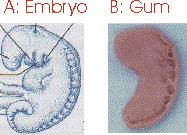
| When comparing the appearance of an embryo at the mugdah stage with
a piece of gum that has been chewed, we find similarity between the two.
“We created man from an extract of clay. Then We made him as a drop
in a place of settlement, firmly fixed. Then We made the drop into an alaqah
(leech, suspended thing, blood clot), then We made the alaqah into
a mudghah (chewed, lump)” (23:12-14) |
 |
We find that the external appearance of the embryo and its sacs during
the transitory stage (alaqah) is similar to that of a blood
clot. This is due to the presence of relatively large amounts of blood
present in the embryo during this stage. (4)
| The blood in the embryo does not circulate until the end of the third
week. (5)
Thus the embryo is like a clot of blood at this stage!
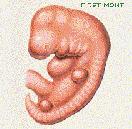
The embryo at the mudghah stage acquires the appearance of a chewed-like
substance because of the somites at the back of the embryo that “somewhat
resemble teethmarks in a chewed substance.” (6) |
|
* Alaqah : Bloodsucker (Pg.92), Suspended
(Pg.745), Clot (Pg.146). Elias Modern Dictionary,
E-A, 1992
** Mudghah : Chewed (Pg.137) Elias Modern Dictionary, E.A,
1992
(1) The developing Human, Moore and Persaud, 5th ed., Page:8
(2) Human Development as described in the Quran and Sunnah, Moore and
others, Page:36
(3) A brief guide to understanding Islam with colorful illustrations,
I. A. Ibrahim, Page:6
(4) Human Development as described in the Quran and Sunnah, Moore and
others, Page:37-38
(5) The developing Human, Moore and Persaud, 5th ed., Page:65
(6) The developing Human, Moore and Persaud, 5th ed., Page:8
40 DAYS IN THE WOMB
Joe Leigh Simpson, Professor of Obstetrics and Gynecology
at the North Western University in Chicago in the United States of America.
As we know, these chromosomes contain all the characteristics which the
new human being will have such as the color of the eyes, skin, hair,etc.
Hence, many of the details in the human being’s make-up are determined
in his chromosomes. These chromosomes begin to form during the early nutfah
stage of embryonic development. In other words, the distinguishing features
of the new human being are determined from the very beginning at the nutfah
stage. Allah, the Most Exalted, the Most Glorified, has stated this fact
in the Qur’aan:
During the first 40 days of gestation, all the body parts and organs
are completely, though
consecutively formed. The Prophet Muhammad, (sallallahu ‘alaihi wa
sallam), has informed us in a hadeeth that: In every one of you,
all components of your creation are gathered together in your mothers’
womb by 40 days. (Narrated in Saheeh Muslim and Al-Bukhaari).
In another Hadeeth, Prophet Muhammad (sallallahu ‘alaihi wa sallam)
said: When forty-two nights have passed over the drop (nutfah), Allah sends
an angel to it, who shapes it and makes its ears, eyes, skin, flesh and
bones. Then he says, "O Lord, is it male or female?" and your Lord decides
what he wishes. (Narrated in Saheeh Muslim). Professor Simpson studied
these two hadeeths extensively, noting that the first 40 days constitute
a clearly distinguishable stage of embryogenesis. He was particularly impressed
by the absolute precision and accuracy of those hadeeths. Then during one
of the conferences which he attended he gave the following opinion:
So that the two hadeeths that have been noted can provide us with a specific
time table for the main embryological development before 40 days. Again,
the point had been made repeatedly by other speakers this morning that
these hadeeths could not have been obtained on the basis of the scientific
knowledge that was available at the time of their recording. Professor
Simpson says that religion can successfully guide the pursuit of knowledge.
The West, as we said, has rejected this. But here is an American
scientist who says that religion, namely Islam, can achieve this with success.
By analogy, if you go to a factory and have with you the operation manual
of the factory, then you will be able to easily understand the kind of
operation that goes on in that factory, thanks to that manual by the factory
designer and builder. But if you do not have this manual with you, chances
are much less that you will have good understanding of the various processes
there.
Professor Simpson said: It follows, I think, that not only is there
no conflict between genetics and religion, but in fact religion can guide
science by adding revelation to some traditional scientific approaches.
That there exists statements in the Qur’aan shown by science to be valid,
which supports knowledge in the Qur’aan having been derived from Allah.
This is true. I also say that the Muslims can lead the way in the pursuit
of knowledge and that they can accord knowledge its proper status. Moreover,
Muslims know how to use knowledge as proof of the existence of Allah, May
Allah be Exalted and Glorified, and to affirm the Messengership of Muhammad
(sallallahu ‘alaihi wa sallam).
|
|