|
The Qur’aan mentions the lowest part of the earth and states that
it is near Jerusalem, where a battle took place between the
Persians and the Greeks. Allah, may He be Exalted and Glorified, said in
the Qur’aan:
Alif
Laam Meem, the Romans have been defeated, in the lowest part of the land
(adnal-ardh), but after defeat they will soon be victorious.
(Qur’aan 30:1-3).
The term "adna"
means both nearer and lowest. The commentators of the Qur’aan, May
Allah be pleased with all of them, were of the opinion that "adnal-ardh"
meant the nearest land to the Arabian Peninsula. However, the second meaning
is also there. In this way, the Glorious Qur’aan gives one word several
meanings, as described by the Prophet Muhammad
(sallallahu
‘alaihi wa sallam) when he said:
I have been given
the most comprehensive words. {Al-Bukhaari and Muslim]
 |
When we investigated the lowest part of the earth, we found that
it was exactly the same spot that witnessed the battle in which the Romans
were defeated. When we informed Professor Palmer about this, he contested
saying that there were many other areas which are lower than the one referred
to in the Qur’aanic verse. He gave examples and names of other areas in
Europe and in the United States. We assured him that our information was
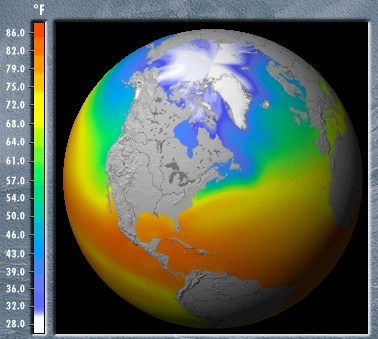
verified and correct. He had with him a topographical globe that showed
elevations and depressions. He said that it would be easy with that globe
to ascertain which was the lowest spot on earth. He turned the globe with
his hands and focused his sign on the area near Jerusalem. To his astonishment,
there was a small arrow sticking out towards that area with words: "the
lowest part on the face of the earth." |
Professor Palmer
was quick to concede that our information was correct. He proceeded to
speak, as you now see him with the globe, saying that this was actually
the lowest part of the earth.
Professor Palmer:
It took place in the area of the Dead Sea which is up here and interestingly
enough the labeling on the globe says "the world’s lowest point". So it
certainly is supported by the interpretation of that critical word.
Professor Palmer
was even more astonished when he found that the Qur’aan talks about the
past and describes how creation first began; how the earth and heavens
were created; how the water gushed forth from the depth of the earth; how
the mountains were anchored on land; how vegetation first began; how is
earth today, describing the mountains, describes its phenomena, describes
the changes on the surface of the earth as witnessed in the Arabian Peninsula.
It even describes the future of the land of Arabs and the future of the
whole earth. At this, Professor Palmer acknowledged that the Qur’aan is
such a wondrous Book which describes the past, the present, and the future.
Like many other
scientists, Professor Palmer was hesitant at first. But soon later he was
forthcoming with his opinions. In Cairo, he presented a research paper
dealing with the inimitable aspects of geological knowledge contained in
the Qur’aan. He said that he did not know what was the state of the art
in the field of science during the days of the Prophet Muhammad. But from
what we know about the scanty knowledge and means at that time, we can
undoubtedly conclude that the Qur’aan is a light of divine knowledge revealed
to Muhammad (sallallahu ‘alaihi wa sallam). Here are the concluding remarks
of Professor Palmer:
We need research
into the history of early Middle Eastern oral traditions to know whether
in fact such historical events have been reported. If there is no such
record, it strengthens the belief that Allah transmitted through Muhammad
bits of his knowledge that we have only discovered for ourselves in recent
times. We look forward to a continuing dialogue on the topic of science
in the Qur’aan in the context of geology. Thank you very much. |
|