|
BARRIER BETWEEN THE OCEANS
Modern Science has discovered that in the places where two different
seas meet, there is a barrier between them. This barrier divides the two
seas so that each sea has its own temperature, salinity and density.” (1)
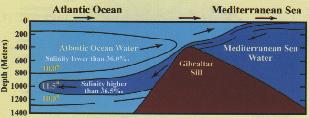
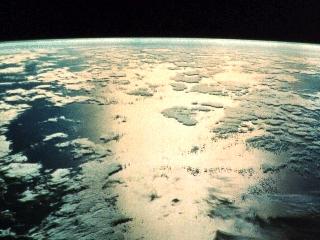
| Here we see the divider between theMediterranean and the Atlantic ocean.
In the middle of this photo we see a colored triangle, this is the base
of the rock of Gibraltar. We can observe a colored partition between the
two bodies of water, although the naked human eye cannot perceive it in
nature. |
|
This has become possible by means of satellite photography and remote-sensing
techniques. These are partitions that can only be seen and perceived by
scientific research and modern
technology.Allah has informed us in the Qur’aan that:
He has let free the two seas meeting
together: Between them is a barrier which they do not transgress.
(Qur’aan 55:19-20).
Traditionally, there have been two major interpretations of this verse.
The Qur’aan goes on to state that there is barrier between them, means
that this barrier will simply prevent the seas from encroaching upon
each other or flooding over each other.
|
Proponents of the second opinion ask how can there be a barrier between
the seas so that they do not encroach upon each other, while the verse
indicates that the seas meet together? They concluded that the seas do
not meet and sought another meaning for the term "maraja". But now modern
science provides us with enough information to settle this issue. The seas
do meet together, as we have seen, for example, in the picture of the Mediterranean
and Atlantic Ocean. Even though there is a slanted water barrier between
them, we now know that through this barrier the water from each sea passes
to the other. |
But when we the water from one sea enters the other sea, it looses
its distinctive characteristics and becomes homogenized with the other
water. In a way, this barrier serves as a transitional homogenizing
area for the two waters. This is an excellent example of Islamic modern
scientific research. Modern techniques can thus be used to prove the inimitability
of the Qur’aan.
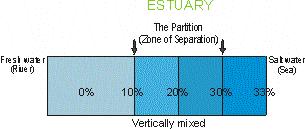
| Modern Science has discovered that in estuaries, where fresh (sweet)
and salt water meet, the situation is somewhat different from what is found
in places where two seas meet. |
|
It has been discovered that what distinguishes fresh water from salt water
in estuaries is a ”pycnocline zone with a marked density.
(2) discontinuity seperating the two layers.” This partition (zone
of seperation) has a different salinity from the fresh water
and from the salt water (3)
“He is the one who has let free the two bodies of flowing water,
one palatable and sweet, and the other salty and bitter. And He has
made between them a barrier and a FORBIDDING PARTITION.” QURAN
(25:53)
DARKNESS IN A DEEP SEA
|
“ Or is like the darkness in a deep sea.
It is covered by waves, above which are waves, above which are clouds.
Darkness, one above another. If a man stretches
out his hand, he cannot see it...” QURAN (24:40) |
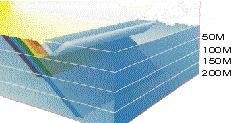
The darkness in deep seas and oceans is found around a depth of 200
metres and below. At this depth, there is almost no light. Below
a dept of 1000 metres there is no light at all. (4)
WAVES ABOVE WAVES
“ Or is like the darkness in a deep sea. It is covered by waves, above
which are waves, above which are clouds. Darkness, one above another. If
a man stretches out his hand, he cannot see it...” QURAN
(24:40)
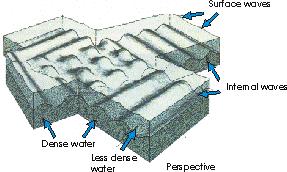
Scientists have only recently discovered that there are internal
waves which “occur on density interfaces between layers of
different densities. (5)
| The internal waves cover the deep waters of seas and oceans because
the deep waters have a higher density than the waters above them.
Internal waves act like surface waves. They can also break just like surface
waves. Internal waves cannot be seen by the human eye, but
they can be detected by studying temperature or salinity changes
at a given location. (6) |
|
(1) Principles of Oceanography, Davis, Page:92-93
(2) Oceanography, Gross, Page:242
(3) Oceanography, Gross, Page:244
(4) Oceans, Elder and Pernetta, Page:92-93
(5) Oceanography, Gross, Page:205
(6) Oceanography, Gross, Page:205
|
|