Bitterroot
Lewisia rediviva
Lewisia rediviva Pursh, Fl. Am. Sept. 2:368. 1814. (Lewis, "On
the banks of Clarck's River," = Bitterroot R., Mont.)
L. alba Kell. Proc. Calif. Acad. Sci. 2:115, fig. 36. 1863.
(No specimens or locality cited)
 Bitterroot,
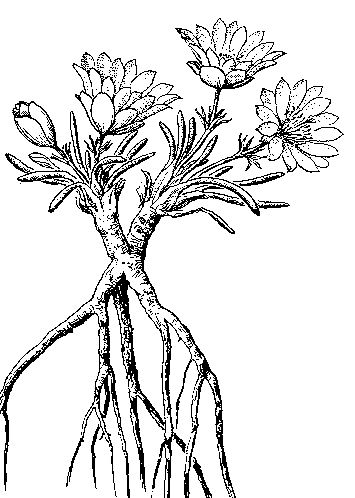
or rockrose, is an unusual plant which grows along rocky
ridges and in thin soils of basalt flats where it remains partially hidden
among the rocks or in rock crevices until beautiful and delicate flowers
are produced. Each flower has numerous petals, and stamen, and in this
respect the bitterroot resembles cacti. The petals are approximately 1
inch long and vary in color from nearly white to deep rose and often have
darker longitudinal stripes. The succulent leaves are small (1-3 inches
long), club-shaped, and inconspicuous. All are borne at ground level or
below from carrot-like roots. The fleshiness of the bitterroot reflects
he water storing adaptation which parallels that of cacti and other "desert"
succulents. The roots can survive extreme dehydration and because of this
ability the name rediviva was applied.
Bitterroot,
or rockrose, is an unusual plant which grows along rocky
ridges and in thin soils of basalt flats where it remains partially hidden
among the rocks or in rock crevices until beautiful and delicate flowers
are produced. Each flower has numerous petals, and stamen, and in this
respect the bitterroot resembles cacti. The petals are approximately 1
inch long and vary in color from nearly white to deep rose and often have
darker longitudinal stripes. The succulent leaves are small (1-3 inches
long), club-shaped, and inconspicuous. All are borne at ground level or
below from carrot-like roots. The fleshiness of the bitterroot reflects
he water storing adaptation which parallels that of cacti and other "desert"
succulents. The roots can survive extreme dehydration and because of this
ability the name rediviva was applied.
In the past, bitterroot was dug by plains Indians and
the roots were eaten after having been peeled and boiled. As the plants
age the roots become woody and bitter thus the plants were collected early
in the spring. The nutritious root is quite variable in its bitter qualities:
some of them will be so bitter as to render them unpalatable. In any case,
cooking removes most or all of the bitterness and improves the flavor.
The root should be boiled to a jelly-like consistency which will frequently
be of a pink color. The bitterness can be greatly reduced by peeling the
root before boiling, to expose the white, starchy, and somewhat mucilaginous
core. In early spring the bitter peel will slip off by vigorously rubbing
the root between the hands.
This species was collected by Lewis
and Clark along what is now known as the Bitterroot River in Montana. The
genus was named in honor of Captain Meriwether Lewis by the noted German-born
and -trained botanist Frederick Pursh.
Pursh was 33 years old working with
a Dr. Barton in Philadelphia when Thomas Jefferson's friend Bernard McMahon
wrote to Lewis recommending Pursh as the person to make scientific descriptions
of the plants collected on the Lewis and Clark expedition. Pursh is often
refered to as British since he published his well-known Flora
in London.
The attractive bitterroot - the
state flower of Montana - is widely distributed in the sagebrush steppe
and along adjacent montane ridges. It flowers in early summer, after most
lithosol associates.
Bitterroot
Valley of Montana, through the EYES OF LARRY JAVORSKY
Page by Don Woodworth
http://www.televar.com/~donew
Wenatchee Chapter Washington Native Plant Society
http://www.televar.com/~donew/wwnps.html