|
OLDE
WYTHE
COUNTY POORHOUSE FARM

The Dean Descendants link to the Poorhouse Farm is acknowledged in 1992, when Abner Bruce and Sarah Helen Johnstone Graham Jr. started restoring the Wythe County Poorhouse Farm. Sarah Helen Johnstone Graham's Great Grandfather Thomas Dean is linked to the Wythe County Poorhouse Farm from the beginning because the two farms Mudlick's Johnstone Farm and Bethel Community's Poorhouse Farm connected. |
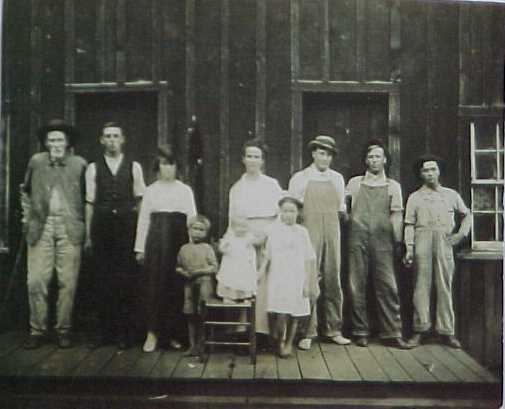
Pictured left to right Elkanah Graham - Abner Bruce Graham, Jr.'s Uncle Gracie Graham - Abner Jr.'s Aunt Abner Bruce Graham Sr., born September 28, 1911 - his Dad Jimmy Graham, Baby in Chair, - Elkanah's son Luemma Adeline Dean Graham - Abner Bruce Graham Jr.'s Grandmother (standing behind the chair holding on to her grandson) Elsie Graham - Abner Jr.'s aunt Walter Houseman - (ran
shovel for oar mines-boarder at this time, he later married Dellie Graham,
Abner Jr.'s aunt - Aunt Dellie said she was bashful and hid when this photograph
was taken. She is the lady who shared so many family stories with us and gave
us this and other family photographs.I made her copies and wrote one of my
short stories for her. Aunt Dellie Graham Houseman Graham also gave us the
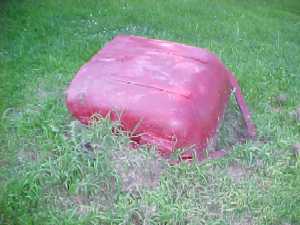
old fodder chopper used by the Adams and the Graham Family. We have it on
display at the LIVING HISTORY BOOK and the Wythe County Poorhouse Farm for
all to see. 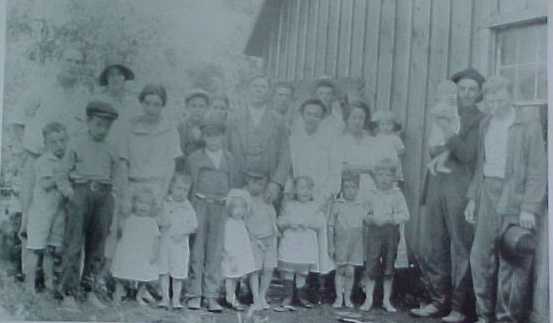
1927, in Locust Hill, Max Meadows, VA 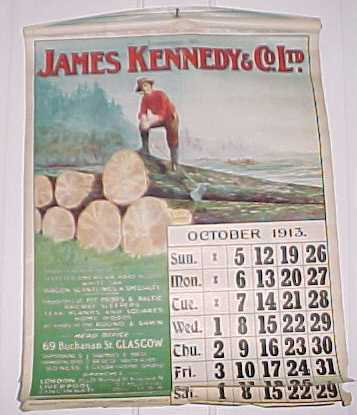
William Allen Crenshaw and Bessie Vance Johnstone Crenshaw, caretakers lived in the Main House at the Wythe County Poorhouse Farm....October, 1913. Abner Bruce Graham Jr. and Sarah Helen Johnstone Graham, caretakers live in the Main House of the Wythe County Poorhouse Farm....October, 2001.... Bessie and Sarah Helen both grew up in the Mudlick Section of Wythe County, VA on the Johnstone Family Farm!! Statue of Liberty Statue of Liberty - Frederic Bartholdi Barbara Bartholdi Crockett's ancestors (Sister-in -Law to Jennie Lou Crockett Morris) 
Isabel Cannoy McAllister Isabel Cannoy McAllister
is standing on the porch of the Tenant House at the Wythe County Poorhouse
Farm where her Dad, Elbert Cannoy worked for Wythe County much of his life.
He was paid by the Wythe County Board of Supervisors. We have documented
records of this as well as the years of memories shared by Isabel's sisters,
relatives and friends. T. A. Turley said he remembers watching "Eb" Cannoy
do blacksmithing work in the back of the olde wash house. The Turley Family
in the 1950s lived near the Poor Farm. The Turley Farm is now Progress Park,
the newest Industrial Park in Wythe County, VA. The olde table with hinged
top used by "Eb" in the olde Wash House is still a part of the LIVING HISTORY
BOOK at the Wythe 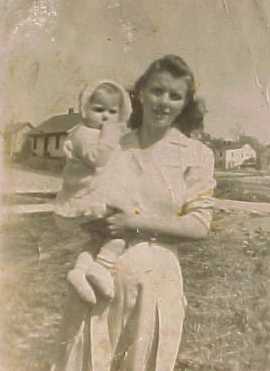
Helen Peary Hancock Johnstone and baby Sarah Helen Johnstone
Helen Peary Hancock Johnstone
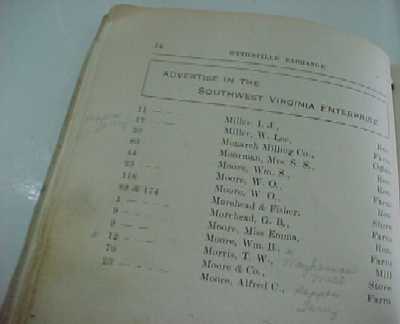
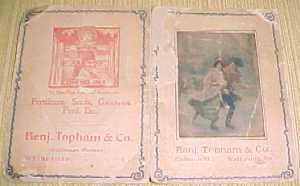
1913 Telephone Book, Wythe County, VA
Maykensaw Mill - T. W. Morris - 1913 Telephone Book, Wythhe County, VA 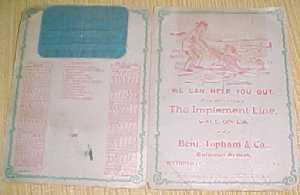
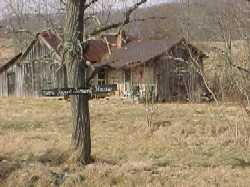
This second built
Wythe Poorhouse Farm Tenant House does still stand. Poorhouse Farm History Notes by Sarah Helen:
Oral history has it that Will Crigger came to work at the Poorhouse Farm shortly
after William Allen Crenshaw became overseer of the Wythe County Poorhouse
Farm in the late 1800s. When William Albert Crigger at Crenshaw's retirement
was promoted to overseer of the Poorhouse Farm in 1930, the Crigger/Cassell
family moved into the main
Elbert Richard Cannoy and Mary Jackson Cannoy and their family moved into
this Tenant House from the one that was built by Wythe County in Shoestring
Bottom. Both houses were built for full time paid labor for the Wythe Poorhouse
Farm. "Eb" Cannoy as he was fondly called worked for the County Farm most
of his life. Mr. T.A. Turley shared many James Crigger and Ethel Cline Crigger and their family also lived in this Tenant House. Little Jim as he was called also worked for the Wythe County owned Poorhouse Farm. Ethel also remembers making lye soap, she gave me a piece she had made in the 1930s to be added to our LIVING HISTORY. There are many other names in our historical records of men and women who worked here at the Poorhouse. The women were hired to help do everything from cooking, cleaning, making butter, yeast, to making pots full of lye soap. The day labor as well as
the full time labor worked the 340 acre Wythe County owned Poorhouse Farm.
The men plowed, planted, and harvested the fields of corn and wheat as well
as the large vegetable gardens and apple orchards. They did every chore involved
in working the large farm, from milking cows to butchering hogs, beefs and
mutton. It was a busy The two tenant house, as
I call them were built by Wythe County for families who worked full time
and were paid from the County Budget by the Wythe County Board of Supervisors.
Bill Crigger, born in 1910 said "Mom got burned bad while making lye soap
in that old black pot" as he pointed at the large black iron pots believed
to have been made at the well My Johnstone aunts and uncle and my Dad often visited the Poorhouse Farm in the early 1920s and up until 1930." We loved to visit Aunt Bessie and Uncle Shaw", they all have told me. Aunt Alpha has written two books and copies have been donated to the Kegley Library at Wytheville Community College. Thank you Aunt Alpha for sharing your memories with us......
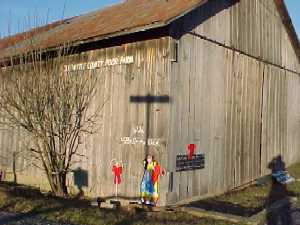
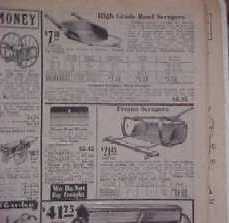
On display at the Olde Wythe County Poorhouse Farm, one of the original horse drawn road scrapers used by the road crew who helped maintain Wythe County Roads long before the state of Virginia took over these duties.
Jack Johnson......is part of Sarah Helen Johnstone Graham's extended ancestral Umberger Family Tree .... this beautiful coin was a gift to the LIVING HISTORY BOOK at the Olde Poorhouse Farm, Spring of 2001. Jack Johnson is linked to Sarah's extended Umberger Family Tree.Their common ancestors are Heinrich Umberger, born in 1688 and Julian. Many of Sarah Helen and Jack's ancestors rest at the beautiful historic St. John's Lutheran Cemetery in Wytheville, Virginia.
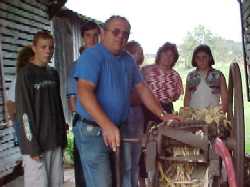
THE OLDE FODDER CHOPPER AND ITS ENDLESS MEMORY Abner Bruce Graham Jr.
demonstrates to a group of home study students how the antique fodder chopper
was used to cut corn stalks into feed for livestock as they tour and study
history at the Olde Wythe County Poorhouse Farm. The 1800s 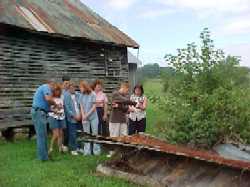
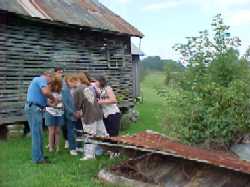
Studying History
.......they all closely examine 'jewel weed' said to have been used by the Indians and early settlers for curing poison oak ...... also the group had fun putting a leaf in water and watching it turn a bright silver color... .......the green plant with orange bloom grows beside the ruins of the Olde Poorhouse Farm Barn
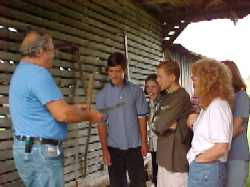
It's an old tool to make wooden shingles....
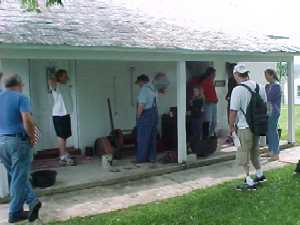
This group listens as a
welcomed visitor to the LIVING HISTORY BOOK demonstrates how the antique log
winch was operated during early Poor Farm Days!
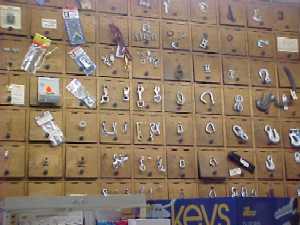
KINCER MILLER
HARDWARE'S OLD OAK DRAWERS STILL IN USE TODAY, MAIN STREET, WYTHEVILLE, VIRGINIA
|
|
This collection is for private research only, and not for commercial use or sale. Copyright © 2001 Wythe County Poorhouse Farm 2001. |