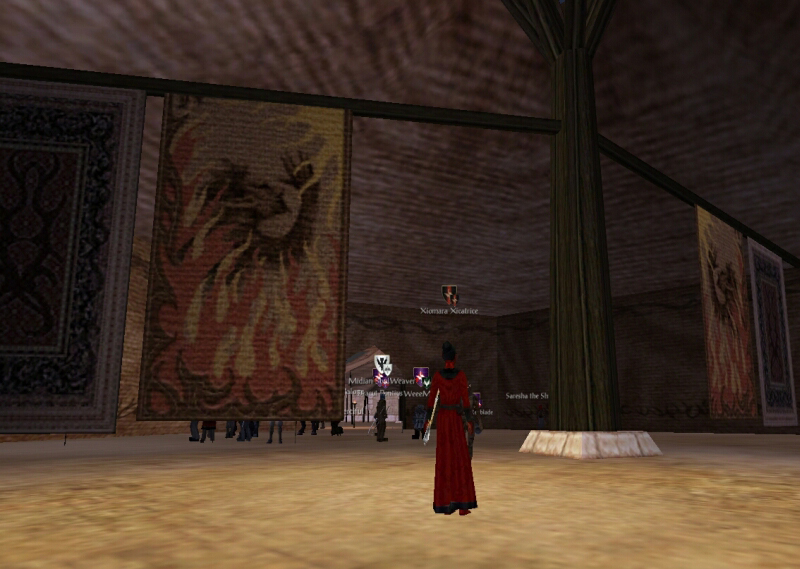
The Irekei barracks or "Bursar's tent" of Khar Th'Sekt, as it is commonly known, seen from the inside. Here we see how carpets do double duty as asmalyk'al ("hangings" or tapestries) when hung from the side struts of the main tent pole*. This serves to divide the large interior visually, to define separate spaces without the necessity of putting up complete partitions, and to display the carpets without letting them become worn under the heavy foot traffic prevalent in this area. It also helps absorb the noise of so many babbling, breath-wasting fir'khanim voices as are typical in this day and age in the city.
The asmalyk'al to Xi'a's left are two fine examples of the Irekei weaver's art. The left-most is of a soft, fine wool in an intricate field-and-border design and may contain as many as 130-320 senneh knots** per square inch. The asmalyk to the right of it is made of sturdier stuff, on a more robust base, and depicts a Khalinviri at the moment of his Transformation by Kharikryst (the Phoenix, Dread Lady of the Sun, the Dragon's Daughter) into one of the Irekei. This design is of great significance and is accorded some reverence, as versions of it reproduced on carpet are usually made neither to be walked on nor even merely displayed but to be laid down as the base for for a the bed of a married couple. It is thought lucky and proper to conceive children while cushioned on a rug of this or a few other chosen illustrative designs.***
*The main pole of this large tent is a true roof-tree, crown of branches left intact. It is socketed into a stone well at its base and penetrates the earth in this fashion for several feet straight down.
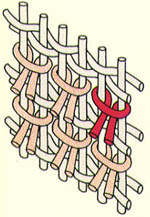
**In the ghiordes knot, the supplementary weft yarn passes over the two warp yarns, and emerges to form the pile coming between them; it has a symmetrical structure.
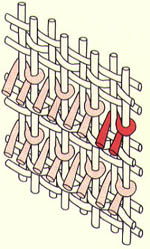
In the senneh knot, the supplementary weft yarn passes behind one warp yarn, and the two ends emerge on either side of a warp yarn; it has an asymmetrical structure that produces a more surface-conforming carpet with a cushier feel under foot.
***There's an old saying that the Bride does her best all the years of the marriage to preserve the bed-carpet, and the Bridegroom as Husband does his best to wear it out. In any case, in days of yore the first of a pair of spouses to decease the other would have his or her corpse (if found...) wrapped up in the bedclothing shared throughout the marriage, including the bed-carpet if any, for proper disposal. Since the Turning, of course, such funeral customs have become unpracticable and nearly forgotten.
| Previous | Next | |||
| Home | Image 30 of 30 |
