Mayan
Archaeology In Mexico

 El
Castillo Pyramid
El
Castillo Pyramid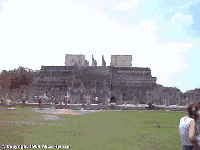 The Temple of the
Warriors
The Temple of the
Warriors
Photos © Copyright
1998 Alice Hymas. All rights reserved.
The Maya civilization is split up into into three time periods which span
approximately 3,000 years. The first is the Pre-Classic period which spanned
from 2000 B.C.-250 A.D. The second is the Classic period which spanned
from 250 A.D.-900 A.D. The third is the Post-Classic period which spanned
from 900 A.D.-1500 A.D. The Maya lived in the eastern one third of Mesoamerica,
mainly in the Yucatan Peninsula. Many modern day Maya still inhabit the
area today. They are a group of related Native American tribes who have
the same linguistic organization. The best known group of Maya are the
Maya Proper. The Maya Proper generally occupied the Yucatan peninsula.
Chichén Itzá was first settled by the Maya who built up the
original sections of the city. Chichen Itza was then conquered by a displaced
segment of the Toltec population, who settled in the city, and remained
for 200 years, until the fall of their empire. Some scholars hypothesize
that the attacks of the Toltecs may have been one of the possible factors
that lead to the ultimate demise of the Maya. Sculptures, murals and ceramic
vessles in the Mayan and Toltec art styles have been uncovered from the
site at Chichen Itza by archaeologists. This excerpt was taken from an
article on Mesoamerica on the Minnesota State University Science Museum
web site at:
http://www.anthro.mankato.msus.edu/prehistory/latinamerica/
The information has been edited
for clarity.
The name Chichen Itza (chee-chehn eet-sah) means "mouth of the well of
the itzas" and some writers have referred to it as the "city of the water
sorcerers", according to the guide at the site. Chichen Itza is an ageless
and time worn Mesoamerican city, and an archaeological treasure trove.
Chichen Itza is very popular for it's ancient archaeological ruins and
is one of the most visited tourist sites in Mexico. It is cherished because
of it's vast amount of Mayan ruins still standing on the site today. It
is, unequivocally and without a doubt, a "must see" for the serious ruin
buff. Some of Chichen Itza is still partially buried deep in the tropical
rainforests, in the central part of theYucatan peninsula, just southwest
of Cancun, Mexico near the Caribbean sea, in the state of Yucatan, Mexico.
Below is a picture of the pyramid "El Castillo" or as it is known as in
english "The Castle" at Chichen Itza.
 Photo
© Copyright 1998 Alice Hymas. All rights reserved.
The Maya
were highly skilled in architecture, math and astronomy. The pyramid has
a square-base and steps on all four sides and is around 75 feet tall. The
pyramid has 91 steps each in 4 faces. The top of the pyramid has 1 step
so that the total of the steps are 91x4+1=365 which are equal to the days
in a year. The pyramid was designed to be (among other things) a calendar
to mark the passing of time. On the north side of the pyramid the
ramps of the staircase are finished at the bottom with two serpent heads.
At each vernal equinox there is a play of light and shadow on the staircase
that looks like a serpent descending from the top and wriggling downwards,
that symbolizes the return and descent of the god Kukulcan. Mesoamerican
pyramids were customarily built over the tops of older pyramids. El Castillo
is no exception. It too was built over an existing structure. This made
the new temple much more astounding and beautiful. It also made the new
temple more supernaturnal and spiritual in that: the Maya believed that
if they repeated the same rituals over and over in their religious ceremonies
(ritual bloodletting, sacrifice, etc.) in the same spot that this
would consolidate and focus all the religious and magical power in one
spot and cause it to grow in that spot over time. Inside El Castillo archeaologists
have found well preserved art and architecture in the older more sacred
temple buried beneath the newer temple. It is a major archaeological find.
Photo
© Copyright 1998 Alice Hymas. All rights reserved.
The Maya
were highly skilled in architecture, math and astronomy. The pyramid has
a square-base and steps on all four sides and is around 75 feet tall. The
pyramid has 91 steps each in 4 faces. The top of the pyramid has 1 step
so that the total of the steps are 91x4+1=365 which are equal to the days
in a year. The pyramid was designed to be (among other things) a calendar
to mark the passing of time. On the north side of the pyramid the
ramps of the staircase are finished at the bottom with two serpent heads.
At each vernal equinox there is a play of light and shadow on the staircase
that looks like a serpent descending from the top and wriggling downwards,
that symbolizes the return and descent of the god Kukulcan. Mesoamerican
pyramids were customarily built over the tops of older pyramids. El Castillo
is no exception. It too was built over an existing structure. This made
the new temple much more astounding and beautiful. It also made the new
temple more supernaturnal and spiritual in that: the Maya believed that
if they repeated the same rituals over and over in their religious ceremonies
(ritual bloodletting, sacrifice, etc.) in the same spot that this
would consolidate and focus all the religious and magical power in one
spot and cause it to grow in that spot over time. Inside El Castillo archeaologists
have found well preserved art and architecture in the older more sacred
temple buried beneath the newer temple. It is a major archaeological find.
Would you like to see inside
the Mayan Pyramid El Castillo?
Then click next and step inside of the mysterious pyramid into a ritual
bloodletting and burial chamber. Come into the tomb. Or there's always
the chicken way out. Back to the index. The guide grabs your harm and tells
you in his heavy mayan accent that he will not go in with you if you go
on. He says the pyramid will curse those who disturb the rest of the king
and their
god Kukulcan. Are you cursed if
you enter? You decide whether to go on or not. Hmm, don't know about you
my friend but I am going on. 
 The intellectual property on this page is Copyright 1998 Alice Hymas. All
rights reserved.
The intellectual property on this page is Copyright 1998 Alice Hymas. All
rights reserved.