
This project is totally created by YATHEENDER NATH ALLURI including diagrams.. Alluri® .All rights reserved.2001 Site Hosted on 12 Aug 2001 Back to Hobbies

Proudly Made a Mac
This project is totally created
by YATHEENDER NATH ALLURI including diagrams.. Alluri®
.All rights reserved.2001 Site Hosted on 12 Aug 2001 Back to Hobbies
Constructing a 6 Inch
Reflector Telescope or Newtonian Telescope:-
Introduction:
I got my Telescope parts from Galilean Telescopes in Delhi by ordering through internet.They are perhaps the only one and famous in manufacturing parabolic Concave mirrors in India.You get a concave mirror (400 mm), a diagonal mirror, a Eyepiece holder , two eye peieces (15mm,28mm) and a Maginfier along with the telescope making kit.Along with this you need a Plastic PUC pipe for the Body of the telescope and a black paint tin for eliminating the reflected light that bounces off from the white plastic tube inner walls.U need to make a simple stand for the telescope where your tele is mounted on (Any suitable design according to your requirements)and you need to make a Adjustable mount for the concave mirror.The diagram is illustrated in brief below. The Basic Principle of convex mirror illustrated below for people who wants to build a Galilean Refracting Telescope.But, Here i have built a Reflecting mirror Telescope ( Newtonian Telescope ) which is much more complex and Powerful then that of Galilean Telescope
The 6-inch f/8 Newtonian reflecting telescope is probably the
most popular star gazing instrument in use by the amateur astronomers.This
is easily understood when we examine the instrument in more detail.
The "6 inch refer's" to the diameter
of the objective or the main mirror of the telescope tube . The
figure "f/8" is an optical expression derived from the
ratio between the focal length and the diameter of the telescope
mirror. In this case , the focal length is 48 inch or 8 times
the mirror diameter of 6 inches.
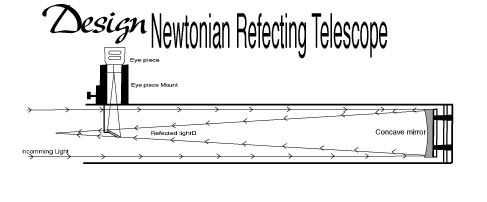
The name "Newtonian" refers to the over-all design of
this type of reflecting telescope in which ray from the objective
or main mirror are focused onto a smaller mirror mirror known
as the "diagonal".The diagonal is set further up in
the telescope tube at a 45 degree angle to the main mirror and
the eyepiece . Its function is to reflect the focused rays from
the objective into eyepiece where they are refocused and magnified
for close viewing of the image .
It is enough to say that the Newtonian design is simply the most
practical and least expensive for nonprofessional instruments.
The word "reflecting" of course ,distinguishes this
scope from a refractor in which the light rays are "bent"
through and focused behind a lens instead of being "bounced"
away from and focused in front of a mirror .
Since the above description pretty well fixes
the size of our reflector we can see one reason for its popularity.
Its about the largest telescope you can comfortably carry.
Lager reflecting instruments up to 8 inches
in diameter are almost always semi portable , with usually a permanent
mount and perhaps a transportable main tube.
Much more larger reflectors those over 8 inches
in mirror diameter require the construction of a permanent observatory.
Another obvious reason for the popularity of the Newtonian reflectors
is this size or smaller price.To buy a completely finished and
assembled 6-inch reflector of this type would cost you about 200$.Prices
of larger instruments soar drastically for the finished product.You
can , however , own a high quality instrument for a fraction of
the price if you built or assemble your own telescope .The object
of this chapter is to help you do just that.
Requirements for making a reflector telescope:
SIX- INCH REFLECTOR
Pyrex Parabolic 6" Mirror
6" Mirror mount
7" O.D. Aluminum tube
Eyepiece mount
Elliptical Mirror Diagonal
Mirror Diagonal holder
Equatorial mount and tripod
Keller Eye piece 28 mm F.L.
6-power finder scope , bracket
You will note that there is a list. This is an illustration
DESIGN OF THE NEWTONIAN REFLECTING TELESCOPE
The CROSS SECTION of the 6" Reflector
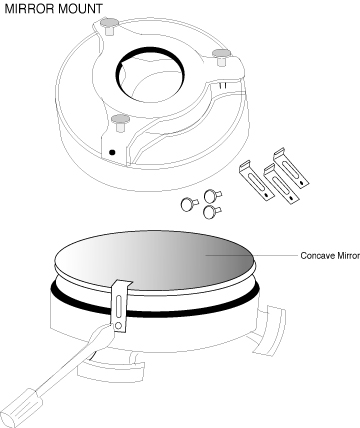
The first diagram is the back view of the mirror
mount shows the tension bolts for adjusting tilts.Clips hold mirror
in the mount.The second diagram the mirror is mounted tight in
holding rings. Add shims at edges if needed.Attach retaining clips.
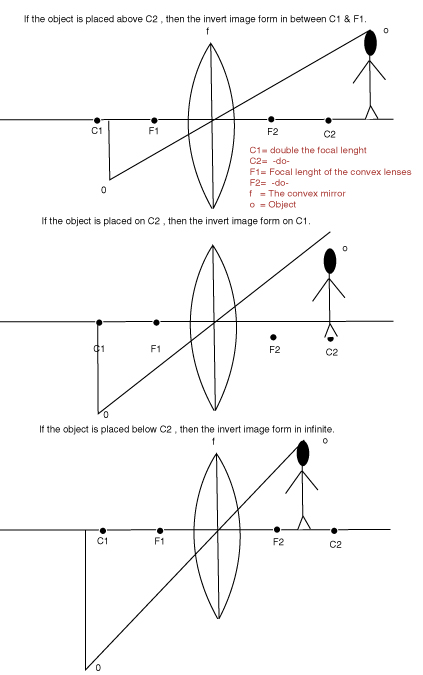
Experiment in finding the focal length of a convex mirror
Activity for showing the formation of images by convex lens:-
Take a double convex lens of a known "f"
and place it in the grove of a V-shaped stand. Using a meter scale
and chalk piece, mark a straight line on the table. Identify a
convenient point (O) at the center of this line and place the
stand with convex lens, with respect to 'O' . Mark the principal
foci of the convex lens (F1 and F2) and also the center of curvatures
(C1 and C2)on this line. Use a wire gauge as an object[The torch
and wire gauge can be replaced by a candle flame . Now flash light
passing through the wireguage and the lens. On the other side
of the lens place a screen to catch the image. The distance between
the object and the lens is called object distance denoted by letter
'u' and the distance between the image and the lens is called
image distance denoted by letter 'v'. Now place the object at
the distance equal to three times the " f "of the lens
and observe the image formed. Now keep decreasing the object distance
such that it is placed at the other five positions and note down
the image distances and their natures. "f" of the lens
can be calculated using the formula.
Properties of the convex lens
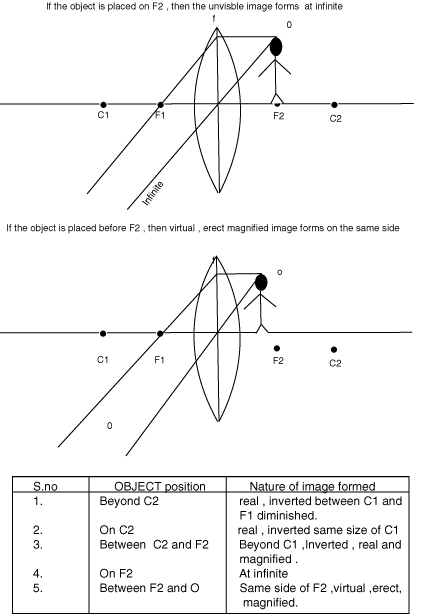
Alluri®
All rights reserved..©2001