 |
| THE MAJOR ARCANA |
| Descriptions and interpretations of the Major-Arcana Tarot cards were incorporated into Golden Dawn teaching. The following brief summaries of these are adapted from The Tarot, by S.L. MacGregor Mathers. Deck shown is my own personal Rider Tarot Deck. Each illustration was scanned by me! |
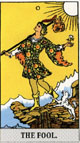
| 0-The Fool. A man with a fool's cap, dressed like a jester, with a stick and bundle over his shoulder. Before him is the butterfly of pleasure luring him on, while a dog attacks him from behind. It signifies folly or expiation. |
|
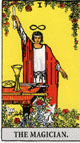 |
| 1-The Magician. Before a table covered with the appliances of his art stands the figure of a magician, one hand upraised holding a wand (or a cup), the other pointing downward. He wears a cap of maintenace like that of kings,whose wide brim forms a sort of aureole around his head. His body and arms form the shape of the Hebrew letter Aleph, to which this card corresponds. The magician symbolizes will. |
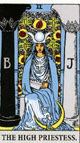 |
| 2-The High Priestess. A woman crowned with a high miter or tiara (her head encircled by a veil), a stole (or a solar cross) upon her breast and the "Book of Science" open in her hand. She represents science, wisdom, and knowledge. |
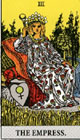 |
| 3-The Empress. A winged and crowned woman seated upon a throne, holding in one hand a scepter bearing a globe surmounted by a cross, resting the other upon a shield emblazoned with an eagle, on whose breast is a cross. She is the symbol of action, the result of the union of science and will. |
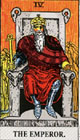 |
| 4-The Emperor. He is depicted crowned and leaning against a throne. His legs form a cross, while beside him, beneath his left hand, is a shield emblazoned with an eagle. In his right hand he bears a scepter similar to that of the Empress. His body and arms form a triangle, of which his head is the apex, so that the whole figure delineates a triangle above a cross. He represents realization. |
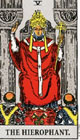 |
| 5-The Hierophant. He is crowned with the papal tiara and is seated between the two pillars of Hermes and Solomon. With his right hand he makes the sign of esotericism, and with this left he leans upon a staff surmounted by a triple cross. Before him kneel two ministers. He is the symbol of mercy and beneficence. |
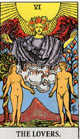 |
| 6-The Lovers. This card is usually described as representing humanity positioned between vice and virtue, while a winged genius threatens vice with his dart. It is usually considered to mean proof or trial. |
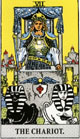 |
| 7-The Chariot. This represents a conqueror crowned, bearing a scepter and riding in a cubical chariot surmounted by four columns and a canopy. The chariot is drawn by two horses, one which looks straight forward, while the other turns his head toward the conquerors. (Two wheels are shown in the complete, single-headed figure). It represents triumph and the victory of justice and judgement. |
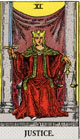 |
| 8-Justice. A woman crowned and seated on a throne (between two columns), holding in her right hand an upright sword and in her left the scales. She symbolizes equilibrium and justice. (note: the positions of Justice and Strength, may occasionally be switched) |
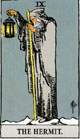 |
| 9-The Hermit. An old and bearded man, wrapped in a mantle, with his head covered with a cowl, bearing in his right hand the lantern of occult science, while in his left he holds his magick wand partially hidden beneath his cloak. He symbolizes prudence. |
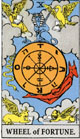
| 10-The Wheel of Fortune. A wheel of seven spokes (the two halves of the double-headed cards make it eight spokes, which is incorrect), revolving between two uprights. On the ascending side is an animal ascending, and on the descending side is a monkey descending; both forms are bound to the wheel. Above it is the form of an angel (or a sphinx in some decks), holding a sword in one hand an a crown in the other. This very complicated symbol signifies fortune, good or bad. |
 |
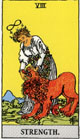
| 11-Strength. A woman wearing a crown and cap of maintenance, who calmly and effortlessly closes the jaws of a curious lion. She represents strength (note: Strength and Justice are somtimes switched. |
 |
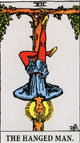 |
| 12-The Hanged Man. This extraordinary symbol is almost unintelligible in the double-headed cards. Properly, it represents a man who has been hung head downward from a sort of gibbet, to which he is attached byone foot. His hands are bound behind his back in such a manner that his body forms a triangle with the point downward, and his legs a cross above the triangle. Two sacks or weights are sometimes attached to his armpits. He symbolizes sacrifice and is usually depicted with a halo. |
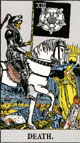 |
| 13-Death. A skeleton armed with a scythe, with which he mows down heads in a meadow like blades of grass. He signifies transformation or change. |
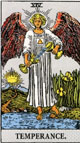 |
| 14-Temperance. An angel with the sign of the sun on her brow, pouring liquid from one vessel into another. She represents combination. |
 |
 |
 |
| For Major Arcana no# 15-21, click Last of the Major Arcana!! It will take you there! |