The Chinese suffered under the unreasonable Japanese rule. They murder, rape, loot, burn etc., their cruelty was impossible to list. Allow me to cite a few examples from accounts which survived through this ruthless regime.
Forms of tortures – Usually used for punishment of defiant POW
1)
The Japanese chop off the heads of the Prisoners of War primarily for entertainment and practice. Some prisoners were used as a test of strength of sword, some used to test the guts of freshly-recruited Japanese soldiers (superiors challenged them to behead the Chinese) and some used for competitions between the Japanese commanders. (Note the smile on the butcher's face in the picture.) Others were tied to sticks to pose as human targets for the soldiers’ bayonet and shooting practices.

2) The "water treatment"
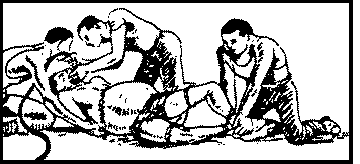
The victim would be bound with barbed wire, mouth gagged with rags. Then, his body would be filled with water through a hose into his nose.
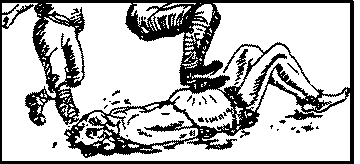
When his stomach was fully filled, the Japanese would start the beating. They started beating with square poles, then kicked the body, and then jumped onto the distended stomach until it ruptured.
3)
The victim would be forced to kneel on sharp sticks for up to 3 hours, exposed to the blazing sun, dehydrating without water and carrying a heavy stone. Should the victim collapse or fail to keep the stone raised, he would be beaten as a punishment. After which, he would be remounted onto the sticks if he was still conscious.
4)
The victim’s hands would be tied to a trees, and left alone for days. Sometimes (like in the picture) the toes would touch the ground.
5)
The victim would be tied to a tree with barbed wire for days without food and water. A bucket of water was then thoughtfully placed in front of him to remind him of what he most needed. This is a vicious way of physical and psychological torture.
6)
Prisoners were confined to cramped cells, devoided of sunlight. This was how they looked like after years ofimprisonment.
Vivisections and Biological Warfare
The Chinese were left in lurch as the United States US supported vivisections and biological warfare. The Chinese fell prey into the Japanese inhumanity, leaving a irremovable imprint on the Chinese with their gory acts.
Vivisection
Vivisection involved Unit 731 and Japanese Red Cross (!) and was supported and covered up by US. The subjects provided by Kempeitai.
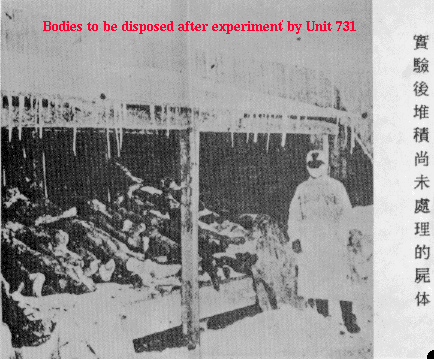
The Chinese were tied to a bed, and dissected alive without anesthetic as it was said that anesthetic might affect the normal workings of the organs and blood vessels. These vivisection were mostly for practices of appendectomy, amputation, tracheotomy to be used on battlefields.
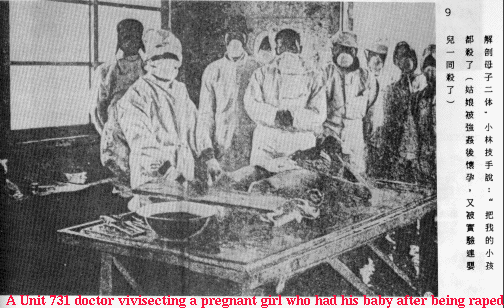

Accounts revealed that females delibrately made pregnant and then operated on, and operation was conducted on even a three-day old baby. Also, the human experiments dumped away into holes after use. Besides, the Japanese sacrificed the thousands of victims for human parts, tissues or even cells.
Biological Warfare
The Japanese deduced that if biological warfare was so harmful that it had to be banned under international laws (Geneva Protocol of 1925) it must be a great weapon. The warfare was a tragedy for it was a violation of international laws and detrimental to human morality. China was an ideal target for the land vast enough for testing and the people were physically weak due to lack of food. The inhumane warfare was, again, covered up by US. It was even rumoured that US bought the biological research from the Japanese.
Before the release biological weapons, tests were conducted on the Chinese. The Japanese placed the infected prisoners with healthy ones to gauge how fast the virus spread. Another testing method was done on proving grounds called Anda where people were tied to stakes in a pattern, virus was dropped from plane to see how far the virus spread. Prisoners were also locked in pressure chambers where the Japanese would gauge the limit of body endurance before the eyeballs pop out from their sockets. The victims were also deliberately infected with plague, then cut opened to see the effects of the diseases on the man’s inside. Such were cruelty and inhumanity of the Japanese had executed on the Chinese.
Chinese cities disfigured by the biological warfare included Ningbo in eastern China, Changde in Hunan, and Zhejiang Province. The Japanese also took more than 20000 lives when thousands of plague-infected rats were released in 22 counties of Heilungchiang and Kirin provinces. Wells and ponds were cautiously infected with diseases like plague, anthrax, cholera, dysentery, typhoid, and other pathogens. The Japanese was ruthless in that even when war ended, they released plague-infected animals and killed at least 30000 in Harbin area from 1946to 1948. Kamikazi suicide planes with plague bombs were used to attack the Chinese. Gas bombs were also used since the Japanese invasion of Wusung and Shanghai in August 1937. From then on, 1131 times of posion gas were used within 8 years. Conclusively, the Japanese not only destroyed China’s land physically using bombs, they also infected the Chinese with epidemic diseases and polluted their environment with toxic gases.
However...
China did benefit from World War II to some extent for she achieved elevation of status in the international eyes. In January 1943, the USA and England gave up extraterritorial rights, and other Western countries soon followed suite. In October 1943, China attained the status of a Big Power in the Moscow Declaration. In November 1943, Chiang Kai-shek met US President Roosevelt and British Prime Minister Churchill in Cairo where they assured Chiang of support against the Japanese and to restore all territories lost to Japan. In December 1943, the United State Congress repealed the laws which impeded the Chinese from her shores. Due to Western efforts to alienate the Japanese, they advocated self-determination by giving up extraterritorial rights. China benefited from it as it was now recognized as a friend and ally of the West, a full sovereign and independent country. It was a great achievement since the ceding of the 1st concession in the Opium War.
Conclusion
Ultimately, no one can deny that the Second World War was a traumatizing experience for the Chinese. Hatred for the Japanese remained till today. However, in the midst of all the calamities and suffering, China was considered fortunate to earn the Western protection after decades of exploitation by them.
 [Go back to mainpage]
[Tragedy for SEA]
[Go back to mainpage]
[Tragedy for SEA] 