|
The Earth's rocky outer crust solidified billions of years ago, soon
after the Earth formed. This crust is not a solid shell; it is broken
up into huge, thick plates that drift atop the soft, underlying mantle.
The plates, which we called lands, are made of rock and drift all over
the globe as they move both horizontally and vertically. Over long periods
of time, the plates also change in size as their margins are added to,
crushed together, or pushed back into the Earth's mantle.
PLATE TECTONICS
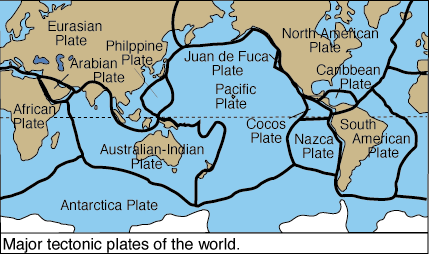 The
theory of plate tectonics (meaning "plate structure") was developed
in the 1960's. This theory explains the movement of the Earth's plates
and also explains the cause of earthquakes, volcanoes, oceanic trenches,
mountain range formation, and many other geologic phenomenon. The
theory of plate tectonics (meaning "plate structure") was developed
in the 1960's. This theory explains the movement of the Earth's plates
and also explains the cause of earthquakes, volcanoes, oceanic trenches,
mountain range formation, and many other geologic phenomenon.
The plates are moving at a speed that has been estimated at 1 to 10 cm
per year. Most of the Earth's seismic activity, like volcanoes and earthquakes,
occurs at the plate boundaries as they interact.
The top layer of the Earth's surface is called the crust . The crust
that the solid rocks are on is called the Continental crust. Oceanic crust,
which lies under the oceans is thinner, denser and more active than continental
crust. Constantly, Crust is constantly being created and destroyed
TYPES OF PLATE MOVEMENT
At the boundaries of the plates, various deformations occur as the plates
interact; they separate from one another (seafloor spreading), collide
(forming mountain ranges), slip past one another (subduction zones, in
which plates undergo destruction and remelting), and slip laterally.
Divergent Plate Movement
(Seafloor Spreading)
|
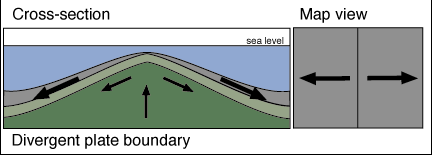
Seafloor spreading is the movement of two
oceanic plates away from each other, which results in the formation
of new oceanic crust from magma that comes from within the Earth's
mantle along a a mid-ocean ridge. Where the oceanic plates are moving
away from each other is called a zone of divergence. |
Convergent Plate Movement
|
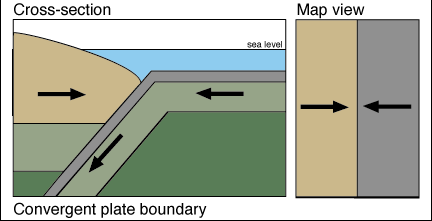
When two plates collide, some crust is destroyed in the impact
and the plates become smaller. The results differ, depending upon
what types of plates are involved.
Oceanic Plate and Continental Plate
When a thin, dense oceanic plate collides with a relatively light,
thick continental plate, the oceanic plate is forced under the continental
plate; this phenomenon is called subduction.
Two Oceanic Plates
When two oceanic plates collide, one may be pushed under the
other and magma from the mantle rises, forming volcanoes in the
vicinity.
Two Continental Plates
When two continental plates collide, mountain ranges are created
as the colliding crust is compressed and pushed upwards.
|
Lateral Slipping Plate Movement
|
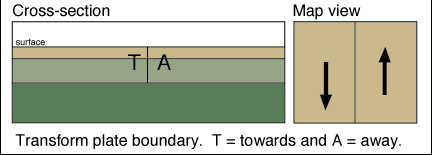
When two plates move sideways against each other, there is a tremendous
amount of friction which makes the movement jerky. The plates slip,
then stick as the friction and pressure build up to incredible levels.
When the pressure is released suddenly, and the plates suddenly jerk
apart, this is an earthquake. |
|