|
Life's isn't a bed of roses. That's goes the same for the fate of the
sky. Even though the rain is a natural watering system for the plants
and trees in his world, it has its disadvantage side too. Heavy rain falls
in almost every seasons in those tropical countries. These heavy rain
are called typhoons in the Philipines, China and Japan, hurricans in the
Caribbean and tropical cyclones in India, Bangladesh and Australia.
Formation of Tropical Storm
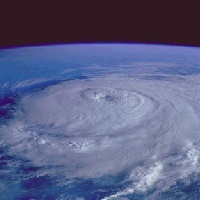 Tropical
storms are formed over the seas and oceans. Firstly, a low pressure zone
is formed over such water bodies and as the air rises, condensation occurs
and the latent heat released makes the air warmer and lowers its pressure
so that more moist air from the seas is drawn into this low pressure system
to form dense cumulonimbus clouds which produce torrential rain. As the
air moves from high pressure to low pressure, the surronding high pressure
air will moves into the intense low pressure in a spiral manner, with
the speed of 200km/h. The cool air sinks at the centre of the storm, which
is called the eye, and creates an area of calm weather marked by clear
skies. Tropical
storms are formed over the seas and oceans. Firstly, a low pressure zone
is formed over such water bodies and as the air rises, condensation occurs
and the latent heat released makes the air warmer and lowers its pressure
so that more moist air from the seas is drawn into this low pressure system
to form dense cumulonimbus clouds which produce torrential rain. As the
air moves from high pressure to low pressure, the surronding high pressure
air will moves into the intense low pressure in a spiral manner, with
the speed of 200km/h. The cool air sinks at the centre of the storm, which
is called the eye, and creates an area of calm weather marked by clear
skies.
Weather associated with Tropical Storm
- Before arrival of tropical storm
The temperature is high(about 30°) and
so is the humidity. The air is still and the pressure is average(about
1012 mb). There is fine weather.
- Arrival of the vortex, the extreme end of the storm
The pressure drops rapidly and winds blow very strongly. The sky
is overcast with cumulonimbus clouds and torrential rain falls. Temperature
drops to about 25°c.
- Arrival of the eye
The pressure reaches its lowest, sometimes as low as 960mb. The
temperature rises to about 30°c. There are only a few clouds and
no rain. The winds are light.
- Arrival of vortex
The pressure rises. The sky is overcast with cumulonimbus clouds
and the torrential rian falls. The temperature falls to about 25°c.
The winds blow very strongly.
- After the Tropical Storm
The pressure returns slowly to normal. The temperature rises to
about 30°c. The wind blows gently. The rain may last a day or two
after the outmost rainbands of the tropical storm have moved away or
died out.
|