I would like to offer an honest appraisal of what I consider to be equipment worth spending money on. I don't always go for the most expensive,but I do look for the best. My approach to bying gear is this: First, get your hands on as many brochures as you can for the type of gear you're interested in buying. From these, you will learn a lot about what goes into the gear and what the manufacturer considers important. After comparing several choices, you can make your own decision about what is important and look for the gear that best meets your needs. Finally, you can try renting the equipment you're interested in to try it out. You have to be honest with yourself and ask questions like "do I really need a bota bag that has a built-in shaving kit?" Even then, you'll sometimes look back and wonder why you ever bought such-and-such. Here is a list of gear I never regretted buying.
There's a lot of hype out there, especially about backpacks. I don't believe in wasting money on something that can't carry the load or causes backpain or shoulder strain. Since I like to go caving in remote areas, I need to carry my caving gear with me. This includes climbing gear and can weigh 20lbs by itself. For a week-long trip, my pack can weigh 70lbs .
This alone is enough to deter many people, who opt for light-weight packs. For carrying heavy loads, there are only two ways to go. The cheapest route is to buy an external-frame pack, like the Kelty Super Tioga. This is a solid pack with lots of room. It is also pretty comfortable. An internal-frame pack with equivalent load carrying capability will cost twice as much. In my area, this pack costs <$200.
For those who want to be able to go anywhere
in any conditions (say, off-trail or on skiis), only an internal frame pack will do.
IMHO, the best internal frame pack on the market is made by McHale
in Seattle.
I own the Inex Alpineer and would recommend it to anyone looking for the
top-of-the line pack. This pack is a little more expensive than the brands you're
likely to find at your local store, about $560.00 in 1996.
But, it is custom-made and guaranteed not to blow out on you. The pack is
built to last and is definitely worth the price. I've tried other packs and when I realized
what I was getting for the money, I decided the real value was in buying from McHale.
Also, it carries the weight better than any other pack I've ever tried. With
70lbs on my back, I can still stand straight up. This is also the only
pack I know of where 100% of the weight can be put on the hips. You have
to see this pack to believe it.
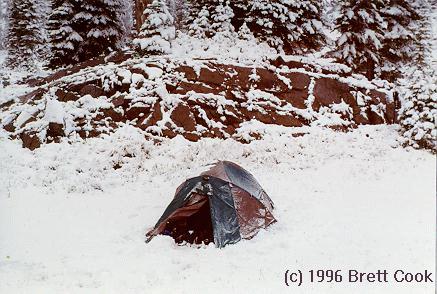
I chose the Mountain Hardware Trango 2. This is a solid four-season tent that is well made, down to the minute details. It's spendy (about $400), but won't leave you wet and cold in inclement weather. It only takes one cold, shivering night to convince you that it's worth the extra money. But, that's another story.
MSR Whisperlight International. This stove is reliable, easy-to-use and burns a variety of fuels. This one is a must.
Wiggy's Lamilite. I know of nothing better. People will tell you that nothing beats down for warmth/lb, but down is worthless once it's wet. I live in too wet a climate to have something that can't take a little water, so I went with a synthetic. Wiggy's makes the only bag that even comes close to down in terms of insulation. This is a hard characteristic to measure (as Wiggy himself will tell you), but his temperature ratings are the most realistic and honest I've seen. I wouldn't trade my Wiggy's bag for any other brand. It's something I can count on and that's important to me. My wife is also convinced. She sleeps cold even at home, but had no problem at 7500' in September. The temperature at night was below freezing but she stayed warm in an Ultralight (+20 deg) bag.