|
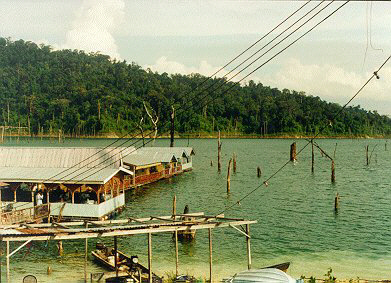
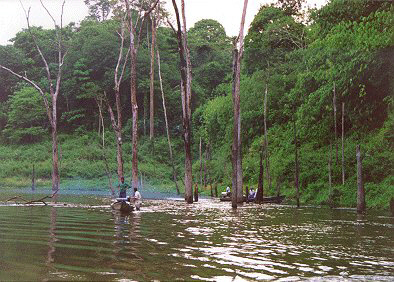
If I'm not mistaken, Temenggur Dam was built around 1970s. At that time, Temenggur was listed as a black area because of threats from the Communist bandits. The easiest way to go to Temenggur Lake is from a small town in the state of Perak called Grik. By this time, there should be a new highway connecting Grik to Ipoh, so travelling there should be easy. The starting point for the journey is at Lake Bading. It's easy to recognize this place because it has a number of floating restaurants around it. The seafood here is fresh because the fish are reared next to the restaurant itself. Our first stop for the day was a nearby Orang Asli (natives, Malaysian aborigines) village. The journey by boat took about 3 hours. During this we were presented with the most different scenery. The whole lake was originally a forest before the dam was built, so we can still see most of the dead tree coming out of the water, still standing proud. These trees are still harvested as logs and this technique is called underwater logging. The last 10 minutes of the journey was a hard one because we were travelling up the river and the water was not deep enough for the boat, so we had to get wet and push the boat ourselves. |
|
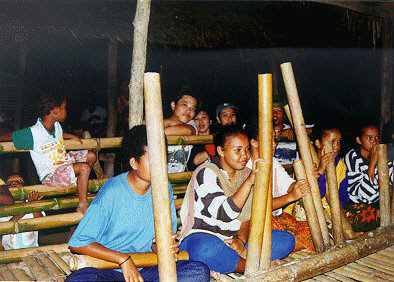
The place was quite big for an Orang Asli village. They were once a nomadic people, but now most of them are staying at permanent villages. That night we were presented what's called a sewang. This kind of ceremony is normally held for festive occasion such as marriage etc. Bamboo is used as musical instruments in sewang. In the old days sewang is usually held for at least a couple of days. |
|
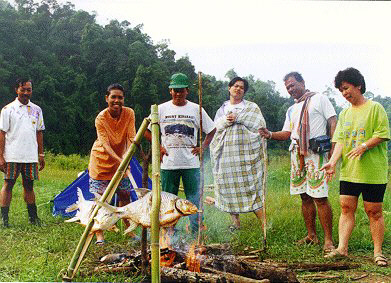
We left the village the next morning for our second destination, which is an area where the nomadic Orang Asli has abandoned. I don't know the name of this place, infact, most of the places we went during this outing doesn't have any formal name given. That night, some of our guide went to set up fishnets in the lake. And were we lucky that night because we caught some of the tastiest fish I've ever had. For the rest of the trip, we went to quite a lot of interesting places and visited places that few have ever visited. |
|
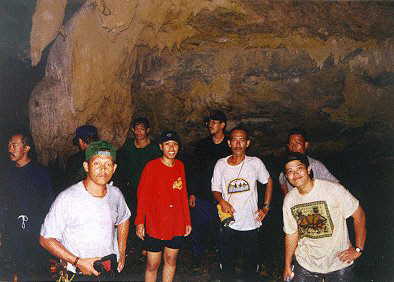
On the final day of our expedition, we went to Gua Itik or Duck Cave. This cave was actually formed by a river cutting through a hill. It is known by that name simply because in most of the narrow passage, we have to walk like a duck to pass through. Since it was raining heavily when we went into the cave, not only we have to walk like a duck (therefore the name Gua Itik), but also swim like a frog through the flooded passages. |
|
|
|
| [Home] | [Next] |
Copyright @ 1999, Jefry
Rizal. All Rights Reserved
Best viewed using IE5.0 at 800x600
with 24-bit colors
This page is hosted by  Free Home Page