A Picture of Huangshan
The Himalayas from Space
A Picture of The Himalayas
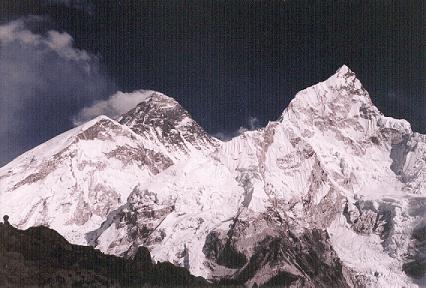
A Picture Mount Everest
A Picture of Mount Everest
A Picture of Mount Everest
The top of Everest is near
A Large Picture of Everest
A Large Picture of Everest
A large picture of a Snow Leopard.
A Picture of a Snow Leopard.
A Picture of A Himalayan Blue Sheep.
Another Picture of a Snow Leopard.
A Snow Leopard in a Clearing.
Mount Everest Links
Outside Magazines Archive of Everest Stories, including John Krakauer's original article
Sean's Everest Page. Also has a Mailing list you can join and join an Everest discussion.
Jochen's Homepage. Archives of Everest Information. Jochen knows a lot about Mount Everest and is kind enough to help anyone seeking information about this mountain.
Everest Home Page
New Site, Mount Everest Net, discussion and info.
THE MOUNTAIN ZONE: A very nice mountain sports site. Everest stories, all mountain sports.
Mt. Everest Information (mteverest.com)
Everest News and Information Site, with Discussion Group.
The Mountain Zone Links to Everest Coverage.
The Himalayan Explorer's Club.
A History of the Climbing of Mount Everest.
Himalayan Rescue Association Home Page.
Other Everest and Himalayan Links.
The National Geographic Everest Site.
Climbing Magazine
Rock and Ice Magazine
On cloud-trails, I go, Alone, with the chatting porters, there is a crow.
"We felt the lonely beauty of the evening. The immense roaring silence of the wind, the tenuousness of our tie to all below. There was a hint of fear, not for our lives, but of a vast unknown which pressed upon us. A fleeting disappointment--that after all those dreams and questions this was only a mountaintop--gave way to suspicion that maybe there was something more, something beyond the three dimensional form of the moment. If only it could be perceived.--Thomas F. Hornbein. EVEREST: THE WEST RIDGE
"I appreciate why I come to the mountains: not to conquer them but to immerse myself in their incomprehensible immensity — so much bigger than us; to better comprehend humility and patience balanced in harmony, with the desire to push hard; to share what the hills offer, and to share it in the long-term with good friends and ultimately with my own sons..."
--Alex Lowe, Sunday, October 3, 1999 from Shishapangma, Chinese Tibet.
When asked by a journalist why he wanted to climb Mount Everest, George Mallory replied, "Because it is there." ANOTHER ANSWER: "Why climb Everest?" was a question posed rhetorically in Mallory's American lecture tours, and the response, given to Harvard undergraduates in 1923, was: "For the stone from the top for geologists, the knowledge of the limits of endurance for the doctors, but above all for the spirit of adventure to keep alive the soul of man."
Upon being the first person to summit and descend from Mount Everest successfully with Tenzing Norgay on May 23, 1953, Sir Edmund Hillary told his expedition mate, George Lowe, "Well George, we knocked the bastard off."
"Have we vanquished an enemy? None but ourselves. Have we gained success? That word means nothing here."--George Mallory, 1918 Alpine Journal.
MU