GALILEO
CHINI: CERAMICS
Vieri
Chini
In
Europe
, at the
end of the 19th century, a reform movement developed with the purpose of
reviving applied arts from the standstill where they were slumped.
This reform happened mainly through artists specializing in painting and
sculpture. The originality of this
movement was in a form very distant from the handicraft conventions.
Nevertheless,
Italy
, a
country not very prone to officially accepting such radical changes, found in
Galileo Chini one of these very first reformers.
In 1896, along with some friends,
Galileo Chini founded a small factory called, "The Art of the
Ceramics". The articles
manufactured here stirred up excitement due to their modernity and quality.
Their forms, decorated as they were, spoke for themselves. The ornamental
designs were extremely realistic and at the Turin Expo’ of 1898, they were
rewarded with the gold medal.
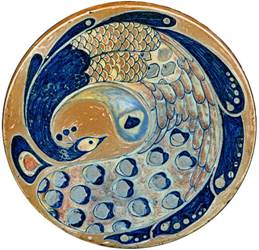
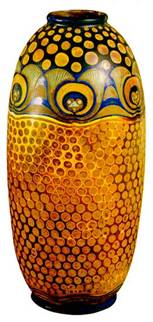
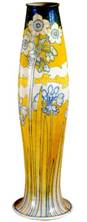
Chini had a preference for pastel
tints and objects d’art produced by "The Art of the Ceramics" were
often the peacock and the swan, animals adored by artists of that period.
The collection of other assorted ceramics, rich in gold, coloration, and
decoration were truly a joy to the eye.
One of the factors that contributed to
the success of the production house was the use of the “lustro metallico”,
which is a very ancient technique. The
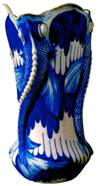
factory engaged also in the production of “grès” (stone-pottery).
The “grès” pieces were almost always monochrome decorated in blue
cobalt on raw background. Decorated
motifs produced were generally palmettos, flying animals, antelopes, and
geometric motifs.
Because of discord among partners,
Galileo, and subsequently Chinos, left "Art of the Ceramics" and
founded a new factory named "Fornaci San Lorenzo" in the native Borgo
San Lorenzo in Mugello, not far from
Florence
.
Compared with the "Art of the Ceramics", the products of this
new factory introduced radical changes. The
factory won public attention at the Venetian "Biennale" exhibition
when a pavement was created in grès polychrome for the “Sala del Sogno”
(The Room of the Dream). Numerous
relationships between Galileo Chini and personalities of the art world, allowed
him to gain even more commercial profit owing to the products of the factory.
Unfortunately, at the same time, there was some misunderstanding between
Galileo and
Chino
perhaps
as a result of differences in characters.
In 1911, upon invitation of the King
of the
Siam
, who
had admired his works at the Biennale exhibition in
Venice
,
Galileo left
Italy
to
decorate the Palace of the Throne in
Bangkok
, where
he stayed for some years. The
absence of Galileo caused great difficulty for
Chino
, who
was left alone to manage the Factory and further tormented by health problems.
The economic situation of the factory was not good and the breakout of the First
World War further increased the precarious conditions of the Fornaci San
Lorenzo, determining, above all, a deceleration of the factory’s activity.
With the return of Galileo from
Siam
in
1914, the production of the factory increased with new typologies.
In the following years, the Factory fulfilled the demanding task of
coating the ceramic stone-pottery of the “Thermal Establishment of
Salsomaggiore”.
It appears that Galileo transferred influences of oriental taste,
assimilated during his stay in
Siam
, to the
planner Giusti. For Galileo Chini,
the
Paris
exhibition in 1925 marked the gradual abandonment of ceramics for a more and
more assiduous return to paintings.
The activity of the Factory continued with the help of
Chino
and his
children, Tito and Augusto, who continued to produce many pieces created by
Galileo in the previous years.