| The twin cities of Rawalpindi
and Islamabad lie against the back drop of Margallah Hills on
the Potohar plateau. On the basis of archaeological discoveries,
archaeologists believe that a distinct culture flourished on
this plateau as for as back as 300,000 years. Based upon the
stone implements found in Soan Valley, researchers have revealed
various aspects of activities of the primitive human being.
The earliest tools stuck from large |
 |
| pebbles have been named as
“Early Soan” and “Late Soan”, when better
and finer tools were made during Paleolithic period. In the
new stone age known as “Neolithic Culture, i.e. 10, 000
to 5,000 BC, finer and polished stone and some Neolithic burials
of long Homo Sapiens near Rawat. These discoveries are comparable
to “Cromerien” tools of Paleolithic period discovered
in Europe. |
 |
|
| Serai Khola, located 03 kms south
west of Bhir Mound, is considered as the earliest settlement of Taxila.
The discovery of stone Celt’s, chert blades, cores, stone arrow
heads, scrappers, terracotta animals and female figurines, clay bangles
, stone and paste breads, copper pins, and wide range of poetry has
pushed the history of Taxila from 600 BC to 3000 BC. Three cultural
sequences, namely , historic at the top, Kota Dijian in the Middle
and late Neolithic at the bottom have been discovered at Seraj Khola
near Taxila. |
| |
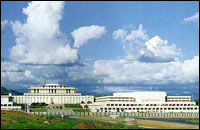
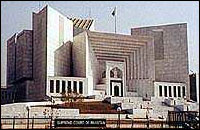
| Islamabad, the capital of Pakistan,
is located against the backdrop of Margalla Hills at the northern
edge of Potohar Plateau. In contrast to its twin city Rawalpindi,
it is lush green, spacious and peaceful. |
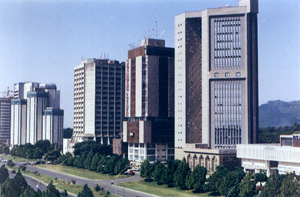
The master plan
of this most modern city was prepared in 1960 by M/S Constantions
doxiades, a Greek firm of Architects. Construction was
started in October 1961. The city came into life on 26
October 1966, when the first office building of Islamabad
was occupied. It is modern and carefully planned city.
|
 |
|
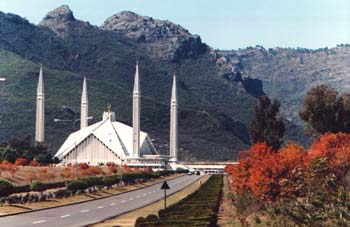 |
There are ample opportunities
for walking, jogging, hiking and trekking around Islamabad
in the Margalla Hills.
|
|
|
|