
Mathematical language and reasoning
"You should say what you mean." the March Hare went on.
"I do."
Alice replied: " - at least I mean what I say."
Lewis Carrol, 'Alice in Wonderland.'
1. Two major themes of the 'Use and Application of Mathematics' section of the National Curriculum are developing mathematical language and reasoning. The Programme of Study is rather vague in detail but makes the point that the material needs to be set in the context of the other areas of mathematics covered. The geometrical content of the Shape and Space section offers a good opportunity to advance this topic since it is less abstract than most others - children often have an intuitive sense of spatial relations and can have concrete examples in the form of diagrams and models to guide them. Another advantage is that the subject is fairly self-contained and the implications are less likely to extend beyond the understanding and experience of pupils of this age. The main theme of this note is examples of the language and reasoning involved in the study of polygons.
| 2. Definitions | |
6. Generalisation | |
| 3. Axioms | |
8. Tilings | |
4. Proof | |
The main emphasis in mathematical language is that it must be precise and concise and an important issue is the place of formal definitions in the scheme of things. Words in mathematics, in contrast to general language, mean only what they are defined to mean and no more - there is no room for ambiguity. In practice life is too short for every word to be defined every time it is used but a mathematician is, in principle, expected to be able to say precisely what is meant by any word used if challenged. An example appropriate to the present theme is the definition :-
A POLYGON IS A PLANE FIGURE. BOUNDED BY STRAIGHT LINES ENCLOSING A SIMPLY-CONNECTED SPACE.
In the bad old days a pupil would have been expected (a) to memorise this definition verbatim and (b) understand what it means. Memorising without full understanding represents failure, but only partial failure - in case of difficulty in later years the pupil at least has the opportunity to investigate exactly what the statement does mean and see whether this resolves the problem. Understanding the general concept without being able to express it precisely inhibits clear thought or communication of ideas.
This definition illustrates an important fundamental principle viz every statement in logic must imply some basic assumptions - as Aristotle noted any logical argument would otherwise extend interminably in search of a 'first cause'. In this case the meanings of FIGURE, LINE, SPACE, BOUNDARY, and ENCLOSE are assumed to be understood intuitively.
A STRAIGHT line is defined as the path between two points having the shortest distance between any two points on it, and a PLANE as the surface generated by a straight line rotated about any line perpendicular to it, while the phrase SIMPLY-CONNECTED means that a continuous path, not necessarily straight, which does not cross the boundary can be found between any two points of the space in question. All of these relate to axioms of Euclidean geometry and are essentially assumptions that not only need not, but in fact cannot, be proved.
3. A relevant real-life example is the case of a pupil who, having plotted a figure from Cartesian coordinates was unable to recall its name. Having been told that since it had four sides, it was a quadrilateral and, having two parallel sides, was more specifically called a trapezium, the pupil enquired (by drawing an example) whether it would still be a quadrilateral if the two non-parallel sides crossed, and might have asked also if it would still be a trapezium. The dilemma is whether it should be considered to be a quadrilateral, a hexagon, or two triangles, and how many vertices it has.
The definition given here says clearly that it is not a polygon since the space enclosed is not simply connected, so it has to be regarded as two triangles in this context. That is not to say however that an alternative definition that would lead to a different conclusion is not permissible - merely that if one is going to deal with such objects a relevant and unambiguous definition has to be provided.

The status of axioms often causes confusion - to say 'this is so because I say it is so' (as opposed to 'this is so because that's the way it is' in Science) seems to contradict the requirement for rigour in mathematics. The Greeks regarded axioms as self-evident truths but during the 19th Century it became apparent that mathematical truth at least is always relative and that the most that can be asked of any mathematical system is that it be self-consistent. Changes to axioms, provided they are not inconsistent, yield different mathematical systems whose relevance to particular practical situations has to be established empirically.
An essential characteristic of mathematical reasoning is an imperative demand for rigorous proof: careful planning and presentation of lessons is needed to avoid obscuring this fact, particularly in 'exploration' work. Intuition, analogy, models, and empirical investigation certainly have a legitimate role in the initial development of mathematical ideas but ultimately a logically rigorous definition or proof has to be found - until it is any idea remains merely a speculation that cannot be used legitimately or reliably. It is a moot point whether prior presentation of 'facts' followed by 'exploration' by pupils to see that what is claimed is so, or initial exploration by pupils followed by formal exposition by the teacher is more effective or, more importantly, less error-prone.
The first encourages familiarity with the style appropriate to mathematical statements and their interpetation, provided the implications are seen, while the second may make the specific factual content, if discovered, more memorable but is liable to give rise to confusing irrelevancies and misconceptions. In practice the relative merit of the two depends on individual pupils' mental style and both approaches will probably be needed, guided by observation of pupil reactions.
5. A popular example is the theorem that the sum of the angles of a triangle is 180°, often 'explored' by dissecting a triangle and fitting the angles together. This is sometimes represented as 'proof' but it cannot not prove the theorem however often repeated, even if the accuracy is untypically high, and special care is needed to ensure pupils are fully aware of this. The use of 'tangrams' to illustrate the concept of area has similar problems - the 'Lucky 13' dissection of a square shows the danger clearly.
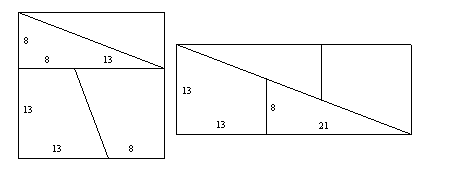
21×21=441
13×34=442
A better empirical approach to the triangle theorem is to cut out three identical triangles from a sheet of paper folded twice and fit the appropriate angles together. This not only tends to be more accurate but gives a clear hint as to how the theorem might be proved viz the line formed by the bases of two triangles appears to be straight and parallel to the base of the other triangle. A rigorous proof can then be constructed by drawing a line through one vertex parallel to the opposite side when, using the 'alternate angle' axiom, the sum of the angles can be shown to equal the angle at the straight line ie 180°.
In educational circles this term is sometimes used as meaning application of the technique used in a particular example to a range of related examples but mathematically it generally means extension of a concept to a wider range of situations with any necessary modifications to meet new implications.
As an example of mathematical generalisation the corresponding definition for three dimensions can be quoted viz
A POLYHEDRON IS A SOLID FIGURE BOUNDED BY PLANES ENCLOSING A SIMPLY-CONNECTED SPACE.
The 'triangle' theorem leads directly to useful examples of mathematical generalisation viz the sum of the angles of a quadrilateral is 360°, proved immediately by drawing a diagonal to give two triangles, and the sum of the angles of a polygon having n sides is (n-2).180°, proved similarly by drawing diagonals from one vertex to all the others (two are already joined by sides), to give (n-2) triangles.
This method of proof also suggests another result - the information required to define a polygon uniquely ie to be able to produce an exact copy of it. This can be done by drawing first one of the component triangles involving the common vertex of diagonals, requiring three pieces of information ie two of the polygon sides and the length of the diagonal joining their ends or the two sides and the included angle. The remainder of the component triangles can be added one at a time but require only two pieces of information since one of the sides is already in place from the previous triangle. The number of pieces of information required in total is thus two for each triangle plus one extra for the first ie 2(n-2) + 1 = 2n - 3.
The simplest from the practical point of view is to know all the sides and the lengths of diagonals from one vertex to the others, since this allows construction with compass alone, but a combination of lengths and angles can be used. Note however that if all the sides are known the three internal angles associated with the last two sides are redundant, as implied by the formula.
7. If the polygon is regular or semi-regular some of these quantities are the same viz for a regular polygon only the common length of the sides and the number of sides is required, the internal angles all being (n-2).180°/n, from the previous result on the sum of the angles of a polygon. This result also provides the starting point for the study of regular polygons called for in the Shape and Space section since it allows pupils to draw these using a graduated scale and protractor. Note that the redundancy in this case provides a means for pupils to check the accuracy of their drawing viz if scale and protractor is used throughout, the length of the last two sides can be checked, or if a compass is used to complete the last two sides, the three internal angles associated with these. This in turn leads naturally to work on network patterns, although the Programme of Work does not make it clear whether or not study of these is required. In fact the word 'pattern' is used loosely in the document, as a synonym for 'sequence' and to characterise less precise similarities in numerical manipulations as well as in its more usual sense of a periodic pattern, relevant here. It also leaves it unclear whether or not tilings should be included - these have close connections with periodic patterns, in that most but not all tilings are periodic.
The formal definition of a periodic pattern - "an object which remains unchanged by some rigid translation". Comprehensive study of these is an enormous subject but an introduction via regular tilings (which are also network patterns) is simpler and can be developed conveniently from this work on regular polygons. Tessellations in general are an example of an open-ended mathematical topic in that the name is used for a wide variety of objects with different properties. An appropriate definition in the present context is :-
"A tiling is an arrangement of shapes which covers a plane without gaps or overlapping using a single shape or a small number of different shapes".
In some cases the definition is extended to cover curved surfaces, often the shapes allowed are restricted to polygons, and sometimes restriced to arrangements which are periodic, although an older meaning includes 'pictures' as well. This definition allows a wide variety of arrangements which can be classified in a number of ways eg
(a) according to whether polygons or curvilinear shapes are used.
(b) according to the number of different shapes used.
(c) according to whether they are regular (ie all sides and all angles the same), semi-regular (ie all sides but not all angles the same), or irregular (ie neither all sides nor all angles the same).
(d) according to whether they are periodic or not.
The categories overlap and appropriate classes in the present context (ie as an introduction and to illustrate mathematical reasoning) are those that are regular, some which are semi-regular or irregular but use a single shape, and perhaps those which use a number of regular polygons. A class which may be relevant to the Art Curriculum are periodic tessellations which use a single curvilinear shape.
9. The simplest case is a regular tiling employing a single polygon as a tile and a complete analysis of the possibilities should be feasible for most KS2 pupils. The first, creative, step is to identify relevant 'facts' from those discussed above
(a) For any tiling the sum of the corner angles meeting at a vertex must be 360° if there are to be no gaps or overlaps.
(b) Since the tiling is to be regular, the polygons must also be regular, so that all sides and all angles are equal
(c) Since the internal angle of all regular polygons is less than 180° (from (n-2).180°/n) at least three must meet at any vertex to make the required 360°.
At this point a number of approaches are possible viz
(a) Draw a set of regular polygons and cut them out to form tiles, finding possible combinations by trial and error.
(b) Draw possible vertices with a protractor to find those which fit the conditions.
(c) Calculate the internal angles of a series of regular polygons (from the formula) and sum them to find which combinations will fit without gaps or overlaps.
The first two empirical methods are more time consuming and inevitably subject to errors, large or small, which make the exactness of the fit uncertain. Only the last can be truly described as 'mathematical reasoning': in this case the most direct method is to calculate how many polygons will fit into the 360° angle at a vertex using the formula for the internal angle. ie number of polygons = 360 ÷ (n-2).180/n = 2n/(n-2). If this number is an integer then the corresponding number of polygons will fit exactly, otherwise there will be gaps or overlaps
| Number of polygon sides,n | 3 | 4 | 5 | 6 | 7 | 8 |
| Number of polygons,2n/(n-2) | 6 | 4 | 10/3 | 3 | 14/5 | 8/3 |
Since the values for n > 6 are less than the minimum of three no polygon larger than the hexagon can be used and the pentagon is excluded because the ratio is not an integer, leaving the equilateral triangle, square, and hexagon as the only regular polygons which can tile a plane alone. This result provides an excellent model of an exhaustive and conclusive mathematical analysis which should be well within the grasp of KS pupils
The range of possibilities for semi-regular and irregular tilings is so large that comprehensive analysis is impracticable but two simple single-polygon cases are of interest in illustrating typical mathematical approaches to problems viz semi-regular tiling using a pentagon and irregular tiling using a scalene quadrilateral.
In the case of regular pentagons it is seen that three give a vertex angle that is too small and four a vertex angle that is too big, suggesting that perhaps it might be possible to distort the angles so as to make a tiling with two types of vertex feasible (ie junctions of 3 and 4 pentagons respectively). The sum of angles for a pentagon is 540° so, pursuing the thought, if two of the angles are made 90° (making a 4-vertex possible) the remaining three angles total 360°, making a 3-vertex also possible. Since a pentagon has five corners, the distortion allows only two alternatives - the 90° angles may be adjacent, or non-adjacent with one obtuse angle on one side and two equal obtuse angles on the other (all possible choices give one or other of these).
When the 90° angles are adjacent the 'tile' has the form of a square joined to an equilateral triangle and gives two tilings corresponding to the possible combinations of these two regular polygons (see 12). The other case gives a flattened pentagon known as the Cairo tile (from its use as a paving stone in that city) with angles approximately 132°, 90°, 114°, 114°, 90° which does indeed tile the plane. In terms of mathematical reasoning this illustrates the creative aspect, by seeking a modification which evades restrictions that stand in the way of the desired outcome.
11. The scalene quadrilateral case shows another aspect of creative mathematical reasoning viz recognition that an argument used in one specific context may have wider implications. In the square tiling the 90° angles are deduced from the fact that the sum of the angles of any quadrilateral is 360° and it is clear that in the general case of a scalene quadrilateral (ie with all sides unequal) the four angles also form a possible vertex. Since the angles are all unequal no one of them at such a vertex can be replaced by another without creating a gap or overlap. Two pairs of the angles might equal 360° but in this case the sum of one of each of the pairs must equal 180°, giving the special case of a parallelogram. The inequality of the sides in the general case implies that only corresponding ones can be joined.
12. The case of a semi-regular tiling using squares and equilateral triangles is more complicated but still sufficiently simple to be accessible to most KS2 pupils. In this case we have available corners of 30° and 90° to build a 360° vertex. All of these angles are multiples of 30° viz 2,3, and 12 respectively. Since the required factor for the sum, 12, is even we must use an even number of squares. Four squares leaves no room for triangles so the only possibility is 2 squares and 3 triangles. The only different cyclic permutations these allow are with the two squares adjacent, or separated by one triangle on one side and two on the other ie vertices tttss or tstst (t=triangle, s=square). Note in passing the difference between cyclic permutation (ie different arrangements of objects around the circumference of a circle, ignoring direction) and the more familiar linear permutation (with 10 possibilities here).

|
|

|