
Positional value number representations
"All animals are equal, but some animals are more equal than others"
George Orwell, 'Animal Farm'
Understanding positional value notation is a requirement of the KS2 Curriculm and with the increased emphasis on mechanical arithmetic is an important feature. Pupils however sometimes find it difficult to associate the seemingly arbitrary rules of computational algorithms with the positional value system. The 'facts' of arithmetic are independent of notation and a passing acquaintance with the advantages and disadvantages of alternative systems that have been used may give a clearer understanding.
| 1. Origins | |
5. Recording and zero | |
| 2. Tallies | |
7. History | |
| 3. Cumulative symbols | |
8. Notes | |
| 4. Addition | |
Details of the origins of number and arithmetic are lost in the mists of time. By the time writing developed to the extent of producing sufficient surviving records number concepts and arithmetic prove to be already well established and this is confirmed by discoveries of Stone Age artefacts with number markings. The earliest of these is dated around 30,000 BC and contains a two tallies, of 25 and 30 objects, but their purpose in unknown. The discovery of a bone with scratched number markings dated around 9000 BC at Ishango, in East Africa, however shows considerable numerical sophistication, containing a multiplication table up to 2 × 5 followed by the prime numbers in sequence up to 19, with a third row giving 10±1 and 20±1 (ie 9, 11, 19, 21). There has been considerable debate as to its function but the fact that it was considered worth the effort of producing it indicates appreciable numerical activity.
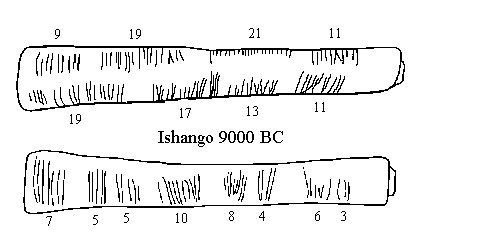
It seems possible the development of a number concept was contemporary with the invention of language. The only indirect evidence we have is in 'linguistic archeology' - words and phrase structures associated with number are seen to be stable and long-lived. Common phrase structures and word roots found in many languages indicate an early origin of the concept involved, before the individual spoken languages diverged. By tracing changes in word roots and forms in general a rough chronology of the origins and development of individual languages can be established, giving us some idea of how and when number and arithmetic concepts may have developed. The following scenario should start "Once upon a time..." but provides a plausible rationale for the development of the positional value concept.

One of a goat-herd's main responsibilities is to ensure that all the goats he takes out to pasture return. If he puts a stone in his pocket as each goat comes out of the gate when setting out and removes one from his pocket as each goat returns through the gate he is assured that none have been left behind if his pocket is empty after the last goat has entered. This requires no ability on his part to count (ie assign names to the successive natural numbers) or to remember the number. His main problem is probably having to walk lop-sided because of the weight of stones he carries in his pocket.
To avoid carrying so many stones he could drop a brown stone into a bowl, say, as each goat emerges and when ten brown stones have accumulated replace these with a white stone, similarly replacing ten white stones with a black stone if necessary. By putting the final tally in his pocket and reversing the process on return he achieves the objective of verifying the number of goats with far fewer stones but still without having to remember (or name) the number or count higher than ten. This approach provides a possible basis for the development of systematic enumeration of ordinal numbers eg two black stones, five white stones, and three brown stones - corresponding to the basic phrase structure found in many languages. This structure suggests a cumulative symbol system is in use - the hundreds, tens, and units are spoken of as separate entities whereas rigorous attachment to a positional value system would produce the phrase "two five three" - a form sometimes used in modern times.
If the village head-man requires to know how many goats the villagers possess collectively all the goat-herds can bring their bowls of stones to a central point and the whole herd be tallied in a similar way without requiring the presence of the goats, introducing higher value 'stones' when necessary. This process is much more convenient if the goat-herds sort their stones into heaps of separate colours and lay them out in order in parallel lines. This is still a cumulative symbol rather than a positional value system but begins to suggest the idea of positional value and, possibly, a monetary system.
5. Recording
To avoid the inconvenience of having to store the physical tokens a scribe might record the total number of goats by drawing a 'picture' of the resulting heaps of stones. To save time (and paper, papyrus, or clay tablets) he might well devise shorthand symbols for the number of stones in each heap, thus creating a numeral system with digits 1-9. This is still not a true positional value system since the pictures have to be annotated somehow to indicate the colour of each heap recorded.
6. Zero
While physical tokens are used there is no practical demand for a symbol for zero (ie for an empty 'heap' or 'column') since the absence of stones of any particular colour is self-evident. Once written symbols are substituted a symbol has the advantage that the colour of each heap need no longer be recorded, but specified uniquely by its position in the row of symbols, creating a true positional-value system. Note however that all operations of the type described can be implemented without having to introduce the idea of arithmetic operations or having to count to more than ten ie a positional value system of number representation does not necessarily imply that 'arithmetic' in the modern sense has been developed, nor does a requirement for 'arithmetic' imply that a positional value system is essential.
7. History
The Sumerians around 2000BC used a base-60 positional value notation with a highly developed system of astronomical and calendar calculation probably associated with the periodic floods essential to their agriculture. A symbol for zero is recorded later but seems not to have been used universally. The Egyptians used a cumulative symbol system and by 1600BC had developed arithmetic operations using multiplication, division, fractions, and Pythagoras' theorem without a symbol for zero or introducing positional value. Systems essentially similar to the Egyptian continued till medieval times, via Greece and Rome.
The earliest Chinese records use a decimal system based on a partitioned counting board - a vertical stick symbolised one unit and a horizontal stick five units, with combinations of one horizontal stick and five vertical sticks being replaced by one vertical stick in the next partition. A recorded written symbol for zero was late in appearing but by 1100BC they had an extensive arithmetic system including solution of quadratic and Diophantine equations, extraction of cube roots, and modular arithmetic. A transition to numerals is seen in the 'commercial' system where some of the stick combinations are replaced by shorthand glyphs, as is also seen in later Egyptian systems.
Similar systems are seen slightly later in India and decimal arithmetic with positional value notation was transmitted to Europe in the 10th Century AD via the literature of the Muslim culture which arose around 700AD, preserving details of the best in all these systems as well as adding its own contribution.
8. Notes
The criteria for a positional value number representation are
(a) The symbols used for digits of different orders are identical.
(b) The value of the number represented changes if the digits are shuffled.
(c) There is a symbol for zero
The 'coloured stones' approach, the Egyptian and Greek systems, and models such as Deans Apparatus satisfy none of these and are unequivocally cumulative value systems. The Roman system shows some positional value elements in the notation for four and nine for example but is otherwise a cumulative symbol system. The early Chinese system which lacked a written symbol for zero is a border-line case. Mathematics fundamentally deals with things of the mind rather than concrete objects - by Greek choice in 600BC and logical necessity in 2000AD - and it is arguable whether a minds-eye image of an empty position on the counting table constitutes a mental symbol for zero. The issue is clearly resolved when a written symbol for the mental image appears but Chinese records tend to omit operating detail for the counting board or abacus, concentrating on problems and solutions, so that the concept could predate the written symbol by a substantial period.

|
|

|