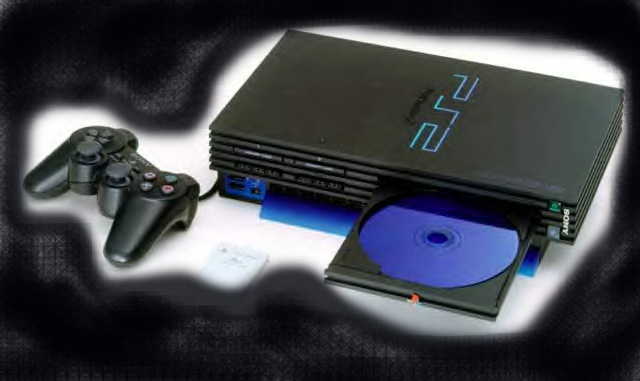
Product:
PlayStation2 Price: Japan gets it for a paltry 39,800 yen ($400). SCEA has yet
to determine a price for the US, but the price will be much lower than Japan's.
Available: Those lucky people in Japan can purchase one on March 4th, 2000.
The US launch is currently stated for Fall release next year. Comes With: Dual
Shock 2 Analog Controller, 8MB Memory Card, Demo Disc, AV Multi Cable, AC Power
Cord. Dimensions: 12" x 7" x 3" Weight: 4lbs. 10 oz. CPU: 128-bit Emotion Engine
294,912 MHz 32MB Direct RDRAM Memory Comments: It's fast; really fast. Forget
your PC, the PlayStation2 is the most powerful home gaming system ever created.
You know how the Dreamcast is thinking? Well, the PlayStation2 already knows.
PlayStation2's Dual Shock 2 Analog Controller Dimensions: Just About the size
of your current PlayStation Dual Shock Controller. Weight: If it's gained some
weight,you can't tell by looking. Features: All functions and buttons except
for "start" and "select" are fully analog. Built-in "Shock" effect. Backwards
compatiblewith original Dual Shock Analog Controller. Comments: Push the accelerator
pedal in a car -- the harder you push, the faster you go. That's how analog
control works. Every control interface on the pad now reacts to how musch pressure
you appply to it. The Sony PlayStation 2 (www.playstation.com) hit the streets
in Japan on March 4 and sold almost one million units in its first two days
of availability. (It will arrive this fall in the U.S.) When the company started
taking preorders online, they had to shut down the site temporarily because
it got.....
flooded
with close to half a million orders in the first few hours. With numbers like
that, Sony is going to have to revise their estimates up a bit from their
original guess of selling one million units in the first week. The company,
the press, and the kids are all excited about the new PlayStation 2 for various
reasons, and I would guess that, as a rabid 3D designer/developer/follower,
you're a bit excited too. More PlayStations means more titles using 3D graphics,
and that means more work for some of us. By now, you've probably heard that
the new machine is supposed to be pretty hot stuff when it comes to the hardware,
and you may have heard about (or are already working on) titles that are supposed
to blow away the competition. The PlayStation 2 hardware is supposed to have
real-time particle systems, multiple transparency layers, fog effects, smoke
effects, reflections, highlights, a built-in, real-time scanline rendering
engine, and just about every other effect short of radiosity (and I've even
heard people claiming that the hardware supports a rudimentary version of
that). All these graphic features are pretty cool, but you have to wonder
how many game developers are going to take advantage of them. For years, game
developers have been following one golden rule when it comes to special lighting
or geometry: You can't rely on the hardware. In other words, you never know
what kind of machine your title is going to end up on. Granted, game-console
developers have the luxury of knowing down to the pixel what their target
hardware was capable of doing, be it a Sega (www.sega.com), Sony, or Nintendo
box (www.nintendo.com). But the prevailing thinking still holds that you'd
have to be crazy to attempt real-time rendering or any kind of serious geometry
processing on one of those machines. Most game developers have relied on good
old prebuilt models and extensive texture mapping to get the effects (and
speeds) they desired. If they wanted a cool effect, they would build it, render
it, and then try and figure out how to get their engine to simulate it during
game play (using as few CPU cycles as possible). If they wanted a truly realistic
background, they would model it, render it, and then slap those textures on
the background at play time. They took the same approach in creating moving
characters: Build the model with a few thousand polys, render it to generate
some texture maps, de-res the original model, then slap the textures on at
game time. Sony, with the much-touted PlayStation Emotion Engine CPU and sundry
graphics coprocessors, is now telling the game-developer community that their
new box is fully capable of handling those tasks in real time. In fact, they
want their developers to start using those features as quickly as possible.
The trouble is that doing these things in real time is anathema to game developers.
They don't even know where to begin building games that rely on real-time
rendering, geometric manipulation, and so on. Certainly, a few games will
be ready at launch time that use some of the hardware capabilities of the
new machine, but for the most part, we'll probably see the majority of titles
sticking to tried-and-true techniques. Eventually, game developers will take
advantage of the hardware as Sony intends, but it will take time and a certain
amount of learning to see how far they can push the hardware and what works
best. About now, you might be wondering what's going to happen to traditional
3D artists when developers can generate textures, particles, and lighting
effects in real time. Does that mean all you texture artists are going to
be out of a job? I don't think so. If anything, it's going to mean that the
successful title developers will be using their 3D artists even more. They
might even start picking their brains a bit and giving them more respect.
The first time pure programmers try to plug some raw geometry into a PlayStation
2 Emotion Engine and the results look like... well you can use your imagination...
they're going to go back to the artists to ask what went wrong. At that point,
the programmers will learn where the artist part of 3D artist comes into play.
Postscript: Sony has recalled all the PlayStation 2 memory sticks. They hinder
DVD playback and can even crash the unit entirely. How this will affect the
new platform remains to be seen, and 3Dgate will keep you informed of details
as they become available.