 |
| Auto-Cocker Exhaust Valve Mod |
| as spawned and hatched by the Electrician, LPCD and Vampyr and the gang at the www.warpig.com technical forums |
| We've been playing with Quick exhaust valves for the rams on cockers. This Idea was basically stolen from the rainmakers. The goal is to exhaust the air through a large port at the ram rather than running it back through that tiny LP hose to the 4-way and exhausting it there. Exhausting the air at the ram allows the ram to move quicker and allows you to set the front pressure regulator lower. Secondly since the air is only moving from the 4-way toward the ram instead of back and forth, more lubrication gets to the ram hopefully extending service life. |
| What it is and Why |
| How |
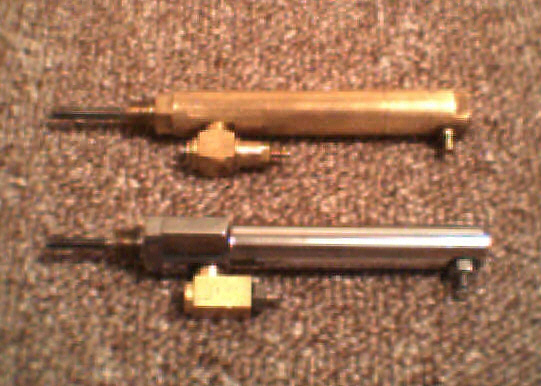
| So far we have used two types of valves: Humphrey SQE Clippard MEV-2 Both of these have a male 10-32 thread port that goes to the cylinder, and two 10-32 thread female ports, one input and one exhaust. There is also a MEV-2-M5 that has the M5 metric thread. Cylinders. There are a lot of them, some require more work than others. We'll try to get you info as we find out ourselves. Clippard Rams, these are already threaded 10-32 and the nose nipple(closest to the front block) is far enough away from the front block, where all that has to be done is unscrew the nipple, screw the exhaust valve into the ram, and the nipple back into the IN port on the valve. Palmer Rams, these are also 10-32 thread, but I don't know how far back the nose nipple is. Stock Pre-2K, these are 6-40 thread. You must disassemble the ram, remove the nipples, drill the holes out, re-tap them 10-32, clean up all of the filings, re-assemble the ram, then treat it like the clippard. Stock 2K+ These need the re-tapping like the pre-2K plus The nose nipple is so far forward (towards the front block) that the exhaust side of the exhaust valve needs to be cut down or it will hit the banjo bolt. The Humphreys are press fit together. The interior press fit is the same size as the (smaller) exterior diameter. You should be able to cut them down to the main body with no risks (this could be done with a saw and file). STO Questionable there is plenty of room between the nose nipple and the front block, but depending on year, they could be 10-32 (old) or 6-40 (new). |
|
| Stock pre-2k with Humphrey |
| Clippard with Clippard |
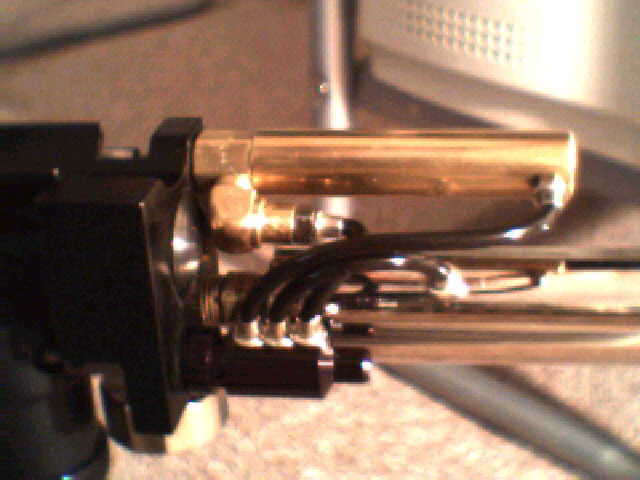 |
| Stock 2K ram note how close to nose threads the valve is. |
| Note the difference in nut size of the tail nipple. The stock (6-40) is much smaller than the clippard (10-32). also look at the additional photos link. |
| Current Opinions/Debates |
| The only valve that is truely required is the nose end. The tail end is the debate. If there is a valve in the tail, the bolt closes faster. The question is whether this will add to paint chopping from the ball not having time to drop or breakage from the bolt hitting the ball harder, as well as the marker jumping more from the inertia of the bolt closing (1/2 m*V*V). I have two on mine (see photo in additional photos.). I tried adding the restrictor to it today (the tail). That was a mistake. If I sent you a restrictor, and you want to slow the bolt closing, you will need to drill it out to allow the bolt to close fast enough. |
| Email addys |
| Up to date discussion |