1620 Geographos
|
Discoverer |
A.G.Wilson - R.Minkowski 1951. |
|
Diameter (km) |
5.1 x 1.8 |
|
Mass (kg) |
4*10^12 |
|
Rotation period (hrs) |
5.222 |
|
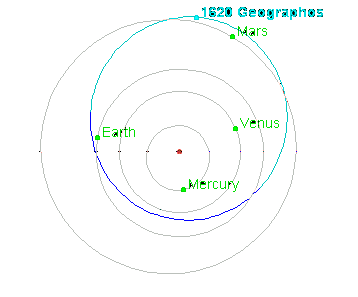
Orbital period (yrs) |
1.39 |
|
Semimajor axis (AU) |
1.24550 |
|
Orbital eccentricity |
0.33557 |
|
Orbital Inclination (deg) |
13.33966 |
|
Albedo |
0.25 |
|
Type |
S |
|
Geographos means geographer. That name was chosen to honor the National Geographic Society for its support of the Palomar Mountain Sky Survey. Geographos is one of many Earth-crossing asteroids. More than 300 such asteroids have been found; however, there might exist hundreds of thousands of similar objects. The asteroids probably include several hundred objects larger than Geographos, thousands larger than 500 meters across, and a few hundred thousand that are larger than 100 meters. Geographos is highly irregular (5.1 X 1.8 kilometers). It has the largest
length-to-width ratio of any solar system object ever imaged to date.
It is not known whether the asteroid
is a single coherent body or consists of several distinct pieces. |
|
Images of Geographos |
|
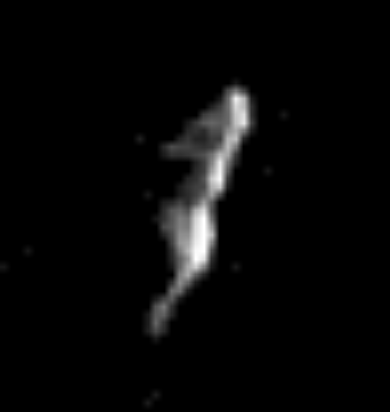
Researchers obtained radar images of the asteroid on August 30, 1994, when the asteroid was 7.2 million kilometers from Earth. They used a planetary radar instrument to image the asteroid from the Deep Space Network's facility at Goldstone, California. Scientists conducted the radar observations a few days after Geographos passed 5 million kilometers from Earth, its closest approach in at least two centuries. (Credit Dr. Steven J. Ostro, JPL/NASA). |
|
|
|
|
|||||
|
|
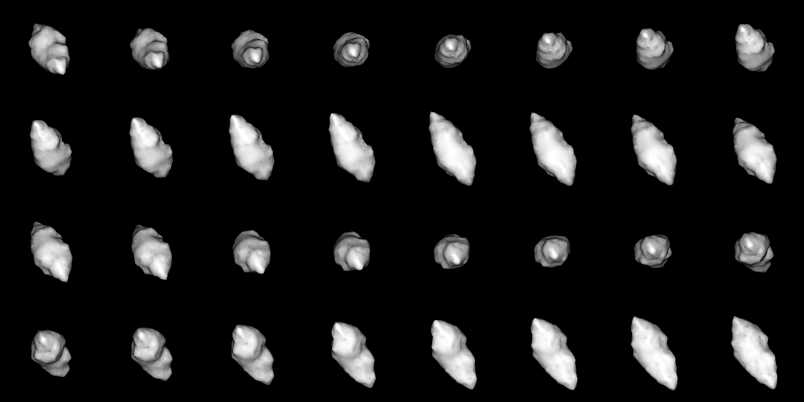
Computer generated models of 1620 Geographos (Credit Scott Hudson). |
||||||
|
|
3-D View of 1620 Geographos |
||||||
|
|
|
|
|
Last updated: March 15, 2002.