What
is Fiscal Policy?
Fiscal policy is the process of shaping government taxation and government spending so as to achieve certain objectives. According to Prof. Samuelson, by a positive fiscal policy we mean the process of shaping public taxation and public expenditure in order to:
(i) To help dampen down the swings of a business cycle, and
(ii) To contribute towards the maintenance of a growing high employment economy free from excessive inflation or deflation.
Classical
View vs. Keynesian View:
There are two views regarding the policies adopted by the government in order to operate the economy – Classical View and Keynesian View.
1. Classical View: Classical economics, the prevailing economic theory prior to the Great Depression, hypothesizes that market economies are inherently stable. In particular, actual GDP automatically adjusts to the economy's productive capacity, called potential GDP. Economic capacity is determined by the quantity and quality of resources available (e.g., labour, capital and natural resources). If resource prices are flexible, they will adjust until resources are fully employed and the economy is operating at economic capacity. If resources are under-employed, their prices will fall. Production becomes more profitable as resource prices fall, encouraging firms to expand output. GDP expands until under-employment is eliminated. Conversely, prices will increase for over-employed resources, reducing profits, decreasing production and eliminating over-employment.
With sufficient resource price flexibility, the economy will adjust to full employment relatively quickly. In this case, counter-cyclical fiscal policy is unnecessary in the short run and counterproductive in the long run. If resource price flexibility stabilizes the economy relatively quickly, fiscal policy is unnecessary in the short run. Furthermore, the economy cannot accommodate the increased aggregate demand after returning to full employment, assuming potential GDP is unaffected by expansionary fiscal policy. Thus, expansionary fiscal policy increases prices in the long run, rather than GDP. As a result, Classical economists believe that the Federal Government should maintain a balanced budget; flexible resource prices stabilize the economy at full employment.
2.
Keynesian View: John
Maynard Keynes formalized a theory linking fiscal policy and economic
performance in his book ‘General Theory of Employment, Interest, and Money’
in 1036. He believed that Classical
economic theory was inconsistent with the Great Depression that the U.S. and
world economies experienced in the 1930s. Even though the U.S. unemployment rate reached 25% in 1933,
flexible resource prices failed to restore full employment.
Keynes offered two
explanations for the Great Depression: sticky
prices and pessimistic expectations. Keynes
hypothesized that resource and product prices are sticky rather than flexible,
particularly with respect to price decreases (i.e., a horizontal AS curve, at
least in the short run). Sticky
prices are slow to decrease as unemployment increases. Furthermore, if producers and consumers have pessimistic
expectations, price decreases might not stimulate increased production.
Lower resource prices will only increase output if producers expect to
sell the extra output. If consumers are pessimistic about future economic
conditions, they will not consume more as prices fall; accordingly, business
will not increase output. Thus,
falling prices might not stimulate business investment and production.
Keynes believed that
prices were sticky and expectations pessimistic during the Great Depression. Under these conditions, the economy can experience prolonged
high unemployment rates. Keynes
advocated counter-cyclical fiscal policy to supplement private spending and
stabilize the economy. He felt that
the potentially prolonged unemployment during an economic contraction imposes
unacceptable social and personal costs. He
supported counter-cyclical fiscal policy to minimize these short run costs.
Keynes was among the
first to advocate that federal budget deficits are appropriate in the short run
when the economy is operating below full employment.
Professor Lind Holm
in his book ‘Introduction to Fiscal Policy’, laid down the following four
main objectives of fiscal policy
(i) The achievement of desirable prices,
(ii) The achievement of desirable consumption level,
(iii) The achievement of desirable employment level, and
(iv)
The achievement of desirable income distribution.
The objectives of
fiscal policy differ in different countries according to their economic
conditions and needs. That is why,
the fiscal policy is known as the process of shaping taxation and public
spending with a view to achieve certain specific objectives.
In advanced countries, the objectives of fiscal policy is to increase
aggregate demand by stimulating consumption function, whereas in underdeveloped
countries, the consumption of luxurious items has to be discouraged in order to
encourage saving for increasing the rate of economic development.
In economically advanced countries, the goal of fiscal policy may be to
reduce the inequality of income in order to check under consumption; whereas in
a backward economy, unequal distribution of wealth may be allowed rather
encouraged for promoting capital formation.
Though the objectives are controversial but they are grouped into three:
1. To achieve full employment without much inflation,
2. To dampen the swings of business cycle and promote moderate price stability in the economy,
3.
To increase the potential rate of growth with consistency
if possible without interfering with attainment of other objectives of society.
1.
Full-Employment:
An economy can attain the potential rate of growth when the
full-employment rate of capital formation, rate of technological change, the
improvement in levels of skill and education, and increased availability of
other factor units are achieved. Total
spending (C + I + G) must at all times keep pace with rising national income
(Y), or otherwise the unemployment will develop.
2.
Price Level Stability:
The maintenance of a reasonably stable general price level is also regarded as a
major objective of fiscal policy. A decline in the general price level is incompatible with the
maintenance of full employment and would generate bitter labour strife, as well
as injuring debtors. Inflation –
a rising price level – does offer the limited advantage of aiding investment.
However, a continued inflation of any magnitude produces is undesirable.
Stability in the
price level does not require stability of prices of all individual commodities.
Commodities experiencing more than average increases in productivity will
decline in price; and those with little change in productivity will rise as
money wages rise to reflect the higher productivity in the other fields.
If money wages keep pace with productivity in manufacturing, the general
price level will rise slowly.
As full employment is
approached unions may tend to push money wages up faster than productivity and
prices will rise. Some trade off
between the two objectives may be necessary, that is, society may have to accept
some unemployment in order to avoid inflation.
One study concludes that 4% unemployment is necessary if the increase in
the general price level is to be held to 1½ percent; with 3 percent
unemployment the price level increase will be 2½ percent or more.
3.
Sustained Economic Growth:
The third goal of fiscal
policy is to increase the potential rate of economic growth. A higher rate of economic growth requires a higher rate of
capital formation and a higher S/Y ratio at full employment. But additional
saving requires reduction in consumption. It
is a choice between present and future consumption.
The government uses
various fiscal weapons in order to achieve a growing high employment economy
free from excessive inflation or deflation.
They are as follows:
1.
Built-in Stabilisers / Automatic Fiscal Policy:
The automatic or built-in stabilisers are as follows:
(a) Taxes: Our
present tax system automatically operates to eliminate the cyclical fluctuation
in the economy. When a wave of
optimistic sentiments prevails in the business circles and there is a rise in
prices, rise in profits and the need is to contract the inflationary pressure,
the progressive tax system comes to rescue and contracts the surplus purchasing
power from the economy. When a
country is faced with falling income and expenditure, the burden of tax
automatically lessens. The state
has not to make any conscious effort to counteract deflationary potential.
As the graduated rates apply on income, the burden of the tax is reduced.
The consumers are thus left with more purchasing power to spend on
consumption as well as on producer goods. We,
thus, conclude that the progressive tax system contains automatic stabilising
properties.
(b) Unemployment Compensation:
In advanced countries of the world, people receive unemployment compensation and
other welfare payments when they are out of job.
As soon as they get employment, these payments are stopped.
When national income is increasing, the unemployment fund grows due to
two main reasons:
(i) Government receives greater amount of payroll taxes from the employees, and
(ii) The unemployment compensation decreases.
Thus, during boom
period, the unemployment compensation reserve funds help in moderating the
inflationary pressure by curtailing income and consumption.
When the economy is contracting, unemployment compensation and other
welfare payments augment the income stream and they prove a powerful factor
increasing income, output and employment in the country.
(c) Farm Aid Programme:
Farm aid programmes also stabilise against the wave like cyclical fluctuation.
When the prices of the agricultural products are falling and the economy
is threatened with depression, government purchases the surplus products of the
farmers. The income and total
spending of the agriculturists thus remain stabilised and the contraction phase
is warded off to some extent.
When the economy is
expanding, the government sells these stocks and absorbs the surplus purchasing
power. It thus reduces inflationary
potential by increasing the supply of goods and contracting the pressure of too
great spending.
(d) Corporate Savings and Family Savings:
The credit of having automatic or built-in stabiliser does not go to the state
alone. The corporations and companies and wise family members too
play an important part to contract cyclical fluctuations. For instance, the corporations pay a fixed amount every year
to the shareholders and withhold part of the dividends of the boom years to pay
in the depression years. Thus
holding back some earnings of good years contracts the purchasing power and
releasing of money in poorer years, expands the purchasing power of the people.
Similarly, wise persons also try to save something during the prosperous
days in order to spend the savings in the rainy days.
2.
Discretionary Fiscal Policy:
By discretionary fiscal policy is meant the deliberate changing of taxes and
government spending by the control authority for the purpose of offsetting
cyclical fluctuations in output and employment.
The discretionary fiscal policy has short-run as well as long-run
objectives:
(a) Short-Run Counter-Cyclical Fiscal Policy:
The main weapons or stabilisers of short-run discretionary fiscal policy are:
(i) Persuasion,
(ii) Changes in tax rates,
(iii) Varying public works expenditure,
(iv) Credit aids, and
(v) Transfer payments.
(i) Persuasion:
In a capitalistic society, the entrepreneurs are not aware of each other’s
investment plans. They, therefore,
in competition with one another over-invest capital in a particular industry or
industries and thus cause overproduction and unemployment in the economy.
Similarly, in depression period, there is no agency to guide them.
If government publishes the total investment plans and marginal
efficiency of capital in various industries, much of the investment can proceed
at a moderate speed and there can be stability to some extent in income, output
and employment.
(ii) Changes in
tax rates: It is an
important weapon of fiscal policy for eliminating the swings of the business
cycle. When the government finds
that planned investment is exceeding planned savings and the economy is likely
to be threatened with inflationary gap. It
increases the rates of taxes. The
higher taxes, other things remaining the same, reduce the disposable income of
the people who then are forced to cut down their expenditure.
The economy is thus, saved from inflationary situation.
If, on the other
hand, planned saving is in excess of planned investment and the economy is
likely to be faced with deflationary gap, the taxes are lowered considerably so
that people are left with more disposable income.
When purchasing power of the people increases, the rate of spending on
consumption and investment increases. The
economy is thus saved from deflationary situation.
(iii) Varying
public works expenditure:
Another important factor, which influences economic activity, is public
expenditure. In times of depression, the government can contribute direct
to the income stream by initiating public works programmes and in boom period it
can withdraw funds from the income stream by curtailing them.
(iv) Credit
aids: The government
can also avert depression by offering long-term credit aids to the needy
industrialists of starting or expanding the business.
It can also give financial help to insurance companies and bankers to
prevent their failures.
(v) Transfer
Payments: Variation
in transfer expenditure programmes can also help in moderating the business
cycle. When the business is brisk,
the government can refrain from giving bonuses to the workers and thus can
lessen the pressure of too great spending to some extent. When the economy is in
recession, these payments can be released and more bonuses can be given to
stimulate aggregate effective demand.
(b) Long-Run Fiscal Policy:
The objectives of long-run fiscal policy / full fiscal policy are as below:
(i) High level of employment
(ii) Stabilisation of price level
(iii)
Reduction in inequality of income
Phases of
Long-Run or Full Fiscal Policy:
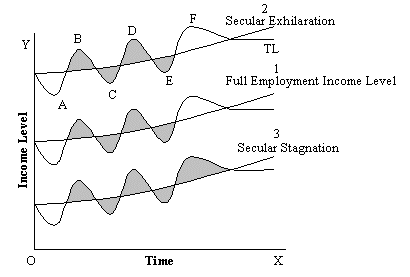
The long-run fiscal policy has two phases:
(i) Secular Exhilaration, and
(ii) Secular Stagnation
In the above diagram,
the cyclical fluctuation around the income level (along Y axis) on line 1, can
be eliminated by an effective short-run fiscal policy.
At trend line 2, the
economy is in a state of secular exhilaration, i.e., it is having a perpetual
inflationary gap. It is obvious
that the condition of chronic inflation is not desirable and so is to be
remedied. The built-in stabilisers and discretionary stabilisers can
only offset the cyclical fluctuations but cannot bring down the level of income
to full employment level. So we
have to adopt long-term fiscal measures. The
economists recommend that government should (i) create surplus financing, and
(ii) public debt over a long period of years.
The trend line 3
indicates a state of chronic depression which Professor Hansen calls secular
stagnation. When the economy is
having a deflationary gap over decades, the anti-cyclical fiscal measures alone
cannot lift the economy from secular stagnation.
The following long-term fiscal measures are recommended to overcome the
situation:
Governments can use
fiscal policy as a counter-cyclical tool, because changes in government outlays
and taxes affect aggregate demand and aggregate supply.
Using fiscal policy as a counter-cyclical tool to promote full employment
and price stability with little or no regard for its effect on the national debt
is known as functional finance.
According to Keynes, market economies had a proclivity to fall into
depression when consumer and business spending declined. Instead of
waiting for self-correcting market mechanisms to work, Keynes advocated
deliberate deficit spending by the government to stimulate aggregate demand.
This would immediately create jobs and incomes for otherwise unemployed workers.
The role of fiscal
policy is to remove the inflationary or deflationary gap from the economy. The government can apply three main fiscal tools, i.e., tax,
government spending, and transfer payments:
1.
Expansionary Fiscal Policy / During Deflation:
During deflation the
government has three choices:
(a) Increase government spending, i.e., government purchases multiplier
(b) Decrease taxes, i.e., tax multiplier
(c)
Increase transfer payments
(a) Increase government spending:
An increase in government spending for public goods and services:
(i) initiates a multiplier effect which results in a cumulative increase in total spending that is greater than the initial change in government spending
(ii) is always undertaken when the public wants more government services.
(iii) should always be accompanied by an equal increase in taxes, so that the budget remains in balance, i.e., balanced budget multiplier.
(iv) is an effective policy tool when the economy is in Stagflation.
(v) is impossible if the budget is already in deficit and the economy is in Depression.
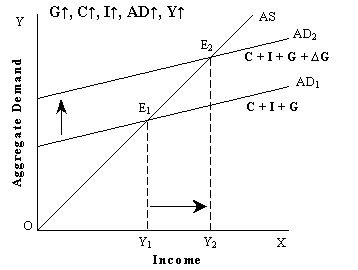
In the above diagram,
the economy is operating at equilibrium point E1, which is less than
the full employment level of E2, or in other words, the economy is
facing deflationary gap. At point E1,
the aggregate demand curve AD1 intersects the aggregate supply curve
AS. When government spending is
increased, the aggregate demand increases from AD1 to AD2.
Now the new aggregate demand curve AD2 intersects the
aggregate supply curve AS at a new point of equilibrium, i.e., E2.
At this new equilibrium point E2, the national output is
higher than before and the economy is operating under full employment level.
(b) Decrease taxes: Generally speaking, the tax multiplier for a decrease in taxes is weaker than the government spending multiplier, because:
(i) paying taxes is voluntary.
(ii) the underground economy avoids paying taxes through tax loopholes.
(iii) income taxes can be passed on to somebody else.
(iv) part of a tax cut will be saved.
(v) politically, it's not as easy to cut taxes as it is to cut government spending.
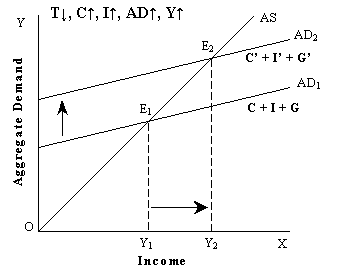
In the above diagram,
the economy is operating at equilibrium point E1, which is less than
the full employment level of E2, or in other words, the economy is
facing deflationary gap. At point E1,
the aggregate demand curve AD1 intersects the aggregate supply curve
AS. When government decreases taxes
to give a boost in consumption and investment expenditure, the aggregate demand
increases from AD1 to AD2. Now the new aggregate demand curve AD2 intersects
the aggregate supply curve AS at a new point of equilibrium, i.e., E2.
At this new equilibrium point E2, the national output is
higher than before and the economy is operating under full employment level.
(c) Increase transfer payments:
During deflation, when transfer payments (pensions, unemployment compensation,
allowances, etc.) are increased, the multiplier effect is of minor magnitude.
However, it can help in:
(i) removing deflationary gap from the economy,
(ii) increasing purchasing power of the people, and
(iii)
bringing full employment level in the economy (to some extent)
2.
Contractionary Fiscal Policy / During Inflation:
During inflation the government has three choices:
(a) Decrease government spending, i.e., government purchasing multiplier
(b) Increase taxes, i.e., tax multiplier
(c)
Decrease transfer payments
(a) Decrease government spending:
During inflation, a decrease in government spending:
(i) will cause a decrease in aggregate demand more than the change in government spending through multiplier effect
(ii) is always undertaken when there is a severe inflationary gap in the economy
(iii) is an effective fiscal measure when the economy is in hyper inflation
(iv) a decrease in government spending should always be followed by an decrease in taxes, so that the budget remains in balance, i.e., balanced budget multiplier
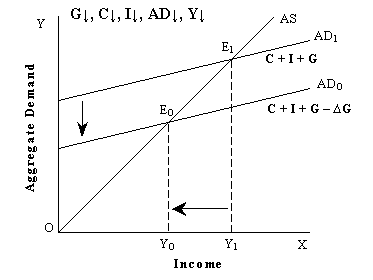
In the above diagram,
the economy is operating at the equilibrium point E1, which is higher
than the full-employment level of EO, or in other words, the economy
is facing an inflationary gap. At
point E1, the aggregate demand curve AD1 intersects the
aggregate supply curve AS. When the
government reduces its spending, the aggregate demand curve shifts from AD1
to ADO. Now the new
aggregate demand curve ADO intersects the aggregate supply curve AS
at a new point of equilibrium, i.e., EO.
At this new equilibrium point EO, the national output is less
than before and the economy is operating under full employment level.
(b) Increase taxes:
If the economy is operating at a level above full employment level, the
government can remove this inflationary gap through excessive taxation.
The removal of inflationary gap will depend on the multiplier effect of
increase in tax or tax multiplier. These
fiscal measures will bring the following changes in the economy:
(i) decrease in aggregate demand
(ii) decrease in consumption and investment expenditures, and
(iii) finally a decrease in national output cutting the extra inflationary pressure in the economy
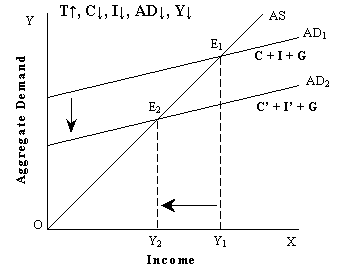
In the above diagram,
the economy is operating at the equilibrium point E1, which is higher
than the full-employment level of EO, or in other words, the economy
is facing an inflationary gap. At
point E1, the aggregate demand curve AD1 intersects the
aggregate supply curve AS. When the
government increases taxes, the aggregate demand curve shifts from AD1
to ADO. Now the new
aggregate demand curve ADO intersects the aggregate supply curve AS
at a new point of equilibrium, i.e., EO.
At this new equilibrium point EO, the national output is less
than before and the economy is operating under full employment level.
(c) Decrease transfer payments:
Decrease in transfer payments can improve the inflationary situation in the
economy, but decreases in pensions, unemployment compensations, allowances, can
be very controversial and socially apathetic.
However, a decrease in transfer payments can remove the inflationary gap
from the economy.
The role of fiscal
policy in less-developed countries differs from that in developed countries. In developed countries, the role of fiscal policy is to
promote full employment without inflation through its spending and taxing
powers. Whereas the position of
developing nations is entirely different. The
LDCs or economically backward countries are caught up in vicious circle of
poverty. The vicious circle of low
income, low consumption, low savings, low rate of capital formation and low
income has to be broken by suitable fiscal measures. Fiscal policy in developing countries is thus used to achieve which are different from advanced
countries. The principle objectives
of fiscal policy in a developing economy are as under:
1.
Resource mobilisation:
Resource mobilisation for financing the development programmes in the public
sector can be attained through:
(a) Taxation:
Taxation is an important instrument for fiscal policy.
It is widely used to mobilise the available resources for capital
formation in the economy. The moping up of surplus resources through taxation is an
effective mean of raising resources for capital formation.
There are two types of taxes which are levied to transfer funds from
private to public use:
(i) Direct taxes: are levied on the income, profits and wealth of the people who have potential economic surplus.
(ii)
Indirect taxes: are the taxes such as excise
duty, sales tax, etc, imposed mostly on good which have higher income elasticity
of demand.
(b) Tax on farm income:
Agriculture sector is another important source of revenue which can be tapped
for capital formation. Agriculture
is the largest sector of under-developed countries and should be subject to
progressive taxation. The
government can raise a substantial amount of tax revenue from agriculture
sector.
2.
Promoting development in the private sector:
In a mixed economy, private sector constitutes an important part of the economy. While framing fiscal policy, the interests of the private
sector should also be prioritised. The
private sector of any economy makes significant contribution to the development
of the economy. The fiscal methods
for stimulating private investment in developing countries are:
(a) Income from government saving schemes be exempted from taxation, in order to boost up private saving,
(b) Rates of return on voluntary contribution to provident fund, insurance premium, etc., be raised for incentive to save,
(c) Retained profits of the public companies should be taxed at preferential rates or exempted from taxation, in order to boost private investment, and
(d)
Rebates and liberal depreciation allowances
can also be granted to encourage investment in the private sector.
3.
Restraining inflationary pressure:
One of the important objectives of fiscal policy is to use taxation as an
instrument for dealing with inflationary or deflationary pressure.
In developing countries, there is a tendency of the general prices to go
up due to expenditure on development projects, pressure of wages on prices, long
gestation period between investment expenditure and production, etc.
Fiscal measures are used to counter act the inflationary pressure.
Tax structure is devised in such a manner that it mops up a major
proportion of the rise in income. Government
also tries to reduce its own spending and achieve budgetary surplus.
It helps reducing inflationary pressure in the economy.
4.
Securing equitable distribution of income and wealth:
A wider measure of equality in income and wealth is an integral part of
economic development and social advance. The
fiscal operations, if carefully worked out can bring about a redistribution of
income in favour of the poorer sections of the society.
The government can reduce the high bracket incomes by imposing
progressive direct taxes. For
raising the income of the poor above the poverty line and narrowing the gap
between rich and poor, the government can take direct investment on economic and
social overheads.
5.
Promoting economic stability: The
ultimate objective of fiscal measures is to promote economic stability with
increased employment opportunities and higher living standards.
Possible Offsets / Limitations / Critical Evaluation of Fiscal Policy
1.
Crowding-out effect:
mostly emphasized by monetarists stating that when expansionary fiscal
policy is adopted, the government has to borrow.
Thus government, for purpose will compete to private sector as a result
rate of interest will go up because of increase in money demand.
The increase in rate of interest will result in reduction in the volume
of private investment and a fall in national income.
Such decrease in national income will offset that effect of increase in
national income which became possible due to adoption of expansionary fiscal
policy. There are two types of
crowding out effects:
(a)
Indirect crowding out:
is the tendency of expansionary fiscal policy through deficit spending increases
interest rate which in turn reduces investment and consumption. The interest
rate declines because government finances budget deficit by government borrowing
and this will compete with the private sector in terms of borrowing money.
Because of this, aggregate demand increases by less than the amount of the
increase in government spending.
(b)
Direct Crowding out:
refers to the situation when expenditure offsets directly. Actions taken by the
private sector will offset government spending actions. That is the way private
sector will spend their money cancel out government actions.
2.
Open economy effect:
When interest rate increases as a result of government deficit spending through
borrowing, then foreigners will demand more rupees. As a result rupee
appreciates which means that the value of rupee will increase relative to other
currencies. Therefore, exports will decrease and imports will increase and
aggregate demand will decrease by the amount of export decrease.
3.
Time lags:
(a)
Recognition time lag:
the time lag required to get information about the economy (recession or
inflation)
(b)
Administrative time lag or action time lag:
the
time required between recognizing the economic problem and applying fiscal
policy into effective. It is too short for both monetary and fiscal policy.
(c)
Operational lag or effect time lag:
the time that elapses
between the onset of the policy and the results of that policy.
4.
Supply side economics:
Both traditional fiscal policy and Supply Side economists suggest tax cuts to
stimulate GDP. Fiscal policy
emphasizes the short run effects of tax cuts on aggregate demand.
Supply side economics emphasizes the long run effects of tax cuts on
economic capacity. In the supply
side model, economic capacity is largely determined by the quantity of available
resources. Reducing marginal tax
rates can increase the supply of resources and expand productive capacity (e.g.,
by reducing taxes on personal income, corporate profits, capital gains, savings
and capital investment).
This introduces an
apparent contradiction: the same
policies are recommended to support two different goals.
In actuality, both viewpoints may be correct. Fiscal policy focuses on fiscal policy's short run effects.
In the short run, lower taxes can increase household consumption and
business investment. This increases
GDP. Supply side economics doesn't
address short run economic fluctuations. It
takes time to translate changes in marginal tax rates into increases in
productive capacity. Supply side
economics focuses on the long run impacts of tax rate changes.
Keynes and the early
Keynesian economists believed that counter-cyclical fiscal policy was more
effective than monetary policy for stabilizing the economy.
This belief considers the mechanisms through which monetary policy
affects macroeconomics performance and experience during the Great Depression.
Specifically, an increase in the money supply stimulates the economy both
directly and indirectly. (See
Monetary Policy.) As the money
supply increases, and supply exceeds demand, individuals will reduce their money
holdings by increasing both consumption and savings.
Increases in consumption increase aggregate demand.
Increases in savings reduce interest rates. As interest rates fall, investment demand increases and
consumption demand increases further (as savings rates fall).
Thus, expansionary monetary policy stimulates GDP in the short run
through a direct increase in consumption demand and indirectly through a
decrease in interest rates. As with expansionary fiscal policy, expansionary monetary
policy is inflationary in the long run, after prices adjust to restore full
employment.
Keynesians felt that
pessimistic expectations during a recession would negate the short run effects
of expansionary monetary policy. In
particular, as the money supply increases, pessimistic individuals won't use the
excess money supply to increase consumption. Thus, there is no direct effect on GDP. Furthermore, investment and consumption demand will not
increase as interest rates fall. Pessimistic
individuals won't increase consumption as interest rates fall and pessimistic
firms will not invest. Thus, there
is no indirect effect on GDP. Pessimism
renders monetary policy ineffective in the Keynesian model.
Keynes referred to this situation as a "liquidity trap."
Therefore, early Keynesians relied on counter-cyclical fiscal policy to
stabilize GDP.
Most modern Keynesian
economists recognize that monetary policy has a short run impact on GDP
(Keynes’ liquidity trap is no longer relevant).
Furthermore, the policy implementation lags are significantly shorter for
monetary policy than they are for discretionary fiscal policy.
Discretionary fiscal policy requires parliamentary approval; monetary
policy can be implemented autonomously by the central bank.
Thus, Keynesians increasingly support automatic fiscal stabilizers and
monetary policy; discretionary fiscal policy plays a smaller role.
Monetary policy
changes the nation's money supply to influence macroeconomics performance,
including unemployment, inflation and economic growth.
Monetary policy is conducted by the nation's central bank, the Federal
Reserve System in the United States. Changes
in the money supply relative to its demand affect financial markets, including
interest and exchange rates. These
changes alter investment, consumption and net exports, which in turn influence
macroeconomics performance.
Increasing the money
supply relative to its demand creates an excess supply of money.
Individuals will spend some of this money on consumption goods and save
the rest in either savings accounts or by investing in stocks, bonds and other
interest bearing assets. An
increase in savings reduces interest rates.
Capital market competition and arbitrage spreads the lower interest rates
across all short run financial markets. As
interest rates fall, investment demand and consumer durable purchases increase.
Finally, lower interest rates affect exchange rates.
As domestic interest rates fall relative to international interest rates,
domestic investment shifts to foreign markets; foreign investment in domestic
capital markets also decreases. This
increases the supply of rupees relative to demand in the international currency
markets, lowering the price of a rupee. Lower
exchange rates stimulate exports and reduce imports.
Thus, increasing the money supply increases aggregate demand for
consumption, investment and net exports.
Monetary policy, like
fiscal policy, is a demand side macroeconomics policy.
In particular, monetary policy indirectly affects aggregate demand and
macroeconomics performance through the financial markets.
Fiscal policy, which involves changes in government expenditures and
taxes, directly affects aggregate demand. Government
expenditures influence government demand; tax policy influences both consumption
and investment demand.
Demand side
macroeconomics policies are often used to offset business cycles and stabilize
economic performance, particularly prices and unemployment.
If the economy is operating below full employment, monetary and fiscal
policies can be used to increase aggregate demand. Presumably, businesses will increase output to satisfy the
increase in aggregate demand. If
there are unemployed resources, including human, capital and natural resources,
output can increase without significantly increasing prices.
As the economy approaches full employment, and there are few slack
resources, increases in aggregate demand primarily affect wages and prices.
Businesses must compete against one another for the limited supply of
resources; product prices increase with wages and input prices.
Given these responses, expansionary monetary and fiscal policy can
stimulate employment during an economic downturn; contractionary monetary and
fiscal policy can alleviate inflationary pressures when the economy is over
heated.
Macroeconomic
stabilization is generally considered a short run policy.
In the long run, market prices for capital, labour and other inputs
adjust to full employment. The
economy automatically converges to full employment in the long run.
In contrast, supply side economics addresses long run economic
performance. Supply side economics
emphasizes aggregate supply. Supply
side economics hypothesizes that long run economic growth requires expanding
productive capacity. In the supply
side model, reducing marginal tax rates increases productive capacity by
increasing the labour supply and capital investment.
Increasing economic capacity enables the economy to accommodate growth
while reducing inflationary pressures.
