"Kryss"
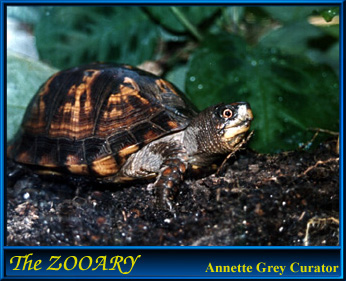
Eastern Box Turtle
"Kryss"
Eastern Box Turtle
Turtles are ancient life forms. The earliest fossils recognized as turtles date from the Triassic period, about 200 million years ago. Thus, turtles were in existence prior to the emergence of the great dinosaur groups of reptiles. Box turtles are small, generally less than 18 cm (7 in); all are terrestrial except for the Coahuilan box turtle, T. coahuila, which lives along water courses and is semi-aquatic. They are recognized by the enclosure of the internal body organs in a hard shell, with only the head, neck, limbs, and tail protruding. Box turtles are further protected by a hinged lower shield that affords complete closure of the shell hence the name "box turtle".
The order is divided into two suborders: the Cryptodira, comprising species that retract their heads by a telescoping movement of the neck; and the Pleurodira, comprising freshwater species that hide their heads by bending the neck sideways. A total of about 335 species are grouped into 9 families.
Box turtles are found in the eastern and central United States, northern Mexico, the Yucatan, and the central United States from South Dakota to south Texas.
Box turtles live mostly on dry land and prefer moist, open woods and swamps, but in hot weather they often enter streams. In winter they hibernate in soft soil. Both lobes of the box turtle's plastron (lower shell) have a common hinge that enables the turtles to close their shells tightly. The plastron, or lower shell, of the box turtle is divided transversely by a cartilaginous hinge, so that both the front and rear portions can be brought up against the carapace (upper shell). The carapace is approximately 4-5 inches long and highly arched. When frightened, the turtle draws its head and limbs into the shell and assumes a boxlike defensive position, which it then closes tightly.
The two-part shell is fused with the vertebrae and ribs. The variations in the structure and size of the carapace and plastron among chelonians are accompanied by adaptive changes in disposition and mode of life. The bones of the turtle skull are immovably united together. The turtle also lacks a breastbone and teeth. The heart, as in other reptiles except crocodilians, has three chambers, but it operates almost as if it had four because of the presence of an incomplete partition in the ventricle.
Box turtles are omnivores, therby eating a variety of foods, including mushrooms, insects, earthworms, slugs, snails, blackberries, and leaves; aquatic species are largely carnivorous.
Box turtles exhibit slight sexual dimorphism. The plastron of the female is usually flat; that of the male curved inward. Males have longer tails, and the eye of the male is usually bright red. The female has dark reddish or brown eyes.
Turtles, like all reptiles, are adapted to reproducing on land. Eggs develop in the paired ovaries; sperm are produced in the testes. Fertilization occurs in the oviducts, which are coiled tubes leading from the ovaries. The lower end of the oviduct contains shell glands, which deposit the materials for the shell of the egg. The round shell-encased eggs enter the cloaca and leave the female's body. In early summer the female buries four or five round eggs in a sunny spot where she digs a hole in loose soil, and then covers the hole with the sand. These hatch in about three months. The young may hibernate soon after, without feeding. The amniote egg has a shell and four membranes that develop from the embryo- the yolk sac, the amnion, the chorion, and the allantois. the egg is an adaptation because the shell keeps the embryos from drying out, allows air to pass threw, and provides a fluid environment for the embryo. Young box turtles grow 1/2 to 3/4 inches yearly for five or six years, then they grow slower--about 1/4 an inch a year. At 5 years they mate and lay eggs.
The life expectancy for the turtle is between 20 and 40 years in their natural environment. As a rule they are long-lived; members of some species live for more than 100 years.
As human habitation spreads, turtle populations quickly become depleted, not only because the slow-moving reptiles are easily captured for food but because the turtle habitats are changed radically. Many thousands of the giant tortoises on the Galapagos Islands were slaughtered by whalers and pirates in order to supply their ships with fresh meat, and the few remaining specimens are now seriously endangered because goats, introduced for food, stripped their habitats of vegetation. In North America, river channeling, swamp draining, and highway construction in recent years have diminished turtle habitats and inhibited movement, especially during nesting.