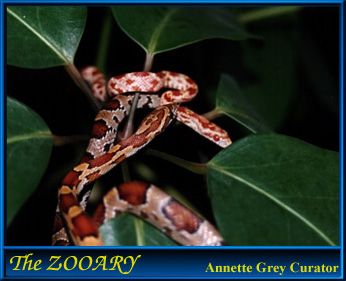
The name corn snake originated from the similarity of the belly markings to the checkered pattern of kernels on Indian corn. Corns snakes are also known as "red rat snakes" and are in the same genus as black, grey and yellow ratsnakes. They are usually orange, yellow and black with large red splotches on the back with a white and black checkered belly. Corn snakes ccan come in a variety of phases. In nature, anethyristic corn snakes can be found that are lackinf one of the corn snake colors. Black anethyristic corns are missing the reds and oranges, and red anethyristic corns are missing the black markings (as shown in the above picture). Through selective breeding, herpetologists have breed an amelanistic corn snake, totally devoid of color known as "snow corns" which are almost pure white. However, this variation has not been found in the wild.
Cornsnakes are found throughout Florida and southeastern United States, in wooded groves, rocky hills, meadows, barns, and abandoned houses.
Cornsnakes are very secretive snakes and spend much of their time under cover prowling through rodent burrows.
Hatchlings tend to accept small lizards and graduate onto mice and other rodents. Adults corn snakes primarily eat rodents and have been known to climb trees in search of baby birds. Corn snakes are constrictors and will use their coils to suffocate food before eating. However, they have been observed to swallow small prey item alive.
Sexual maturity in cornsnakes is determined by size rather than by age. Most species begin to reproduce when they reach approximately half their eventual size two to four feet. Females lay a clutch of about thirty eggs with a gestation of 60-65 days at approximately 82oF. The longest recorded length of a corn snake is six feet.
Up to 23 years.
Corn snakes are listed by the State of Florida as Species of Special Concern due to habitat destruction in the lower Florida Keys. All snakes help to control rodent populations which might otherwise spread disease. They are also a food source for many animals, especially raptors.
Conant, Roger, and Joseph T. Collins. A Field Guide to Reptiles and
Amphibians of Eastern and Central North America. Boston: Houghton Mifflin
Co., 1991.
Halliday, Tim R., and Kraig Adler. The Encyclopedia of Reptiles and
Amphibian. New York: Facts on File, 1987.
Mattison, Chris. A-Z of Snake Keeping. Sterling Publishing Co., Inc. 1991
Mattison, Chris. Snakes of the World. New York: Facts on File, Inc.,1986.
Mattison, Chris. The Care of Reptiles and Amphibians in Captivity.
Bradford, 1992