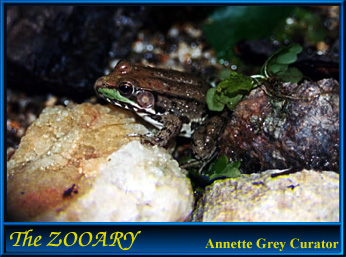
"Frog"
Bronze Frog
"Frog"
Bronze Frog
Frogs, like other amphibians, are poikilothermic or ectothermic. Scientists formerly believed that these animals had to avoid excessive heat or cold to survive. Recent studies, however, have found that some frogs, like the wood frog (Rana sylvatica) and the spring peeper (Hyla crucifer) have a natural ability to survive cold temperatures for weeks with as much as 65 percent of their total body water as ice. When ice forms on the frog's skin, it triggers enzymes to convert glycogen to glucose in the liver. The glucose acts as an antifreeze, and travels in the blood to the major organs where it protects them from freezing while ice fills up the frog's body cavities.
The Bullfrog is a species native to the eastern part of North America from Canada to Mexico. It is an aquatic amphibian that formerly was found in North America only east of the Rocky Mountains. It has now been introduced to other localities as a potential source of food; most frog legs sold commercially in the United States are from this species.
Frogs live in diverse habitats. Pipid frogs and many other types spend their entire lives in ponds and streams in the tropics. Other species require only the moisture found on leaves or under rocks or logs to survive. Bullfrogs live in or near quiet lakes and ponds.
There are two types of feeding: tongueless and tongued. Tongueless aquatic species feed by gulping prey into their mouths; tongued forms, usually terrestrial or arboreal species, extend the tongues to capture prey. The end of the tongue has glands that secrete a viscous material that holds the prey on contact. The tongue and prey are then withdrawn into the mouth. True frogs are all voracious carnivores and will eat fish, crustaceans, mice, snakes, small frogs, small birds and anything that can fit in their cavernous mouth.
They are very aggressive in defending their calling territories and attack intruders violently. Vocalization in frogs occurs as inspired air is directed into the vocal sacs (pockets in the floor of the mouth) and forced through the larynx at various rates and frequencies. The inner ear of a frog that vocalizes has sensory cells that are specialized to perceive sound at specific frequencies. Females, distinguishing the call of their species, are attracted to a calling for of their species. Often another male near the territory does not call but tries to intercept females as they approach the caller.
The frog's life cycle is complex. Courtship in many species is highly stylized, involving specific calls or prescribed turns and positions before mating occurs. At one point in the ritual, the male clasps the female, and she extrudes her eggs; given this stimulus, he releases his sperm, shedding them over the eggs. In frogs both fertilization and development is external.
Other frog species lay fewer eggs and protect the developing young in a variety of ways. In the case of the marsupial frog, Gastrotheca, the young develop in a pouch in the skin of the back. Males of the species Rhinoderma darwini brood the young in their vocal sacs. Other means of reducing the number of young include direct development--laying eggs on land, which then develop through metamorphosis without the larval stage--and maternal retention of developing young. Frequently, only one parent protects the clutch while it develops. A few species retain developing young in their oviducts and give birth to metamorphosed froglets. The Australian Rheobatrachus silus broods its eggs in its stomach and coughs up metamorphosed froglets at birth.
In aquatic development, the tadpole's mouthparts develop at hatching, gills are covered by the operculum, and the tail structure is finned. Tadpoles are of different body shapes, depending on their habitat, and their mouthparts also vary. At metamorphosis, limbs develop, hindlegs first, the tail begins to reabsorb, the shape of the head changes, jaws modify, the intestine shortens, and a host of biochemical changes takes place. During metamorphosis the tadpole is vulnerable to predators, and it cannot feed while its body is reorganizing. The adaptation of long hind limbs has resulted in various locomotor patterns. Temperature, body weight, body proportions, and resistance of the medium all affect the method and rate of locomotion.
Frogs are significant predators in their ecosystems. Human actions have caused a reduction of numbers of some frogs, and this has had a detrimental effect in many areas of North America and Europe. Nevertheless, frogs have continued to be in great demand as test animals for studies in biology. As certain frog populations of the United States have been depleted, African clawed frog have been imported in increasing numbers. This has led to a further problem: when released in nature for breeding purposes, the African clawed frog competes with, and eclipses the native fauna. This situation is currently under control, but the problem of supply of biological experimental material is not yet solved.
Frogs and other amphibians are sometimes called the canaries of our freshwater. Coal-miners used to bring canaries with them into their tunnels to indicate in the air was fit enough to breath. If the air was contaminated, the canaries would die and indicate the air pollution to the miners. Because of the permeability of their skin, amphibians are often first to feel the effects of pollution in their environments, as a result we have lost several species of amphibians due to pollution.
The solitary male Bullfrog is characterized by a deep resonant croak, commonly heard at night during the spring. A mature frog is dull green, with a yellowish or white belly, and dark, barred legs. Its body is up to 20 cm (8 in) long with 25-cm (10-in) hindlegs. The large ears, or tympani, behind the eyes are specifically receptive to the mating calls of its species. In bullfrog species, after breeding, the female lays as many as 10,000 eggs in quiet water. The eggs hatch into dark spotted tadpoles that mature into adult frogs in one year in a warm climate and in two or three years if the climate is cool.
These are medium sized frogs divided into six separate species. The Las Vegas Leopard Frog Rana fisheri is thought to have become extinct in 1942 when it's habitat was destroyed. Leopard frogs are one of the most widely distributed amphibians in N. America ranging form Canada to Costa Rica. They are usually the frogs that are dissected in elementary biology courses. They were formerly used in pregnancy tests; the injection of urine from a pregnant woman into the male frog causes the frog to extrude spermatozoa in about two hours. Cascades frog The cascades frog is a diurnal species found in mountain meadows, streams, lakes and ponds above 3000'. in the Northeast U.S.
Behler, John and F. Wayne King. National Audubon Society: Filed Guide to
North American Reptiles and Amphibians (1994)
Dickerson, Mary, The Frog Book (1969).
Grolier Electronic Publishing
Mattison, Chris, Frogs and Toads of the World (1987).
Pyron, Jay, Complete Introduction to Frogs and Toads (1987).
Storey, Kenneth B. and Janet M., "Frozen and Alive," Scientific American,
December 1990.
Underhill, Raymond A., Laboratory Anatomy of the Frog, 5th ed. (1988).