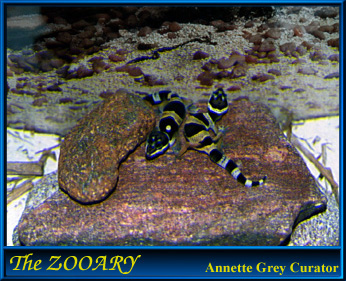
"Fric & Frac"
Leopard Geckos
"Fric & Frac"
Leopard Geckos
Geckos are believed to be among the most primitive lizards alive today. Geckos are characterized by a flattened clawed foot with toe pads covered with microscopic hooks, which enable them to climb vertical surfaces. Geckos are also characterized by having a spectacle, or transparent scale that protects the eye since they do not have moveable eyelids. However, leopard geckos are exceptions to the gecko rule, and do have eyelids, hence they are placed in the subfamily Eublepharinae or "true eyelid". Leopard geckos also lack the flattened foot and toe pads possessed by their cousins, and rely on their tiny claws to aid them in climbing. Leopard geckos reach 8-10 inches in size, including the tail. The name 'gecko' was probably derived as a description of the vocalization that many geckos make.
Leopard geckos are found in deserts and arid grasslands in India and Pakistan.
Leopard geckos are primarily nocturnal animals and in the wild will take shelter under rocks or in burrows during the day. They have elliptical pupils--like a cat-to enable them to see at night.
In the wild, leopard geckos primarily eat arthropods, such as insect, scorpions, centipedes and spiders. However in captivity, they will consume anything moving and smaller than themselves. Full size geckos tend to appreciate a pinkie mouse every now and then. Unlike other desert animals, leopard geckos cannot manufacture water form the food they eat, they must drink water directly. In captivity, they prefer lapping water from a sponge, or plant to drinking from a water dish.
Female geckos lay about two eggs per clutch between February and December. She may have several clutches in a breeding season. The eggs incubate for 40-70 days, and the sex of the offspring--as in most reptiles--will be determined by the temperature at which the eggs are incubated. Female offspring will be produced by the lower temperature (80oF) and males will be produced at a higher temperature (90oF). Baby geckos do not have the spotted marking of their parents, but are born with a banded pattern. Comparisons of juvenile and adult marking can be seen in the pictures above.
Approximately 8-10 years in captivity
Leopard geckos do not seem to be too endangered in the wild, perhaps because they inhabit arid regions which have not been overtaken by man.
Hunziker, Ray. Leopard Geckos: Identification, Care & Breeding. T.F.H. Publications, Inc.