CLASSIFICATION
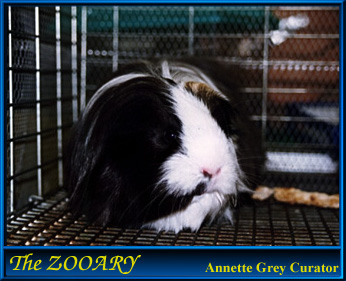
Guinea pigs are rodents of the genus Cavia, family Caviidae. The compact body may be 25 to 36 cm (10 to 14 in) long; the weight ranges from 500 to 1,500 g (1 to 3 lb). The coat is brown or gray in wild guinea pigs, but the domesticated variety may exhibit a wide range of colors. Guinea pigs are domesticated cavies, but in popular usage the term is applied to all species, domesticated or wild. Guinea pigs resemble rabbits but have short, rounded ears and no tails. The hair in some species is long and varies in texture from rough to smooth. Some guinea pigs are solidly white, black, or tawny; others are white, streaked, or blotched with darker colors.
Guinea Pigs are hystricomorph (hedge hodge like) animals which were carried to Europe as curiosities by sailors in the 16th century, where they were selectively bred. Common varieties include the English short hair, the Abyssinian with short, rough hair in whorls and rosettes, and the Peruvian long hair (rag mop).
Wild guinea pigs are native to South America. Among the most important species are C. porcellus, native to Brazil; C. boliviensis, found in the higher ranges of the Andes; and C. cutleri, a Peruvian species.
Guinea pigs main habitat are the mountains and grasslands in Brazil, Peru, Argentina, and Uruguayas they are native to South America and were domesticated for food centuries ago in Peru. In the wild, guinea pigs live in burrows and feed at night on plant material. Special adaptations include having a sebaceous gland on the rump. This gland puts out a scent that tells other animals to stay away, because this territory is already taken. When excited, Guinea Pigs are likely to run around in circles or stampede.
Wild guinea pigs live in burrows. They are herbivores so their diet consists of only vegetation. Like humans, Guinea Pigs lack the enzyme that makes vitamin-C. Because of this the diet must consist of vegetation high in vitamin-C like cabbage, kale, or oranges, or it could die. Guinea Pigs will drink 10 ml per 100 g of body weight daily. They will consume about 6 g per 100 g of body weight daily. The average weight of the male is 900 to 1200 grams, and 700 to 900 grams for the female.
The gestation period of a guinea pig is about 68 days. Wild guinea pigs breed once a year and produce litters of one or two young. They are born in an advanced state of development and are able to feed themselves by nibbling foliage the day after birth.
Domestic guinea pigs resemble wild guinea pigs in the rapidity of their early maturity. They develop so quickly during gestation that they shed their lacteal teeth in the womb and are born with their definitive teeth in place. Domesticated guinea pigs begin to breed at the age of two months. They breed five or six times a year, and the litters contain 4 to 12 animals. Newborns weigh 60-100g.
The life expectancy for the wild Guinea pig is 4 to 5 years. For the domesticated, it is around 8 years.
The origin of the term guinea pig is an unsolved etymological problem. Some authorities believe the name may come from Guineamen, who were in the slavetrade and may have been the first to bring the animals from South Americato England. Others believe guinea is a corruption of the word coney, because guinea pigs were called pig coneys in 1607.
Guinea pigs have been valuable as experimental laboratory animals, used in toxicity and genetics research and especially in bacteriology for research on the effects of pathogenic microorganisms. They have been largely replaced in the laboratory by smaller animals, such as mice, rats, and hamsters. Guinea pigs are useful in diagnostic tests for tuberculosis, however, because of their low resistance to the tubercle bacillus, which kills them in four to eight weeks.