Five Lined Skink
FIVE LINED SKINK
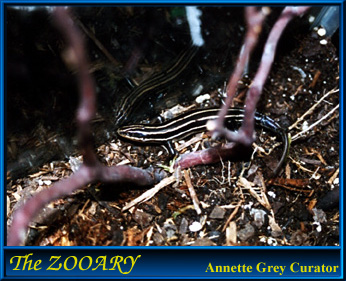
"Kalpernia"
Five Lined Skink
CLASSIFICATION
- KINGDOM:Animalia
- PHYLUM:Chordata
- SUBPHYLUM:Vertebrata
- CLASS:Reptilia
- ORDER:Squamata
- SUBORDER:Sauria
- FAMILY:Scincidae
- GENUS:Eumeces
- SPECIES:fasciatus
Typically, skinks have smooth, shiny, overlapping scales and elongate,
cylindrical bodies. Their heads are cone shaped. Femoral pores are absent.
The pupil is round, and many species have a large, transparent scale on the
lower eyelid that enables them to see even when the lid is closed. In most
species the tapering tail is easily broken but can be regenerated. Skinks
are generally alert and active diurnal lizards but tend to be secretive,
spending much time foraging under leaf litter.
Most skinks are small, usually not exceeding 200 mm (8 in) in total length,
but a few species are larger, and the Solomon Islands giant skink, Corucia
zebrata, may exceed 600 mm (24 in). This species is unusual in that it is
arboreal and has a prehensile tail. Skinks are most frequently striped but
may be banded, spotted, or uniformly colored. Males of many species develop
broad heads, presumably used in fighting during the breeding season.
RANGE
The skinks, with about 75 genera and 600 species, are one of the two
largest lizard families. They are widespread and are particularly abundant
in the great forests of Africa and Indoaustralia. The five-lined skink is a
small striped lizard found in the wooded areas of the southeastern United
States.
HABITAT
Lizards break their tails (autotomy) when they are confronted by an enemy
or roughly handled. This break does not occur between the vertebrae (tail
bones) but rather in a zone of weakness in a vertebra itself. These
specialized vertebrae can be voluntarily split by muscular contraction;
sphincter muscles in the tail stump close off the caudal artery to prevent
excessive bleeding. Five-lined skinks have a bright blue tail, at least as
juveniles, which serves to draw attention away from more vulnerable parts
of the body. If attacked, the bright blue tail wriggles when broken off,
catching an enemy's eye as the skink escapes. Although tail autotomy may
seem like a drastic measure, in actuality it does the lizard little harm,
for a new tail is soon regenerated. The new tail, however, is not
identical to the original. Its skeletal support consists of a
fibrocartilaginous rod instead of vertebrae; its musculature is
nonsegmental; its scales are different in size and form; and its color is
usually subdued or otherwise altered.
Five lined skinks prefer sheltered areas near woods. They are very
secretive and are usually found beneath rocks or logs and underneath tree
bark. They rarely bask and burrow readily and rapidly.
DIET
Most skinks feed primarily on insects and other arthropods, but some of the
larger forms are partially or completely herbivorous (genus Corucia; the
Cape Verde skink, Macroscincus cocteay; and the Australian genera Egernia
and Tiliqua). Herbivorous skinks have blunter teeth than insectivorous
ones, and some species have broad-crowned grinding teeth.
GESTATION
Skinks may be either oviparous or viviparous. Some skinks are notable
because the female remains with her eggs for up to 6 weeks, until they
hatch.Babies are black with yellow stripes and a bright blue tail. The
stripes and tail color fade with age, with adults becoming a dark brown and
males having a bright red head resemblign the broad-headed skink.
BIBLIOGRAPHY
Conant, Roger. Reptiles and Amphibians: Eastern/Central North America.
Houghton Mifflin Company. 1975
Walls, Jerry G. Skinks: Identification, Care and Breeding. T.F.H.
Publications Inc. 199
Whynne, Richard. Lizards in Captivity. T.F.H. P{ublications. 1981