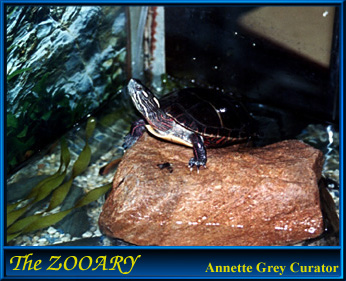
Species: picta
These are brightly marked North American turtles found from Canada to
Northern Mexico and are the most conspicuous of our basking turtles.
Painted turtles are smooth-shelled reptiles with a shell typically 4 to 7
inches long, or up to 15 inches in other types of sliders. They have red,
brown, green or yellow markings on their flat, black or greenish-brown
carapace. There are many species and subspecies within the genus
Chrysemys, but due to hybridization, it is often hard to identify
individuals.
Range
They are found in North America ranging from Southern Canada to Georgia.
They are possibly the most common and certainly the most widely distributed
turtle in North America.
Habitat
Painted turtles usually perfer shallow quiet water, such as ponds and
ditches, but they are also found in stream and lakes. They like to bask in
the sun maybe on a fallen tree or partially submerged logs. Although they
are easily observed wih binoculars, trying to observe them closer is very
hard, as they will immediately slide into the water as you approach.
Diet
They are omnivores, eating insects, aquatic plants, tadpoles, fish,
crustaceans, and are even sometimes cannibalistic eating very small
turtles.
Gestation
The breeding season is from late spring to early summer. The females lay 5
to 20 bluntly oval white eggs in spongy soil. The eggs have a soft shell
and the mother lay them in a flask shaped hole. In Northern states,
p[anted turtles lay 1 to 2 clutches of eggs, but can lay up to four in the
warmer Southern states. Hatchlings are brightly colored and from 7/8 to 1
1/4 inches in diameter.
Males reach sexual maturity at 2-5 years, while females reach maturity in
4-8 and usually become larger with more domed carapaces than males. Young
can usually be identified by the markings on their plastron (ventral
surface).
Longevity
Turtles can live for a very long time. Members of some species live more
than 100 years, but painted turtles have a life expectancy around 25
years.
Bibliography
Collier's Encyclopedia. New York, 1991.
Conant, Roger. Reptiles and Amphibians: Eastern/Central North America.
Houghton Mifflin Company. 1975
Walls, Jerry G. Skinks: Identification, Care and Breeding. T.F.H.
Publications Inc. 1994