Plated Lizard
PLATED LIZARD
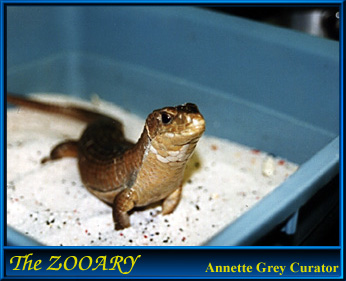
"Keanu"
Plated Lizard
CLASSIFICATION
- Kingdom: Animal
- Phylum: Chordate
- Class: Reptile
- Order: Squamta
- Family: Cordyldiae
- Genus: Gerrhosaurus
- Species:
The species range in size from 40-70 cm (16-28"). Their powerfully-built
bodies are only slightly flattened and are supported on relatively
delicate-looking legs, much like our own Alligator lizards (Gerrhonotus).
The neck is not well differentiated from the head. The tail is typically
twice the length of the body.
Scales are evenly arrayed in lines down and around the body. Dorsal scales
are keeled while the ventral scales are smooth; little overlapping. Colors
are various shades of brown with some lighter longitudinal stripes. A fold
of skin is generally noted running laterally along the length of the body -
this allows for expansion.
RANGE
Native to southern and eastern Africa. There are six species found in dry,
rocky semi-open habitats. Frequently found in termite mounds.
HABITAT
These lizards like to dig and are good swimmers and divers. They are very
secretive and in captivity it is necessary to provide caves or slabs of
bark for hiding and basking.
DIET
These omnivores eat a variety of small vertebrates and invertebrates as
well as greens and small amounts of fruits such as worms, crickets, mouse
pinkies, cantalouope, oranges and kale.
The plateds become rather tame fairly quickly. While they appear cumbersome
and slow, they are capable of very fast movement and, when acclimated, feed
well and have been observed to steal food from larger lizards.
GESTATION
To breed, a winter dormancy period of 4-6 weeks is required. Plated
lizards lay 2-6 eggs per clutch.
BIBLIOGRAPHY
Obst, et al. Completely Illustrated Atlas of Reptiles and Amphibians
for the Terrarium. 1988. TFH Publishing, Neptune City, NJ.
Wynne, Richard. Lizards in Captivity. T.F.H Publications Inc, 1981.